
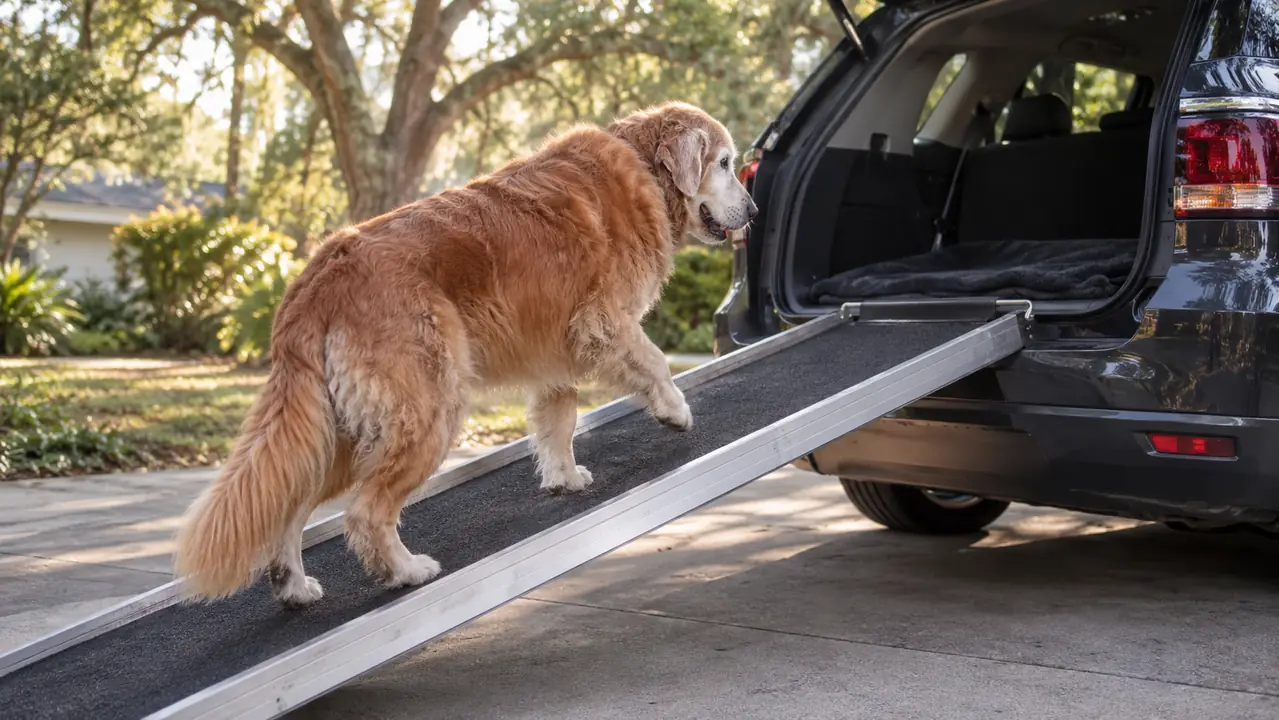
The first time I leaned the PetSafe Happy Ride Telescoping Ramp against the back of my SUV, Tucker walked around it. Not over it. Around it, through the grass, and then he stood at the tailgate looking up at me like I had lost my mind. I had spent the better part of a week deciding to buy the thing. He spent four seconds rejecting it. That gap between what a ramp is supposed to do and what an old dog will actually agree to do is the entire story of owning one, and it is the part the listing photos never show you.
I am 66 and I spent 29 years shooting for a regional daily here in Sarasota, which means most of my working life was spent watching bodies move and figuring out where the weight was going. That is not veterinary training and I am not going to pretend otherwise. It is a habit of looking. When Tucker turned 11 and started hesitating at the two back porch steps, I started watching him the way I used to watch a runner come into frame: where is the load, where is the compensation, where does the motion break down. What I saw was a 68 pound yellow Lab mix who no longer trusted his back end on a downslope. So I bought the PetSafe ramp after a good deal of reading and one honest conversation with my vet. Here is what I would tell a friend about it, including the parts that annoyed me.
The Quick Verdict
A solidly built piece of equipment that solves the tailgate problem for a stiff senior dog, sold with no real guidance on the one variable that decides whether your dog will use it: the angle you set it at.
Amazon Check Today's Price →The ramp that got Tucker into the truck without me lifting him
Aluminum frame, extends from 39 to 72 inches, rated to 400 pounds. Three weeks in, this is the one piece of gear I would buy again without hesitating.
Amazon Check Today's Price on Amazon →What Nobody Tells You Before the Box Arrives
The listing says this ramp extends from 39 to 72 inches, and that is accurate. What it does not explain is that those two numbers are two completely different jobs, and picking the wrong one for your vehicle is how a perfectly good ramp ends up folded in the corner of a garage for two years. Short means steep. Long means gentle. There is no version of this where you get both, and the decision is made by the height of your tailgate, not by anything on the product page.
Do the arithmetic before you order, because nobody at the listing will do it for you. My SUV tailgate sits about 30 inches off the ground. Set the ramp at 39 inches and you have built a staircase for a mountain goat. Set it at the full 72 inches and the rise is spread out enough that an old dog can commit his weight forward instead of scrambling. The difference between those two setups is the difference between a dog who hesitates and a dog who walks. I measured mine on a Tuesday morning with a tape measure, running the tape from the driveway up to the lip of the open tailgate. Thirty inches. Thirty inches of rise over 72 inches of run is about 23 degrees of slope. The same rise over 39 inches is closer to 37. I did not need a protractor to know which one a stiff dog would prefer. I also measured my neighbor's truck bed while I had the tape out, mostly out of nosiness, and at 34 inches that is a vehicle where the full extension stops being generous and starts being necessary. Whatever your number turns out to be, write it down, because it tells you whether this ramp is even the right shape of tool for your car.
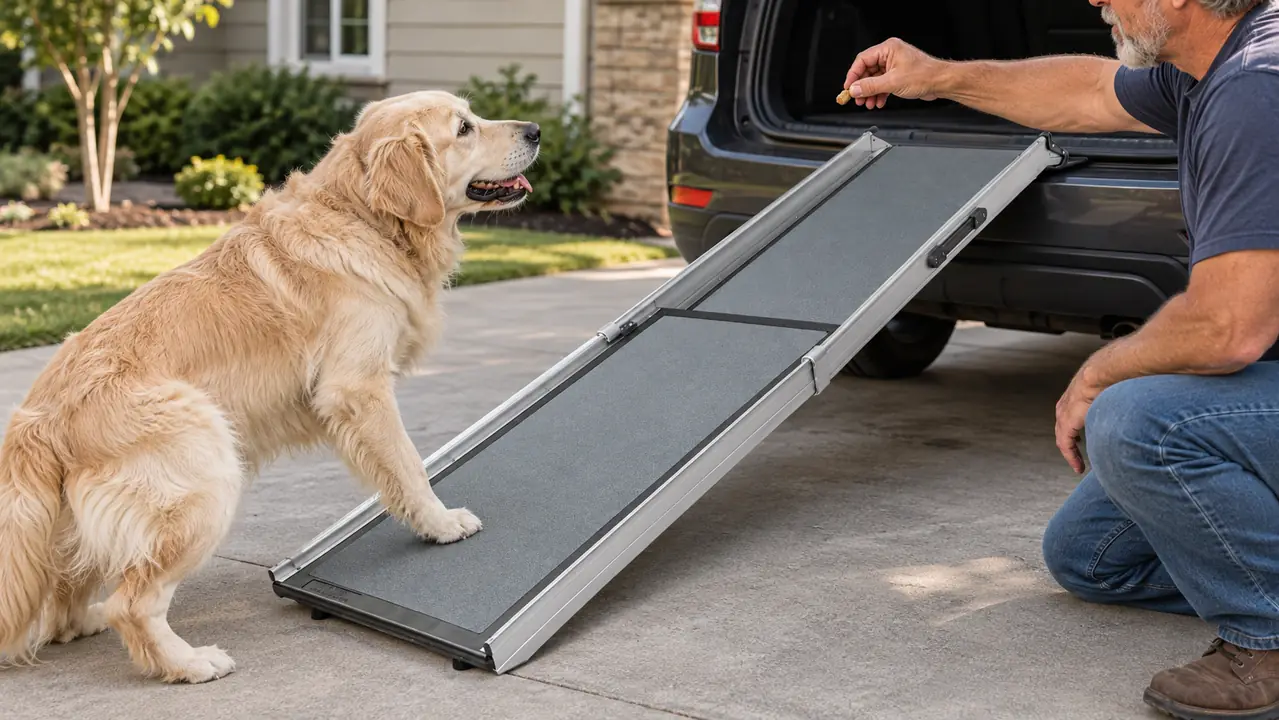
The other thing nobody mentions is that a dog has to be taught that a ramp is a floor. Tucker spent 11 years learning that the world has two surfaces, ground and vehicle, and that the space in between is a thing humans solve. A ramp introduces a third surface that gives slightly and sounds hollow under a paw. It took four days of me setting it up in the driveway attached to nothing, no car, no destination, just the ramp on flat concrete with a treat at the top. Day one he put one paw on it and backed off. Day four he walked up on his own and stood there waiting for me. If you are not willing to spend that time, the ramp will not work, and it will not be the ramp's fault.
How I've Actually Used It
For the SUV, I run it near full extension, which puts the deck at a slope Tucker can manage without that little hitch in his stride. I back the truck up to the flattest part of the drive, set the top edge on the bumper, and check that the rubber feet are resting on concrete and not on grass. That last part matters more than it sounds. The feet are what keep the base from walking out from under him, and on soft Florida ground after a rain they will sink and shift. I learned that the hard way on a Saturday. We had heavy rain the night before, the kind that leaves the drive slick and the yard soft, and I set the feet down on the grass edge because it was closer to where I had parked. Tucker got halfway up before the base started creeping and I heard the aluminum shift against the concrete. Nobody fell. I caught the base with my foot and he backed down on his own. Now I back onto the concrete pad even if it means a three point turn, and I press down on the base with my hand before I let him anywhere near it.
For the two steps down to the lanai, I tried it and then stopped trying it. Two steps is a short drop, and a ramp that short is steep, and Tucker was working harder on it than he was on the steps themselves. That is not really a knock on the ramp so much as an honest note about where it earns its keep. This PetSafe model is built for tailgates and truck beds and the height of a vehicle floor. If your dog's only struggle is two or three porch steps, this is more machine than the job requires, and I will get to what I think you should look at instead.
The walking surface is 17 inches wide and that has turned out to be the right number for a 68 pound dog. He is not walking a balance beam and he is not wandering off the side. The side rails do real work here, not decorative work. In the second week he drifted left on the way up, felt the rail against his shoulder, and corrected himself without me saying a word. A dog who has lost some awareness of where his back end is needs that kind of feedback, and he was getting it from the rails rather than from me.
Set at 39 inches it is a staircase. Set near 72 inches it is a walk. Same ramp, same dog, entirely different outcome.
Traction, Sand, and the Florida Afternoon Storm
The deck has a high traction texture to it and it works well enough when it is dry. What I have found is that it collects sand. Between the beach access road and my own driveway, there is grit in this thing constantly, and grit on a textured surface is not the same thing as grip. Once a week I hose it down and let it dry in the sun before it goes back in the truck. It is a two minute chore and I would not skip it if your dog is at all unsteady, because a slick patch under a back paw on a slope is exactly the scenario you bought the ramp to prevent. The rinse is not optional in this house. There is a stretch of shell grit on the access road behind the park where we walk in the evenings, and it works into the texture like sand into a sponge. Hose, stiff brush, ten minutes in the sun, and it is back to grip. Sunday mornings now, along with the rest of the chores.
The aluminum frame means it does not rust, which in Sarasota is not a small thing. Everything metal in my yard eventually gives up. This ramp has been through a wet summer and shows no corrosion at the joints. The rubber feet are the part I expect to wear first, and they are the part I check every few months before I trust the base on a hard surface. If a foot ever goes missing, I would stop using the ramp that day rather than improvise.
What It Weighs, and Where It Lives
The ramp weighs 6.69 kg according to the listing, which is just under 15 pounds. That sounds light. It does not feel light when you are holding it out at arm's length behind an SUV with a dog leaning against your hip, and it does not feel light at 6:30 in the morning before your coffee. I can manage it. My neighbor, who is 71 and had a shoulder replaced two winters ago, tried it once and handed it straight back to me. That is worth knowing about yourself before you order. There is a rhythm to it that I did not expect. Open the hatch, pull the ramp out by the top edge with both hands, walk it back until the feet touch, set it down. What it does not take is one hand. I tried that in the first week, holding the folded ramp with my left while I fumbled for the hatch release with my right, and I nearly dropped the thing on my foot.
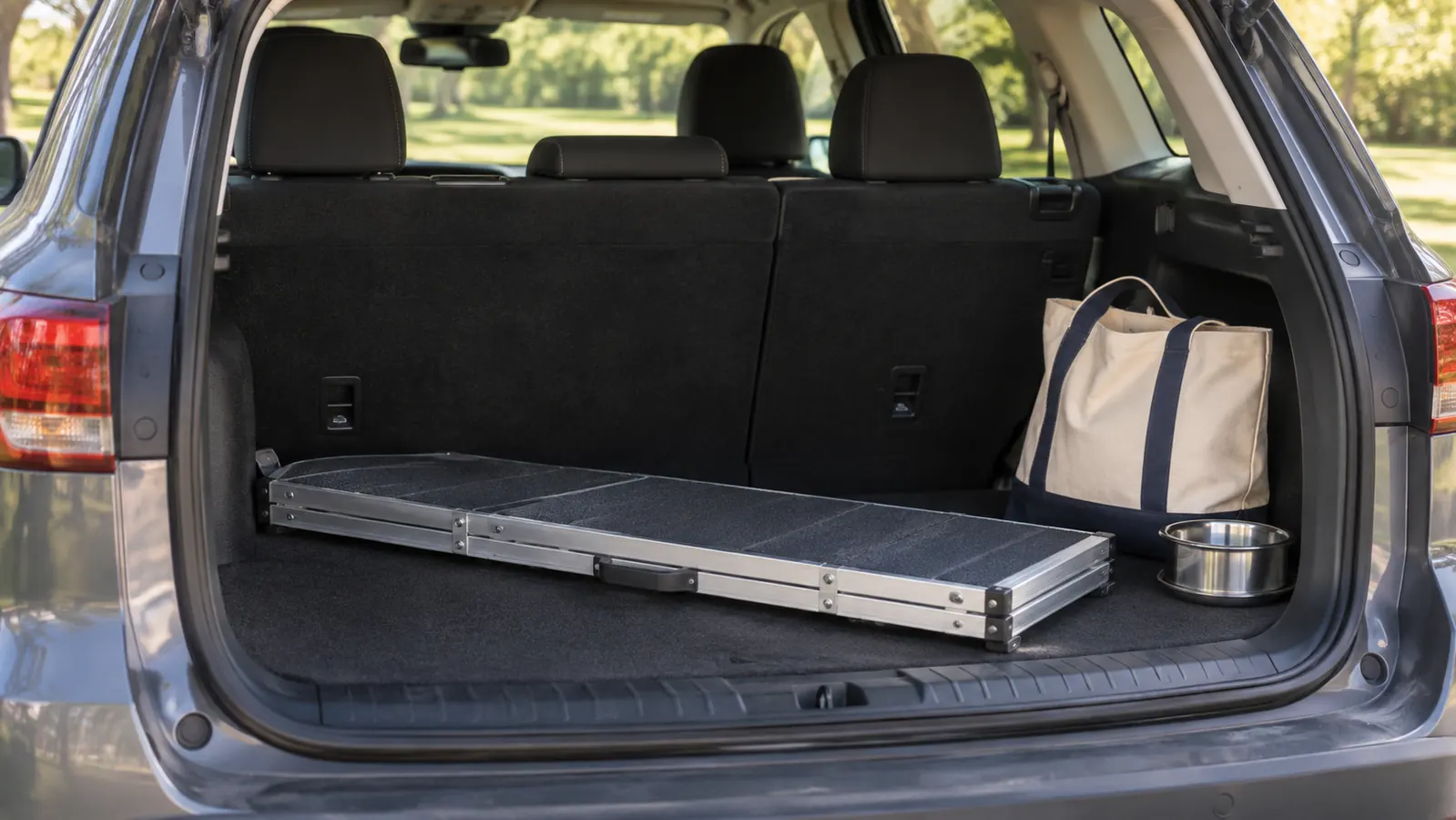
When it collapses, it is about 4 inches tall, and it rides in the back of my small SUV without eating the whole cargo area. That is the reason I chose a telescoping ramp over a fixed one. It lives in the truck. If I had to walk back into the house to fetch it every single time, I know myself well enough to know I would stop bothering, and then Tucker would be back to being lifted, and lifting a 68 pound dog at my age is how I end up with a torn something and a dog who gets walked less.
The Thing I Got Wrong
I bought this four months later than I should have. What finally pushed me was a morning when Tucker stood at the open tailgate for a full ten seconds, front paws up, back paws down, and then turned away and lay down in the driveway. That was the day the hesitation stopped being a small thing. If your dog is already pausing at the truck, the ramp is not a luxury purchase you get around to eventually. The window where a dog will learn a new surface closes slowly and then all at once.
The other mistake was mine and it was about approach. I set the ramp up for the first time in the exact spot where the truck always parks, with the truck right there, and I expected him to just understand. What worked instead was moving it away from the vehicle entirely, onto flat ground, and treating it like a piece of agility equipment. No destination, no pressure, no audience. Once the ramp was a thing he could walk on rather than a thing between him and the truck, everything else fell into place in about an hour.
What I Liked
- Near full extension the angle is gentle enough that a stiff dog stops scrambling and starts walking
- The side rails give a corrective cue, and an unsteady dog will use them
- Aluminum frame came through a wet Florida summer with no corrosion
- Collapses to about 4 inches, so it stores in the truck and actually gets used
- Rated to 400 pounds, which is far more than a large dog will ever need
- 17 inch width is comfortable for a 68 pound dog without being a balance beam
Where It Falls Short
- Close to 15 pounds, and it feels heavier than that at an awkward angle
- Short settings are steep, so it is a poor fit for two or three porch steps
- The textured deck collects sand and needs a regular rinse
- Very little guidance on setup angle or on teaching a dog to use it, and that guidance is the whole ballgame
- Rubber feet will sink into soft ground after rain and need a hard surface under them
A Word About Your Vet
I am not a veterinarian and I am not a vet tech, and I want to be plain about that because this is a joint article as much as it is a gear article. Before I changed anything about how Tucker gets in and out of the truck, I had his back end looked at. What came back was the ordinary stiffness of an older large dog, nothing structural, and a suggestion to keep him moving and stop the jumping down. A ramp fits that advice. But if your dog has a spinal issue, a cruciate injury, or has started dragging a back paw, a ramp is not the first phone call. Your vet is. I would hate for anyone to read three thousand words about aluminum and skip that step.
Who This Is For
You are the right person for this ramp if you have a medium or large dog, call it 50 pounds and up, who has started hesitating at the tailgate but who still wants to go places. You need a vehicle floor high enough that the full 72 inch extension gives you a genuinely gentle slope, and you need the patience for a few days of driveway practice with no destination attached. You also need to be able to carry something close to 15 pounds at an awkward angle twice a day, every day, in all weather, because that is the actual job. If all of that is true, the PetSafe Happy Ride does what it claims and does it without drama.
Who Should Skip It
Skip it if your dog's only obstacle is a couple of porch steps, because the short setting is steep and you will not get the angle you need to make it worth the trouble. Skip it if you cannot comfortably handle 15 pounds out in front of you, because a tool that is a chore stops being used and then you have spent money on a folded object. Skip it if your vehicle floor is low enough that the ramp ends up nearly flat, because at that point a wide, stable set of steps does the same job with less setup. And skip it if your dog has an undiagnosed problem with the back end. Get that looked at first, then come back and measure your tailgate.
The Short Version
Three weeks in, this is a tool I use twice a day and would buy again. It has not made Tucker younger. What it has done is remove the one moment in his day where he used to stand still and think about whether he could do it. He walks up, he gets in, he lies down on the back seat. The ramp is not a treatment for anything. It is a piece of aluminum that removes a small daily failure from an old dog's life, and at this stage of things, that is not a small thing at all.
If the angle works for your vehicle, this is the one to get
Measure your tailgate height first. If you have the room for a long, gentle slope, the PetSafe Happy Ride is the ramp I would hand to a friend.
Amazon Check Today's Price on Amazon →