
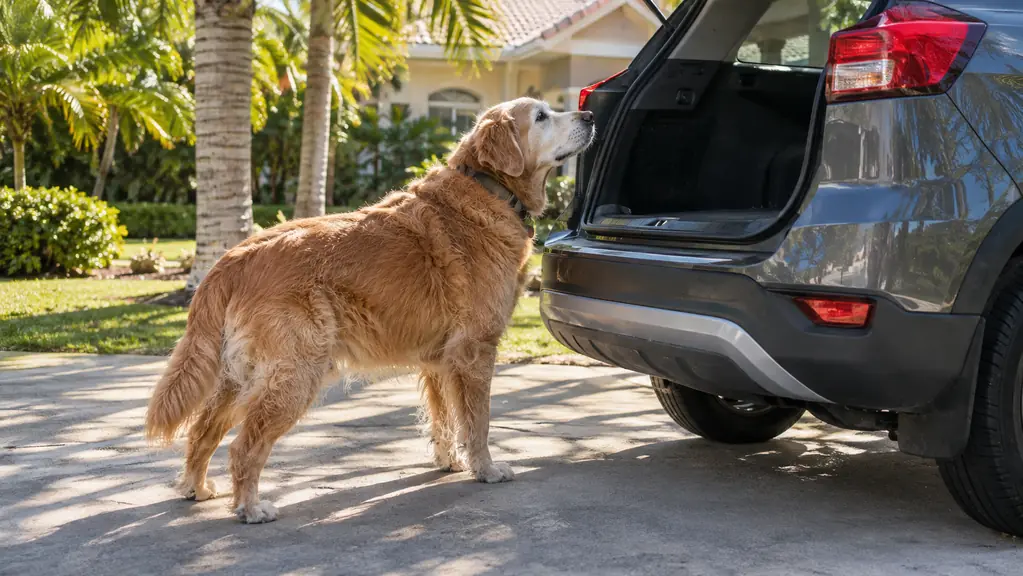
Tucker is eleven years old, sixty-eight pounds, and he used to launch himself into the back of my small SUV without breaking stride. These days he stands at the open tailgate and does arithmetic. I spent five weeks last spring running a PetSafe Happy Ride telescoping ramp against a set of folding pet stairs on the same dog, in the same driveway, on the same mornings before the Florida heat came up. The short answer: for a dog this size with stiff back legs, the ramp wins, and it is not close. The stairs are not junk, though. There is one spot in my house where they beat the ramp outright, and I will get to it.
Here is why the ramp wins, in plain terms. A ramp is a slope. A slope lets an old dog keep all four feet moving in a line, which is the one thing a stiff body still does well. Stairs ask him to lift a back foot, clear a riser, and set it down on a tread narrower than his own stance. Tucker spent a year cheating our two porch steps by swinging his hips out sideways so he would not have to lift. He cannot cheat a narrow stair tread. On the ramp he simply walks up. The walking is the whole point.
How I Compared Them
I am not a veterinarian and I am not a lab with a clipboard. I am a retired newspaper photographer. Twenty-nine years of shooting for one regional daily taught me to watch how a body moves through a frame, and to notice the frame where something goes wrong. So that is how I tested: same dog, same concrete driveway, same small SUV, five weeks, alternating days. The PetSafe ramp went out on Monday and the folding stairs went out on Tuesday, and I wrote down what happened.
What I watched for was not clever. Did he hesitate at the bottom. Did a foot slip. Did he come down faster or slower than he went up. How long did the setup take with a leash looped over one wrist and a treat in the other hand. Where does the thing live when it is not in use, because a mobility aid you dread dragging out is a mobility aid that stays in the garage. And how does it hold up sitting in a Florida driveway in June, which is its own kind of test.
What I could not test is the thing you probably want to know, which is how either one holds up over years. Five weeks tells you about hesitation and slipping and setup. It does not tell you about a hinge that loosens in year three. What I can tell you is that the ramp frame is aluminum and the stairs I tried are plastic, and in a climate that bakes plastic on a lanai, I know which one I would bet on for the long haul.
| PetSafe Happy Ride Ramp | Folding Pet Stairs | |
|---|---|---|
| Fits different heights | Extends from 39 to 72 inches, so it reaches a sedan trunk, an SUV tailgate or a truck bed | Fixed height, sized for one vehicle or one piece of furniture |
| Getting a stiff dog up | A continuous slope with no riser to lift a back leg over | Four or five risers, each one a small step up and over |
| Grip and side support | High-traction walking surface, side rails, rubber feet at the base | Textured treads on each step, usually nothing to hold onto |
| Load rating | Rated to 400 pounds | Ratings vary widely by set, and many are built for small and medium dogs |
| Coming back down | Walks down the same slope he walked up | Drops weight from tread to tread, and a skip at the bottom is common |
| Storage between uses | Collapses to a 72 inch bundle that leans against a garage wall or rides in the SUV | Folds into a compact block that fits on a closet shelf |
| Indoor spots like couch and bed | Wants a clear runway of floor it rarely gets in a bedroom | Short footprint, made to sit flush against a sofa or bed |
| Setup in a hurry | Extend, seat both feet, check the top lip, then load the dog | Unfold and drop it in place |
| Florida heat and sun | Aluminum frame does not go brittle sitting in a hot car | Plastic left on a sunny lanai ages faster |
| Best for | A big dog getting into a vehicle every day | A small dog, or a big dog that only needs the furniture |
Where the PetSafe Ramp Wins
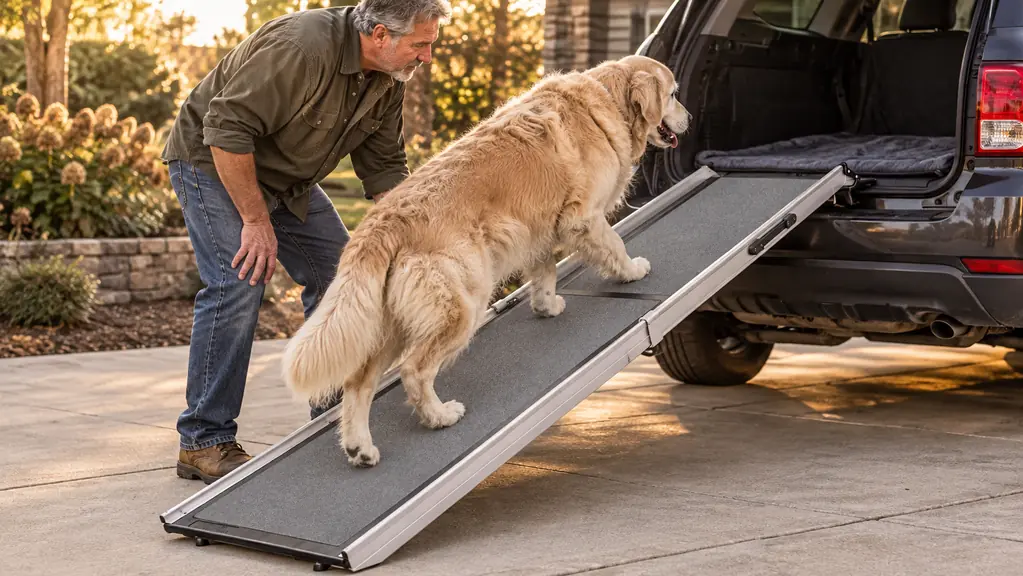
The telescoping part is the reason this one works on more than one vehicle. It extends from 39 inches to 72 inches, so on a low sedan trunk I shorten it and on the SUV tailgate I run it out long. When a neighbor's truck bed needed a dog loaded, the same ramp reached it. One tool, several heights, and the angle gets shallower the further you extend it, which is exactly what a stiff dog wants. A fixed set of stairs is built for one height and one height only.
The walking surface is a high-traction material rather than smooth metal, and the side rails matter more than I expected. Tucker leans. When his right rear leg gets tired halfway up, he drifts that direction and the rail gives him something to brush against and steady himself. Rubber feet at the base keep the bottom from skating when he pushes off. And the load rating is 400 pounds, which I care about for the day he decides to sit down halfway instead of walk.
Coming down is the half nobody talks about, and it is the half that scared me. A dog going down a slope has gravity helping and his brakes doing the work, which is why a stiff dog will often descend faster than he climbed, and why the traction surface matters more on the way down than the way up. On stairs, coming down means dropping his weight from tread to tread. Tucker did that once with a skip at the bottom that made my stomach turn. On the ramp he walks down the same way he walked up.
The frame is aluminum, so it does not go brittle sitting in a hot car or on a sunny lanai. Mine has lived folded in the back of the SUV since spring and it has not warped or gone sticky. That sounds like a small thing until you have pulled a plastic step stool out of a Florida garage in August and felt it flex under your hand. A thing that lives outdoors has to be built for outdoors.
A ramp asks the dog to walk. Stairs ask him to lift, and lifting is the thing his back legs stopped wanting to do.
Where Folding Pet Stairs Win
Storage, for one. The ramp is 72 inches long when it is closed down, 17 inches wide, and about 15 pounds. Against the garage wall that is fine. In a hall closet it is a surfboard. The folding stairs collapse into a block that sits on a shelf next to the beach towels, and because of that they are the thing I actually carry to the far side of the house.
Indoors, second, and this is a real win. A ramp needs a runway. It wants six feet of clear floor in front of whatever the dog is climbing onto, and my bedroom does not have six feet of clear floor once the bed and the dresser have their say. The stairs sit flush against the side of the bed or the couch and the dog steps up. If your senior dog has stopped getting on the furniture and you want that back, stairs are the right shape for the job and a ramp is not.
Setup speed, third. The stairs unfold and drop. That is the entire procedure. The ramp takes two hands and a check: extend it, set both rubber feet squarely, make sure the top rests flat on the tailgate lip and not on the bumper trim. Do it wrong and it rocks. I have done it wrong with a leash in my hand and had to start over. None of that is difficult, but it is a routine, and a routine is what a stiff dog's owner skips on a rainy morning.
The ramp that got my 68-pound Lab back in the SUV without the pause
It reaches from 39 to 72 inches, carries a 400 pound rating, and has rails for the days his back leg drifts. Mine lives folded behind the back seat.
Amazon Check Today's Price on Amazon →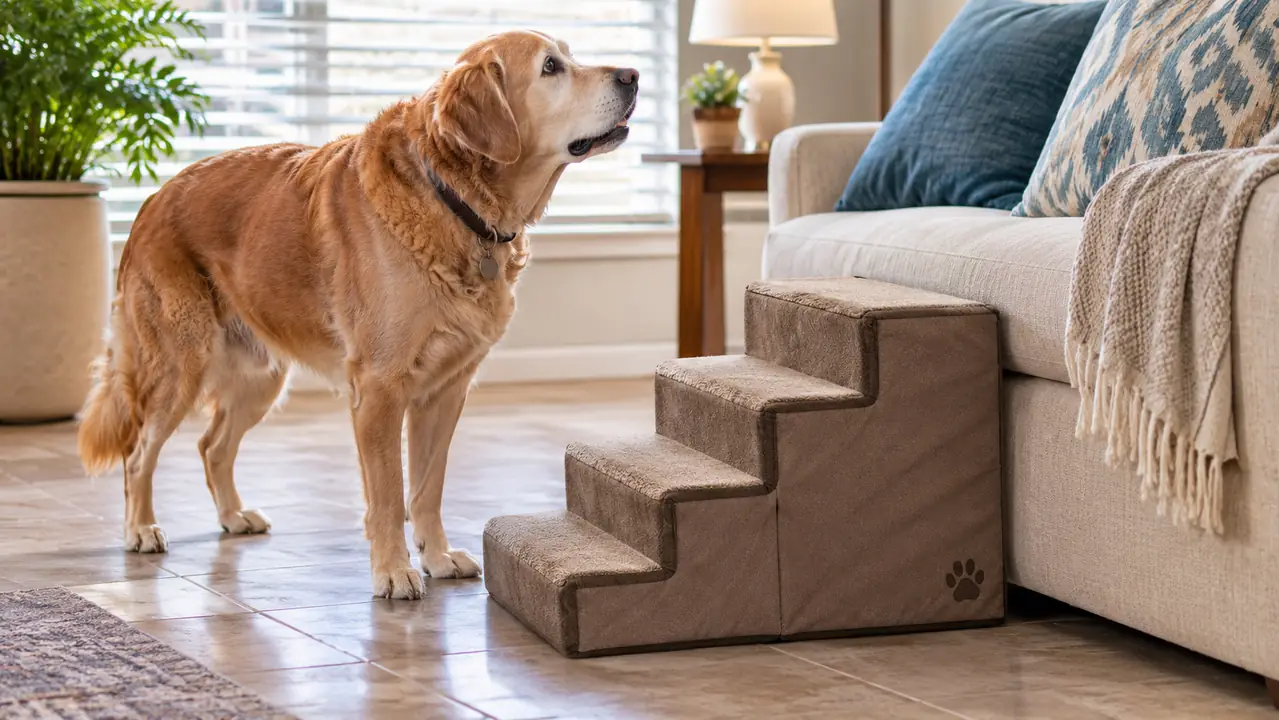
The Two Steps at the Lanai Door
You may be wondering why I did not just use the ramp on the two steps from my screened lanai down to the yard, since that is where Tucker first started hesitating. I tried. The ramp is 72 inches at full extension and the lanai is not 72 inches deep once the chair and the potting bench are in it. Shortened, the angle gets steep, and a steep ramp is worse for a stiff dog than two wide steps he can take one at a time. So the back door got a different fix: a rubber mat at the bottom, a rail along one side, and me not hurrying him.
That is worth saying plainly, because ramps get sold as an all-purpose answer and they are not. A ramp wants distance. Two porch steps with a landing between them are already a decent ramp, just made of concrete, as long as the surface is not slick and nobody is rushing the dog. Put your effort into the tailgate, where the height is real and the distance is available.
What Neither One Fixes
Neither one fixes my kitchen floor. The main rooms in this house are tile, and tile is slick under an old Lab's nails. A ramp at the tailgate does nothing about the morning he slides trying to turn around at his water bowl. I put down rubber-backed runners in the two places he turns most, and that did more for his confidence than either the ramp or the stairs.
Neither one is treatment, either. I am not a veterinarian and I do not play one on the internet. Stiffness in an eleven-year-old Lab can be a lot of things, and a ramp is a way to keep him off the tailgate, not a way to fix what is making him stiff. Talk to your vet before you change his exercise, his food, or add anything to his bowl. Keep his nails short, because a long nail on a hard floor is a lever that pulls the whole leg. And watch his weight, since five extra pounds on a dog with sore hips is five pounds he carries up every slope.
The last thing neither one does is train the dog. Both options need a week of standing there with a treat, tapping the surface, and letting him decide. Tucker took four days to trust the ramp and about four minutes to trust the stairs, which tells you something about how a dog reads a slope. Do not rush it and do not lift him onto it. A dog that gets pushed onto a ramp at 68 pounds learns to fight the ramp.
What I Liked
- Reaches from 39 to 72 inches, so one ramp covers the SUV, a sedan trunk and a truck bed
- 400 pound load rating that holds up when a big dog sits down halfway
- Side rails and a high-traction surface for a dog whose back leg drifts
- Aluminum frame that does not go brittle in Florida heat
- Rubber feet keep both ends seated on concrete
Where It Falls Short
- 72 inches of length to store when it is closed
- Two hands and a real check to seat it correctly
- Wants a clear runway, so it is not the tool for the bedroom
- A cautious dog needs several days of coaxing before he commits
Who Should Buy Which
Buy the PetSafe ramp if your dog is over about forty pounds and the job is a vehicle. That is the case it was built for and the case where the slope genuinely helps. Buy it if you have more than one vehicle height to cover, or if your dog's back end drifts when he climbs. Buy it if you can handle a 72 inch aluminum ramp with two hands, because that is what the setup asks of you.
Buy the folding stairs if your dog is small, or if the problem is the couch and the bed rather than the car, or if you have no floor space to give. Buy them if you want something you can drop in place one handed at seven in the morning. Plenty of people end up with both, and I understand why: the ramp stays in the car and the stairs stay by the bed.
And if you are not sure, start where the height is worst. For most people that is the vehicle, because a tailgate sits higher off the ground than a couch and the dog has to do it in a parking lot with cars waiting. Get the ramp, use it for two weeks, and see whether the hesitation at the tailgate goes away. If it does, you have your answer and the stairs can wait.
There is a third case, and it is the one nobody wants to write about. If your dog cannot walk a shallow slope without his back end giving out, neither of these is the answer. That is a conversation with your vet about slings, lifting, and what his actual limits are. I once watched an old dog go up a ramp with his hind legs crossed the whole way, and the ramp was not helping him, it was letting everyone pretend. Be honest about which dog you have.
Start with the slope, then decide about the stairs
If your dog is hesitating at the tailgate, the ramp is the piece that changes the morning. Rails, traction surface, rubber feet, and a folded footprint that fits behind the back seat.
Amazon Check Today's Price on Amazon →