
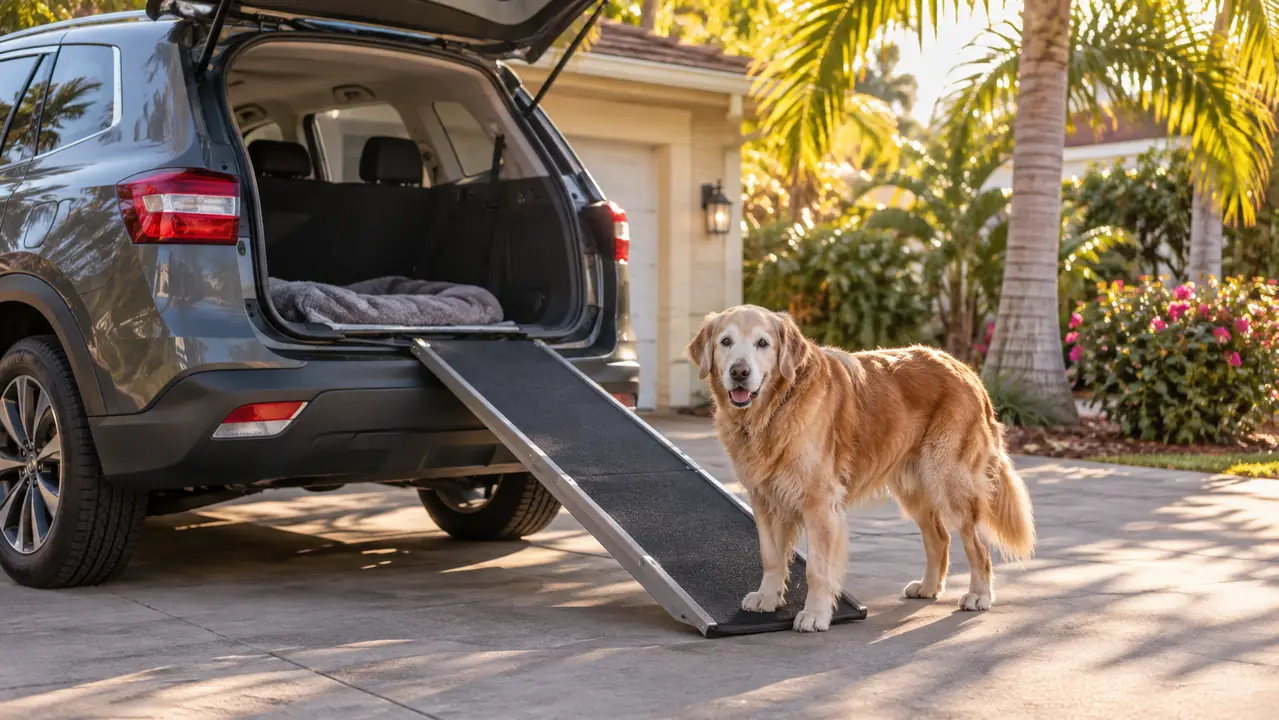
The first time Tucker refused the tailgate, I thought he was being stubborn. He is eleven, a yellow Lab mix, about 68 pounds, and for most of his life he launched himself into the back of whatever car I happened to own. That morning he put his front paws on the bumper, stood there a second, and then backed off and looked at me. Not stubborn. Stuck.
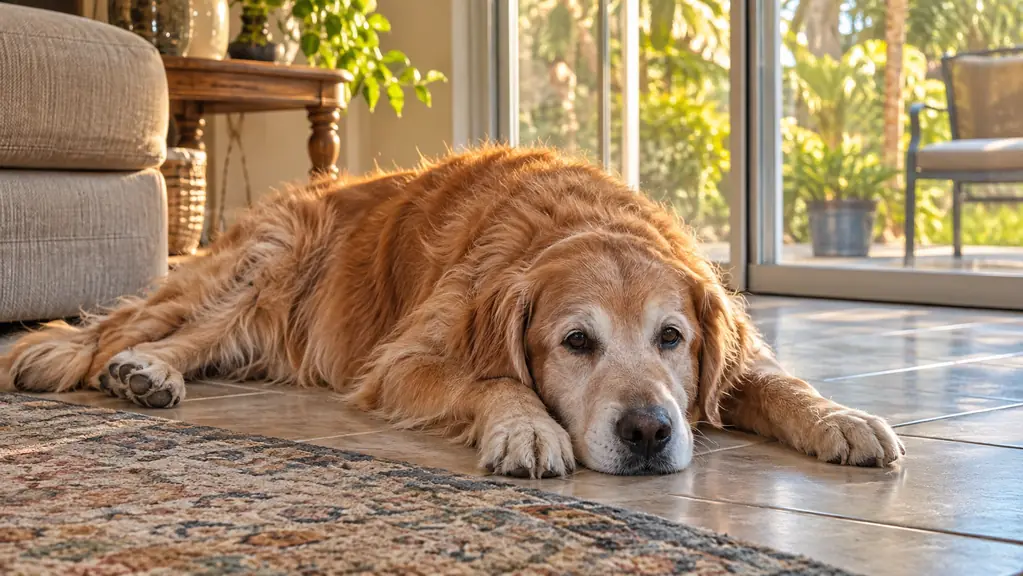
I had watched him stiffen for a year by then. Slow to rise after a nap on the tile, hesitant on the two steps down from the lanai, a little wobbly on cool mornings in January. The SUV was the last thing he could still do on his own, and then he could not. I spent a couple of evenings reading listings and ended up with the PetSafe Happy Ride Telescoping Dog Ramp, the version with side rails. I have used it for about eight months now, for vet appointments, the beach access at Siesta Key, and drives out toward Myakka. This is an honest accounting of what it fixed and what it did not.
The Quick Verdict
It ended the standoff at the tailgate for a 68-pound dog with stiff back legs, and one person can set it up alone in a parking lot. It is heavier than the listing photos suggest, and sand packs into the walking surface.
Amazon Check Today's Price →If your dog is hesitating at the tailgate, this is the one I would buy again
The PetSafe Happy Ride Telescoping Dog Ramp adjusts from 39 to 72 inches, carries up to 400 pounds, and has side rails and a textured walking surface. Current price and availability are on the Amazon listing.
Amazon Check Today's Price on Amazon →How I've Used It
The ramp rides in the back of my small SUV, shortened all the way down, and it sits against the cargo wall without sliding around much. When I need it I pull it out, set the bottom on the pavement, and push the upper section out until it meets the bumper. The whole thing takes maybe fifteen seconds, which matters more than you would think when you are standing in a vet parking lot in July with a dog who wants to go home.
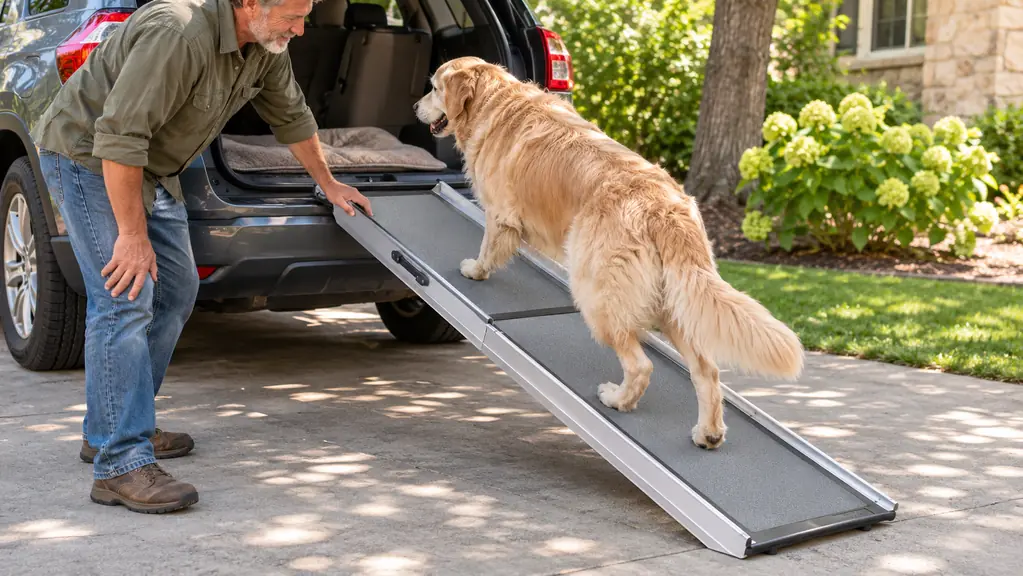
Tucker took to it faster than I expected, and I credit the width more than anything. The ramp is 17 inches across. That reads like a spec sheet number until you watch an old dog try to walk a narrow plank, where his back feet are hunting for the edge with every step. Seventeen inches gives him room to place all four feet without thinking about it. He walks up on his own now. I keep one hand near his harness for the first trip of the day, mostly for my own nerves.
The places it has earned its keep: the vet on Fruitville Road, the beach lot at Siesta Key where the drop from the pavement looks worse every year, and a drive out toward Myakka with a friend who has a taller truck than mine. Eight months of that and the ramp has not slipped off a bumper once. The rubber feet do what they are supposed to do on pavement, and I check them anyway, because that is who I am.
The first week was the hard week, and I want to be specific about it because the first week is where most people give up. I had the ramp set too short on a Tuesday morning in February, rushing to a 9:20 appointment, and Tucker got about a third of the way up before he turned around and came back down. I stood in the driveway and felt foolish. The next trip I gave myself ten extra minutes, parked where the driveway was flat instead of sloped toward the street, and set the ramp up before I put his harness on rather than after. He went up without a pause. Nothing about the ramp changed between those two mornings. The time and the slope did. If you buy one of these, budget six or seven awkward attempts before you decide it does not work.
What the 39 to 72 Inch Telescoping Range Actually Buys You
The ramp extends from 39 inches to 72 inches. In plain terms, that is the span between a low car bumper and a tall truck tailgate, and it means you are not buying a second ramp the day you trade the sedan for something bigger. The listing says it fits cars, minivans, trucks and SUVs, and from what I have used it on, that holds.
For my SUV, the useful setting lands somewhere in the middle. It is the angle that matters, not the length. When I had it set too short the first week, the ramp was steep enough that Tucker was essentially climbing, and I could see his back legs working harder than they should. I pulled it out another eight inches or so, and the difference was immediate. He stopped hesitating at the base.
I measured once, out of curiosity, the way I used to measure things for the paper. From the pavement to my open cargo floor is a fraction over 25 inches. At 39 inches of ramp that is a steep climb for an old dog. At 54 inches it is a gentle walk. At 72 inches it is almost flat, and on my vehicle it also sticks out past the bumper into the sidewalk, which is how I learned to stop extending it further than I needed. Twenty-five inches of rise over 54 inches of ramp is the number that works for my car. Yours will be different, but the principle is the same: more length, gentler angle, more space taken up.
So here is the thing I would tell anyone buying this: the number on the box is a range, not a setting. Set the ramp up once with your dog standing next to it, look at the slope, and adjust before you ask him to walk it. If your dog balks, check the angle before you decide the ramp is the problem. Nine times out of ten it is the angle.
The Side Rails and the Walking Surface
The version I bought has side rails, which are low lips running the length of the walking surface. They are not a fence. They will not stop a dog who bolts. What they do is give an unsteady animal something to feel along the edge, and Tucker drifts right when he is tired. The rail catches him and he corrects without me saying anything. For an old dog with a sore hip, that small correction is worth more than it sounds.
The walking surface itself is textured for grip. On a dry day it does exactly what you want. Wet paws after a beach rinse, which is most of our afternoons, and he still has traction going up. I have not once seen a back foot slide out from under him on the incline, and I was genuinely worried about that before I bought it.
The tradeoff is cleaning. Sand from the beach access works its way into the texture and stays there. I rinse the ramp off with a hose maybe once a week and knock it against the driveway the rest of the time. It is not a defect, it is what a grippy surface does, but nobody mentions it in the listing photos and you should know going in.
Something else worth saying about the surface: the texture is what makes the ramp work in the wet, and it is also what makes it unforgiving on bare feet and bare knees. I kneel on the driveway beside it to check the foot of the ramp before every trip, and the one time I put a knee on the walking surface instead of the driveway I felt every ridge of it through my jeans. Sensible people will not do that twice. It also means a wet dog coming off a beach rinse leaves a very visible paw print pattern on the driveway, which is how I know the grip is grabbing rather than just looking grippy.
Eight months of vet runs and beach trips, and the only thing that has worn out is my patience for sand in the traction surface. Tucker has not hesitated at the tailgate since the second week.
Weight, Storage, and the Part I Did Not Expect
The listing puts the weight at 6.69 kg, which is just under fifteen pounds, and the frame is aluminum. Fifteen pounds does not sound like much until you are lifting it out of a cargo area one-handed with a leash in the other and a dog leaning toward the grass. On a bad shoulder day I feel it. Not enough to regret the purchase, but enough that I plan my grip before I pull.
The listed dimensions are 72 inches long, 17 inches wide and 4 inches thick at full extension. It is the length that decides where it lives. In my SUV it fits diagonally behind the second row when shortened. In a smaller hatchback it would be a nuisance, and in a sedan trunk it would take up most of the space. Measure your cargo area before you order, not after.
The load capacity is 400 pounds, which is more than five times Tucker's weight. Practically, that means I can lean my own weight on the top edge while I steady him and the ramp does not flex or bow under my hand. I have not walked up it myself and I do not intend to, but I have rested a good portion of my weight on it more than once, and it has felt solid every time.
The part I did not expect was what it did for my own mornings. Before the ramp, getting Tucker into the car was a two-minute negotiation followed by a lift I felt in my lower back by the afternoon. My doctor had already told me to stop lifting him, and I had nodded and kept doing it because the alternative was leaving him home. Now the routine is: harness on, ramp out, one hand near the harness, count to three. It costs me about forty seconds and it costs my back nothing. I mention it because the listing sells the ramp to the dog, and honestly half the reason I still have it is the person doing the lifting.
Getting an Older Dog to Trust It
I did not set it against the bumper and expect him to use it. The first day I laid it flat on the lanai tile with a couple of treats scattered along the length and let him walk across it at no height at all. Two days of that, twice a day, five minutes at a time. He thought it was a strange game but he stopped sniffing it suspiciously.
Then I set the low end against the porch steps down to the yard, which are only a couple of risers, and walked him up and down with me beside him. By the time I put it against the SUV, the ramp was already a known object with a known feel under his feet. The first tailgate attempt was uneventful. He simply walked up, which honestly surprised me more than it surprised him.
The part that took longest was me. I had to learn to hold the ramp steady and let him pick his own pace instead of hurrying him along. An old dog reading a new surface needs a beat to think about it. Pulling him forward teaches him to avoid the thing, and then you have two problems. If your dog is more anxious than mine, spend an extra week on the flat-on-the-floor stage. It costs you nothing.
What I Liked
- Telescopes from 39 to 72 inches, so it covers a small SUV and a full-size truck without buying twice
- 17 inch walking surface gives a stiff dog room to place his back feet without hunting for an edge
- Low side rails catch a dog who drifts when he is tired
- Textured surface holds grip on the incline and on damp paws
- Rubber feet have not slipped off my bumper in eight months of use
- Aluminum frame and a 400 pound load capacity feel stable under a steadying hand
Where It Falls Short
- Just under fifteen pounds is a real lift out of a tall cargo area every single trip
- Sand and grit pack into the textured surface and need rinsing
- 72 inches at full extension takes up genuine space in a small vehicle
- The side rails are low and will not stop a dog who panics or bolts
- Setup angle matters and the first attempt is usually too steep
Who This Is For
This is for the owner of a dog who still wants to go, whose back legs have started to disagree with the plan. If your dog stands at the tailgate and looks at you, or if you have started lifting 60 or 70 pounds of dog into the car and feeling it in your own back the next morning, this solves both halves of that problem at once. It kept Tucker in the car for the beach and the vet instead of at home.
It also suits a household with more than one vehicle height, since the telescoping range means one ramp covers the car and the truck. And it suits people who travel alone with their dog, because setup is genuinely a one-person job. I am 66 and I manage it without help, which was the whole point. Talk to your vet first about whether the stiffness you are seeing is something a ramp helps or something that needs treatment, because a ramp does not fix a joint.
Who Should Skip It
If your dog is small, under about 25 pounds, this is more machinery than you need. A set of stairs or simply lifting him will do the job and take up a fraction of the space. The ramp earns its keep with a dog heavy enough that lifting him is bad for your back and awkward for him.
Skip it if your dog has gone past walking up an incline on his own, or if he panics on open surfaces. A ramp assumes the dog can bear weight and choose to move forward. If he cannot, this is not the tool, and your vet is the right person to ask about a sling or a lift harness. And skip it if you have nowhere to store 72 inches of anything, because you will not use it if it is a hassle to get out. That last one is the most common way a good product goes to waste.
One less lift, one less standoff at the tailgate
The PetSafe Happy Ride Telescoping Dog Ramp fits cars, minivans, trucks and SUVs, extends from 39 to 72 inches, and carries up to 400 pounds. Today's price and current availability are on the Amazon listing.
Amazon Check Today's Price on Amazon →