
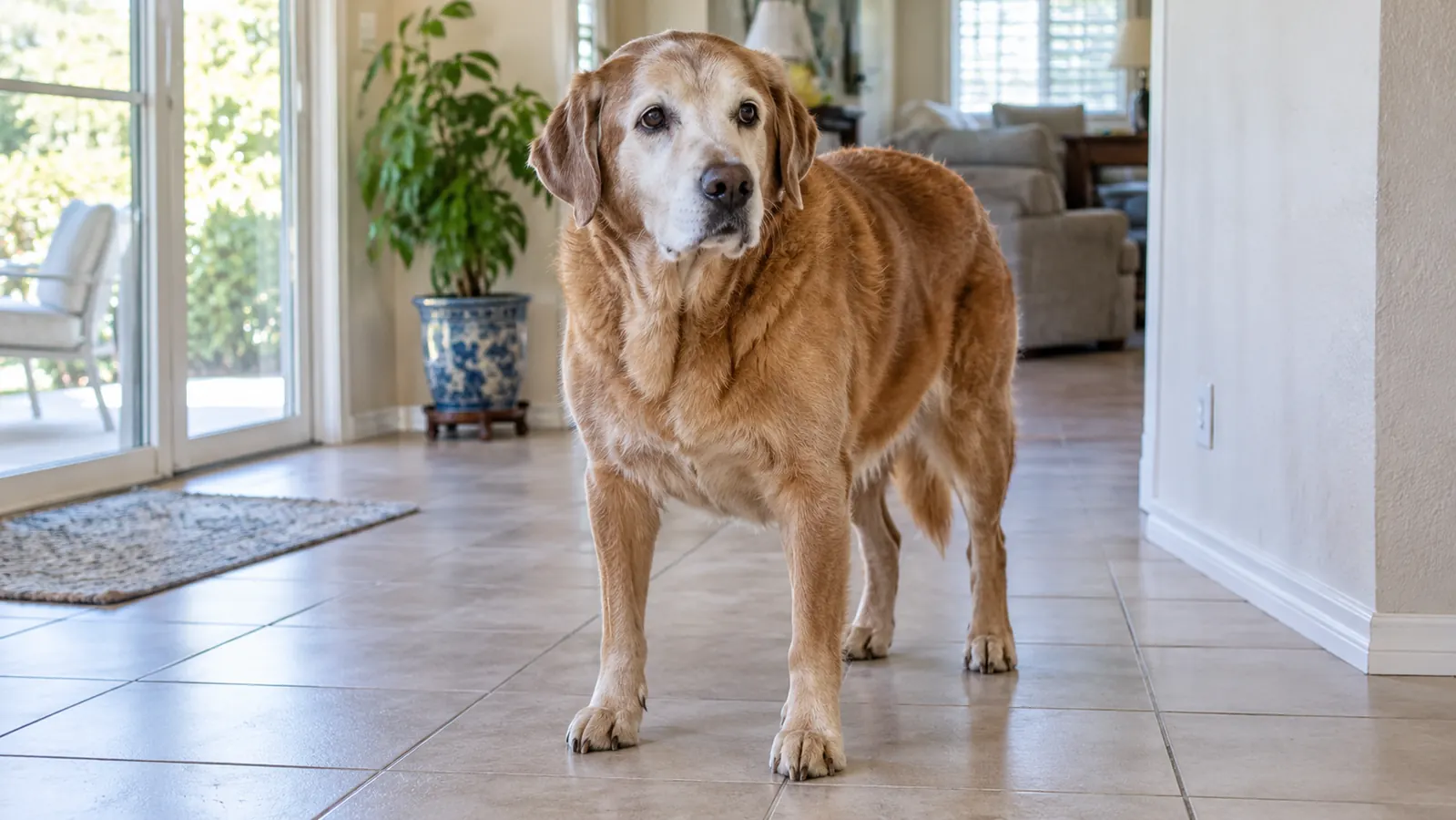
Tucker is 11, a yellow Labrador mix, about 68 pounds, and for most of his life he moved through this house like he owned it. Then last spring I started hearing a sound I could not stop hearing. Not the click of nails on tile. The other one. The skid. A short, ugly scrape of a back paw losing its grip, followed by a hitch and a hurry-up, like a car missing a gear. He would reach the kitchen doorway, turn toward the hall, and his back end would simply not come with him.
Every main room in this house is tile. Cool underfoot in a Florida August, easy to sweep, and about as much traction as a wet parking lot. My first move was the obvious one: two cheap throw rugs from the hardware store. They slid. Then rubber booties, which made him walk like he was wearing swim fins, and he planted all four feet and refused to move at all. What finally worked was a set of DOK TigerToes non-slip socks and a routine that took me about a week to get right. DOK is not paying me to say any of this. I am 66, retired from a newspaper after 29 years, and I only write about things that have been on my own floor.
The Socks That Got Tucker Off the Skid, Not Off the Floor
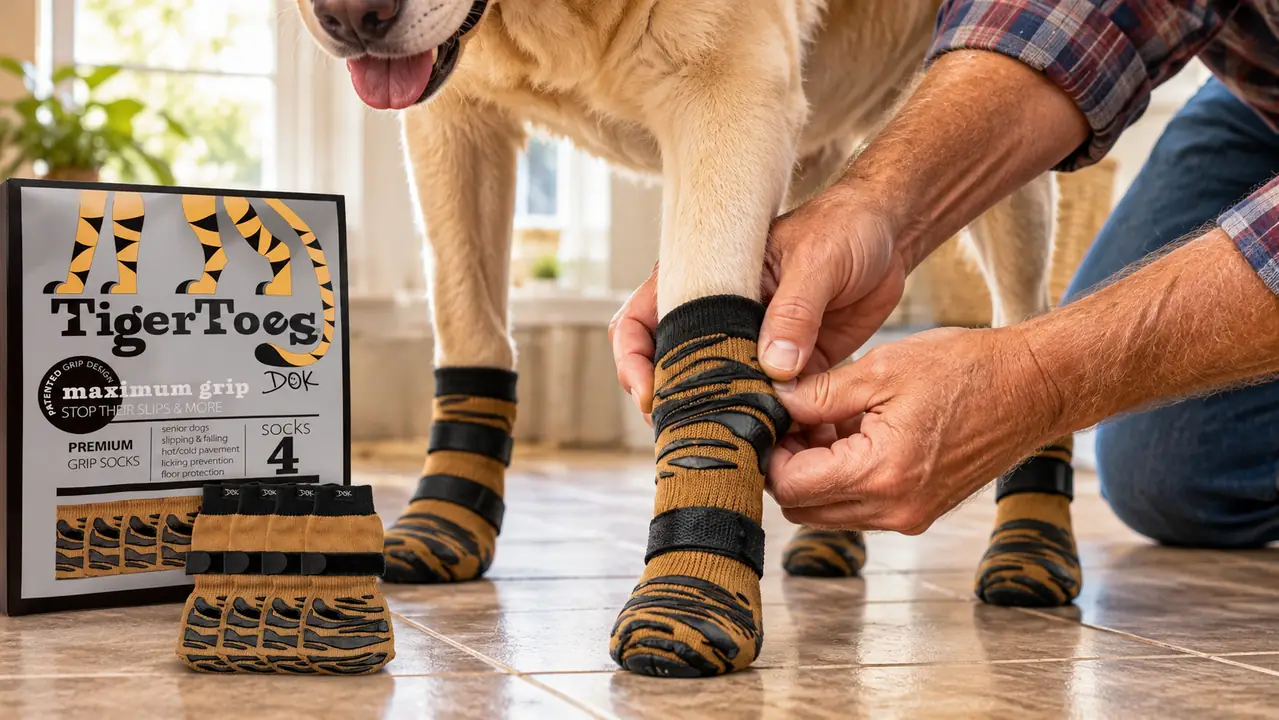
DOK TigerToes come four to a set, sized by paw width rather than body weight, with grip on the bottom and a hook-and-loop closure that stays where you put it. That is the entire pitch. Nothing to charge, nothing to download.
Amazon Check Today's Price on Amazon →Five Steps, In the Order I Would Do Them Again
Step 1: Measure the Paw While the Dog Is Standing
The size chart is the part people skip, and it is the part that decides whether any of this works. DOK builds a large that fits a paw measuring 2.5 to 2.8 inches across the widest point. Not body weight. Paw width. A 68-pound dog and a 95-pound dog can wear the same size if their feet measure the same, and a heavy dog with narrow feet will swim in the large. Buy by the number, not by the breed name on the box.
Do it on the floor with the dog standing on a hard surface, because a paw spreads when it takes weight. Slide a piece of paper under one front paw, mark both outside edges with a pen, and measure between the marks. Then do the other three. Tucker's front paws came in at 2.6 inches. His back paws were slightly narrower, which turned out not to matter, because the fabric is an elastic cotton and nylon blend that stretches and the closure takes up the slack.
Measure again a few weeks later if your dog gets a nail trim in between. Long nails lift the foot off the ground and change how the pad sits, and a sock that fit perfectly in April can sit differently in June. It is a thirty-second job with a pen and a grocery receipt, and it saves you from wondering why the back end is still sliding when the socks are on.
Step 2: Fit Them Standing Up, Not Lying Down
Put them on with the dog upright on the tile, not rolled onto his side. The ones I have pull on over the paw and then close with a hook-and-loop strap at the ankle. I roll the cuff down, slide the sock over the paw, work the grip flat under the pad, and close the strap snug. Two fingers should still slide underneath. Tight enough that it does not spin, loose enough that you are not pinching, and you will see the difference within a minute of watching him walk.
What you are watching for is the back end. The front paws are easy, they just stand there. The rear paws are the ones that tell you the truth, because a back sock that is too loose will roll on the turn at the end of the hall, and a back sock that is too tight will make him stop and chew at it. If he does either, take it off, adjust, try again. Do not force it and do not leave it on a bad fit to see if it settles.
Pick one spot and use it every single time. For us it is the mat by the back door, right before the morning walk. Same spot, same order, same small piece of chicken after the last strap. By the fourth day Tucker was lifting a front paw before I asked him to. Dogs are better at routine than we are, and a routine is what keeps you from skipping it on a hot morning.
Step 3: Ten Minutes at a Time for the First Four Days
Day one, ten minutes. That is the whole session. Put them on, let him walk the hallway and around the kitchen island, then take them off and put them away. An old dog wearing socks for the first time walks strangely. High steps, a little hitch, sometimes a sideways look at his own feet like the floor has personally insulted him. That is not the socks failing. That is a dog recalibrating to a surface that finally has some grab to it.
Day two, twenty minutes. Day three, the full morning walk and the evening one. By the end of the first week he was wearing them the whole time he was loose in the house and had stopped noticing them entirely. What I did not do, and would not do, is strap them on and leave them for a full day from the start. If a dog has never worn anything on his feet, eight hours is too much to ask in one jump.
Keep the sessions boring. Flat floor, short distance, no stairs, no lanai steps, nothing that asks for a hard push-off. The point of the first week is not exercise. It is letting him learn that his feet stay where he puts them, and letting you learn where the strap sits after ten minutes of walking.
Day one he high-stepped like the floor had moved. By day four he was waiting at the back door with a front paw already lifted.
Step 4: Check the Fit Twice a Day for the First Week
Socks rotate. That is not a flaw in the product, that is what fabric does on a moving animal. The grip on the DOK socks is built to keep providing traction even when the sock has twisted partway around the paw, which is the single reason I stopped looking at other options after the bootie disaster. But twisted is still worth fixing when you notice it.
Twice a day for the first week, then once a day after that: run a thumb around the ankle strap, flatten the pad, and look at the skin above the dew claw for redness or rubbing. Check the nail beds too, and check between the toes. You get four socks in the set, so rotate which two he wears and wash the other pair. They are machine washable, and after a Florida summer of daily use they need it. Cold water, air dry, and the grip comes back ready to work.
Step 5: Fix the Rest of the Path, Not Just the Paws
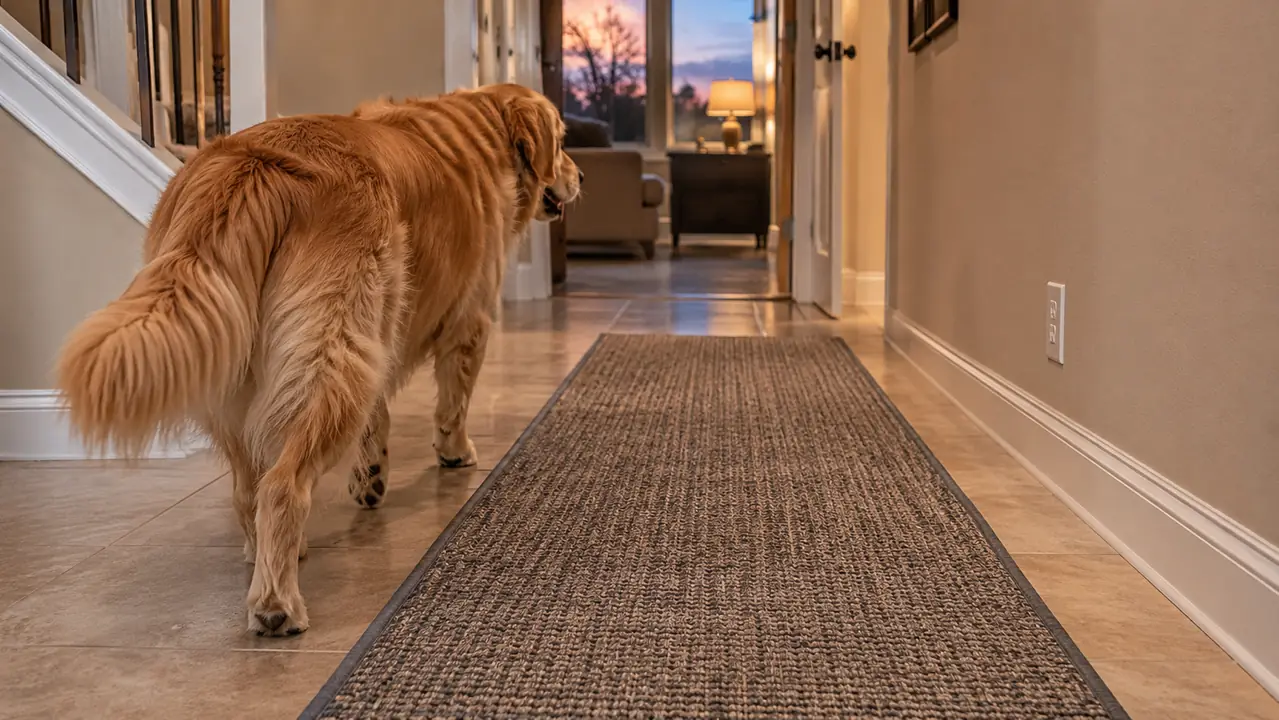
Getting the feet right only gets you partway. The rest of the path has to cooperate. I put two long runners down the high-traffic line from the kitchen to the hall, the plain kind with a rubber backing, and I anchored the ends with double-sided tape so they do not slide when he pushes off. A loose rug under an old dog is its own hazard, and I learned that the hard way.
At the lanai there are two steps down to the yard. I put a non-slip mat on each tread and one at the bottom landing. For the SUV, the tailgate jump was the thing I most wanted to stop, because he was launching off the back leg and coming down hard on the same hip every time. A folding step gets him in and out at half the height. He grumbled about it for two days and now uses it without being asked.
None of that takes a weekend and none of it is complicated, but it has to happen together. Socks on a dog who is still launching himself off a tailgate is half a solution, and half a solution is how you end up back where you started, sitting on the tile at ten at night listening for the skid.
What Else Helps
Ask your vet first. That is not a line I am putting in to cover myself, it is exactly what I did. Stiffness in an 11-year-old Labrador can be arthritis, it can be a soft tissue problem, it can be a nail issue, and it can be more than one of those at once. Tucker was diagnosed in 2024 and his vet gave me a range of motion routine and a green light on the socks. She also trimmed his nails, which mattered more than I expected. Long nails change how the foot meets the floor and cut down the contact patch the grip has to work with.
Keep the weight where your vet wants it. Every extra pound on an old dog is load on joints that are already complaining, and no sock on earth fixes that. Keep walks short and frequent instead of one long one, and go before the heat rather than after it. On our worst August days the evening walk at dusk is the only one that happens, and that is fine.
Watch for licking. If he starts working at a paw through the sock, take it off and look at the skin, because damp trapped moisture is a real thing in this climate and it is easy to miss under fabric. Take the socks off for the hot part of the day, let the feet dry out, and put them back on for the evening. Tucker gets a break at lunchtime and has never once complained about it.
Six weeks in, the skid sound is gone from this house. Not because the tile changed. Because his feet finally have something to hold, and because the rest of the path stopped working against him. He crosses the hallway at a normal walk now, turns the corner without the hitch, and asks to go out at dusk like he used to. That is a small thing to anyone who has not heard the scraping. It is not small to me.
Four Socks, One Week, and a Floor He Can Cross Again
Start with the paw width measurement, then a set of four. Everything else on this list gets easier once his feet stay under him.
Amazon See Sizes and Today's Price on Amazon →