
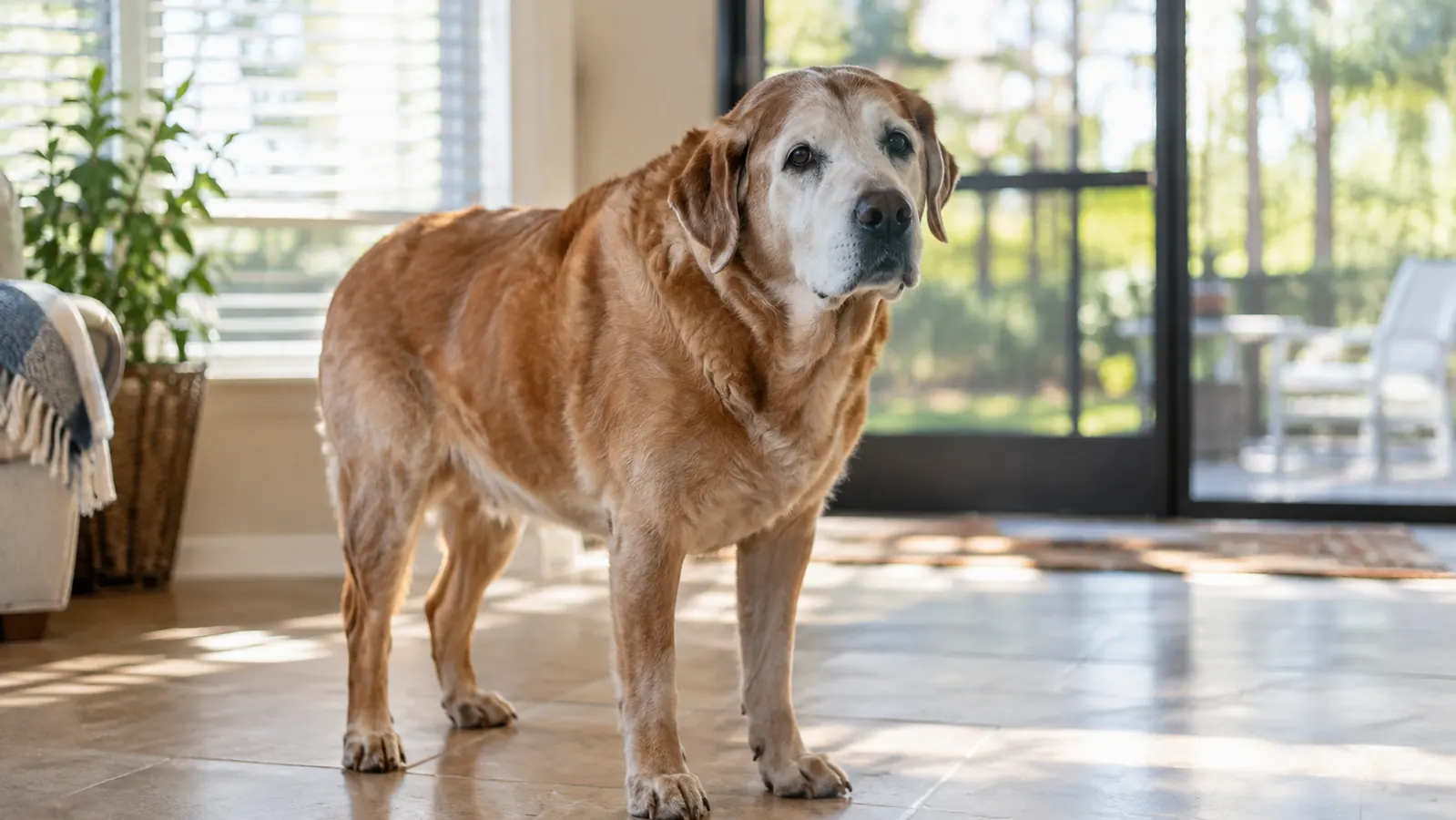
Tucker started stopping at the two porch steps in the spring. Not refusing them. Just stopping, looking down at the tile landing, and thinking about it for a second before he committed. He is an 11-year-old yellow Lab mix, about 68 pounds, and the tile in this house has not changed since we moved in. What changed was him. I spent twenty-nine years as a newspaper photographer, which mostly taught me to watch how a body moves before I decide what is wrong with it. His back end was moving differently.
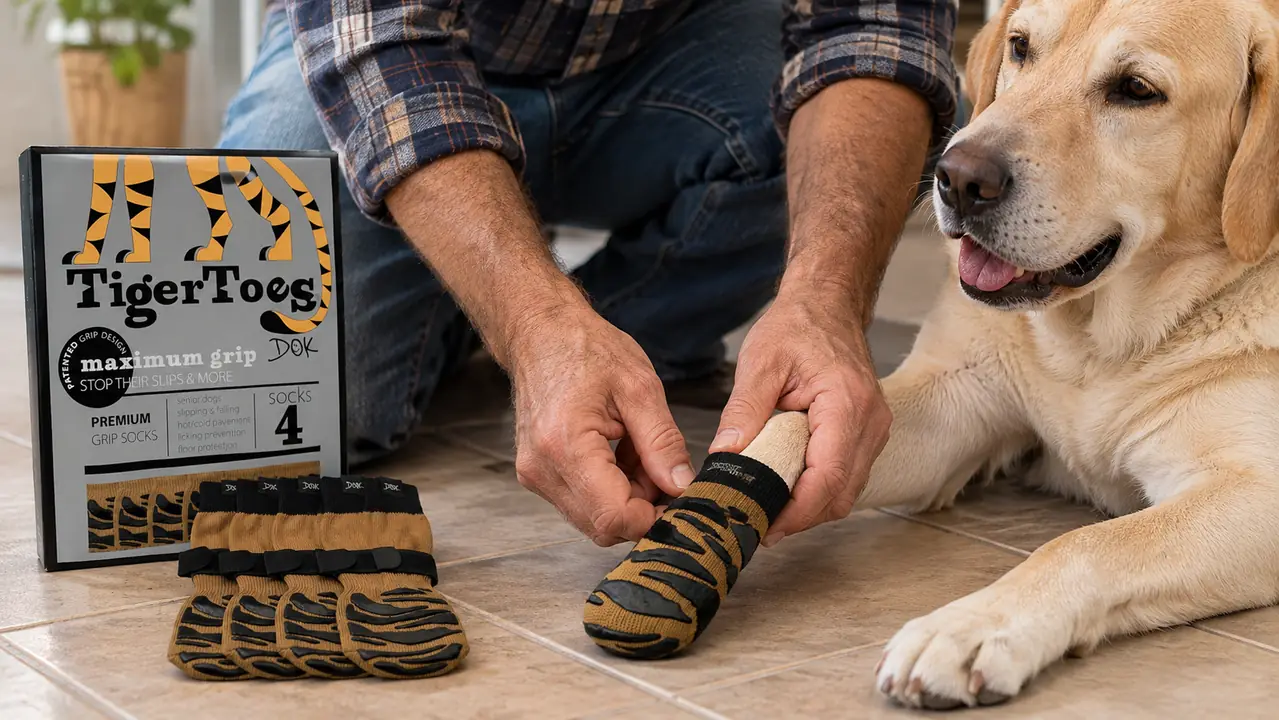
I tried the obvious things first. Runners on the tile, which I tripped over twice. A bath mat by the water bowl, which he folded up and dragged into the living room. Then a friend who shows dogs mentioned grip socks, and I ordered a set of DOK TigerToes in the large size. That was several months ago. They have been washed more times than I can count, lost once inside a laundry basket for a week, found, and put back to work. This is what I have learned, and it is not all good news.
The Quick Verdict
Real traction on tile, and the grip still catches when the sock rotates. Getting all four on takes a minute of patience, and a back sock can loosen after a long lie-down. Worth it for a stiff senior on hard floors, as one part of a plan your vet knows about.
Amazon Check Today's Price →Traction that holds when the sock twists, which is more than I can say for the mats
Four socks per set, machine washable, sized by paw width rather than by dog weight. Tucker has worn the DOK TigerToes on the tile in this house for several months. Measure the paw first.
Amazon Check Today's Price on Amazon →How I've Used It
I put them on Tucker before the morning walk and before the evening one, and I leave them on afterward while he settles, because the tile is where the trouble is, not the sidewalk. On days when the heat keeps us inside, he wears them for an hour or two at a stretch while he follows me around the kitchen. Then they come off and I check all four paws, especially between the toes where fabric can bunch.
Four socks, one for each paw, and they are all the same sock. That sounds obvious. It is not obvious when you are crouched on a tile floor at 6:40 in the morning trying to remember which one is already on. I started laying them out in a row on the counter, front left, front right, back left, back right, the way I used to lay out film backs before a shoot. That small piece of order made the whole routine faster.
The first week I was sure I had bought the wrong thing. He walked like a dog wearing socks, high stepping and mildly offended, and one ended up out in the yard. By the fourth day he had stopped noticing them, which is how it goes with most things you put on a dog. The change in how he crossed the kitchen was visible by the end of the second week.
The two porch steps and the SUV tailgate are where I notice it most, because those are the places he had started to hesitate. He still hesitates at the tailgate, honestly, and I lift him now, which is a different subject and one his vet and I are working through. The steps he takes on his own again. Over several months he has worn the socks maybe five days out of seven. The other two days I skip them, partly to give his paws air and partly because some mornings I am running late, and he is patient about a lot of things but not about that.
What the Grip Does on Tile, and What It Doesn't
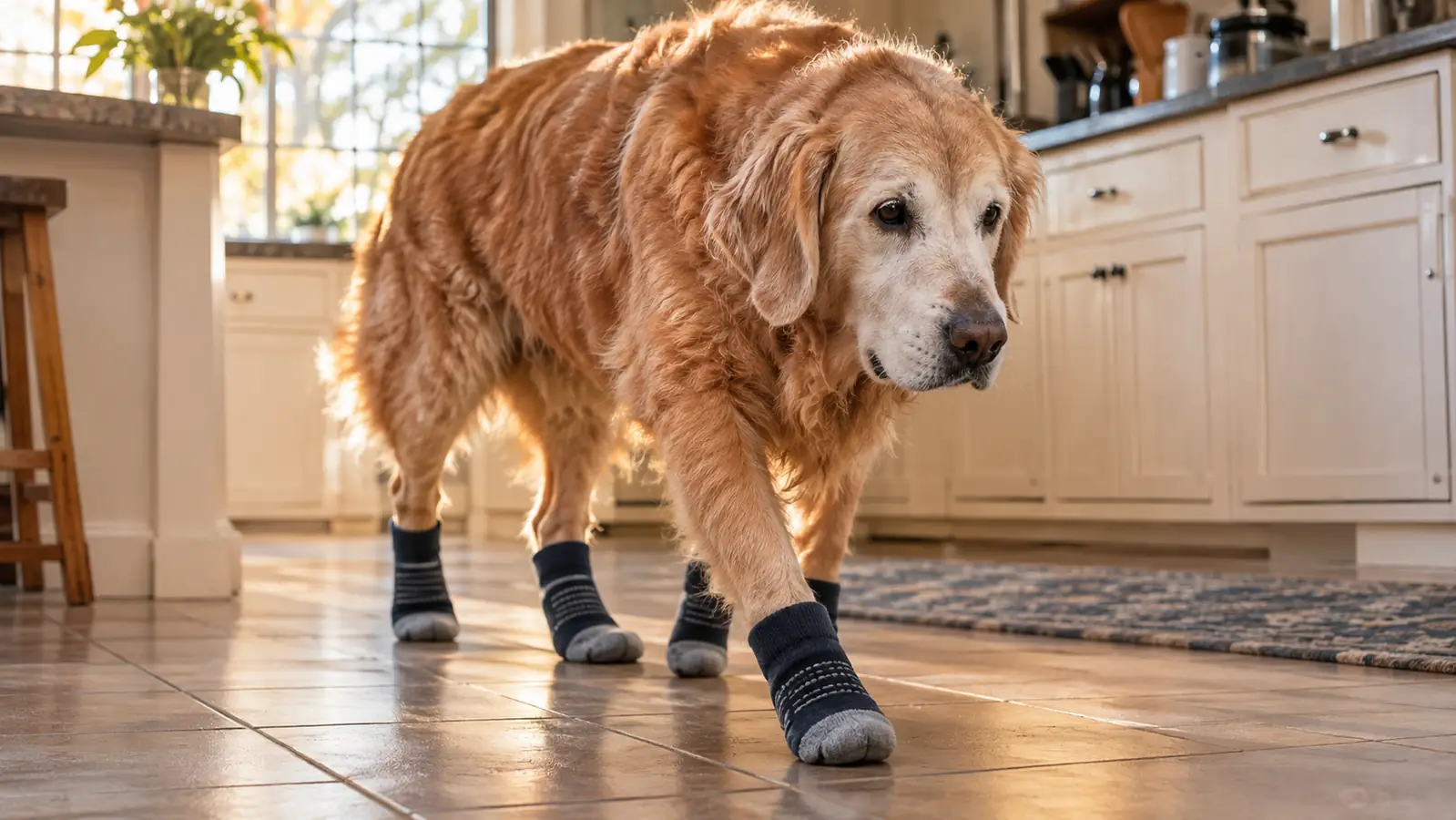
The difference on the tile is not subtle. Before the socks, when he crossed from the area rug to the kitchen, his back feet would slide a couple of inches outward and he would catch himself with a small hitch in his stride. With the socks on, that hitch mostly goes away. He crosses the kitchen like a dog who expects the floor to hold him, which is a thing you notice only once it comes back.
The DOK listing claims three times more grip and says the traction is engineered to work even if the sock twists around the paw. I was skeptical of the second part, because twisting was exactly what I expected. In practice it held up. The grip runs around enough of the sock that when it rotates, some of it is still underneath him. He has done his awkward three-legged turn at the water bowl, the one where a sock always shifts, and come out of it still standing.
One honest note about the floor itself. The socks help most on the smooth ceramic and least along the grout lines, where the fabric catches and he stumbles slightly. Every hard floor in this house has its own texture and the socks answer to all of them differently. If your floors are polished, expect a bigger improvement than if they are rustic tile with deep joints.
His routine on the lanai is the clearest picture of it. Two steps down to the yard, then back up, and for a while last winter he would take the down step and then stop and gather himself before the up step. Now he goes down and up without that pause. I cannot prove the socks did that. What I can tell you is the socks were the only thing that changed in that stretch.
What they do not do is fix the reason he is stiff. They do not make his hips better and they do not give him strength he has lost. What they do is take away one of the things making it worse, which is the flinch. A dog who slides once starts bracing, and bracing on tile is its own problem. Expect the socks to remove one obstacle so the rest of a plan has a chance to work. Mine included a long conversation with his vet about what is reasonable for an eleven-year-old Lab, and I would say the same to you.
The Fit Question: 2.5 to 2.8 Inches
The large size is listed at 2.5 to 2.8 inches of paw width, so measure before you order. I traced his front paw on the back of an envelope, which is what a photographer does instead of finding a ruler, and he came in right around 2.6. The large was correct.
The fabric is cotton and nylon and it stretches, which is the reason the socks go on at all. It is also the reason they can end up too loose if you guess at the size. A sock that is too big bunches under the paw and the dog walks on a wrinkle. A sock that is too small leaves a line across the top of the foot. Measure on a day when the dog is standing, not lying down, and measure twice.
Tucker is 68 pounds and built like a Lab, broad in front and narrow behind. The front socks sit snug. The back ones are looser on him no matter how carefully I place them, and I believe that is his shape rather than a defect in the sock. If your dog has narrow back feet, plan on a little more fussing back there. The socks themselves are small and light, about three ounces for the set and a quarter inch thick, so he is not walking around in boots.
Getting Four Socks on a Dog With Opinions
There is a hook and loop strap at the top of each sock in addition to the pull-on fit, and I use it on all four. It is the difference between a sock that stays where I put it and a sock that is on the floor by the time I stand up.
The first week took me about four minutes for all four paws. Now it is under a minute if he cooperates and two if he does not. The trick, which I got from a groomer and not from a package, is to put them on while he is already lying down and relaxed, and to do the back paws first. If I start with the front ones, he stands up to see what I am doing, and then the back ones are a wrestling match on a slippery floor. I have lived that sentence more than once.
He has worked one off twice. Both times it was a back sock, and both times it was after he had been lying on it for a while and the strap had loosened. That is the honest failure mode. It is not a sock that flies off mid-stride. It is a sock that gives up when a dog lies down and chews at nothing for twenty minutes.
I do not leave them on an unattended dog who is inclined to chew. That is not a DOK problem, that is a fabric and teeth problem. My rule is socks on when I am in the room, and off when I leave the house. If your dog is a chewer, that rule is not optional. It is cheaper than the alternative and I suspect you already know what the alternative is.
Washing, Wear, and Where They Come Up Short
They are machine washable, and I have washed them at least a dozen times. I put them in a mesh bag, which is not required but keeps them out of the washing machine filter, then air dry them. The stretch has held. The grip panels are smoother than they were in March but still doing their job. No seam has opened and the straps still hold.
Where they come up short is the count. Four socks is exactly right and exactly not enough, because one is always wet or lost or in the other room. Plan for a second set from the start, or plan on doing laundry more often than you want to. I bought a second set in the summer and it has made the routine easier to keep.
The other small gripe is sound. Four socks on tile means a soft clicking, and he sounds like a much smaller dog walking through the kitchen. That is harmless. It just took me a week to stop looking up from the paper every time it happened.
What I Liked
- The grip panel still catches on tile after the sock rotates, which is the part I expected to fail
- Cotton and nylon stretch enough to go on without a fight and hold up to repeated washing
- The hook and loop strap keeps a back sock in place through a full walk
- Machine washable, so the routine stays realistic on a busy morning
Where It Falls Short
- Four socks is a set, and one is always wet, lost, or in the other room
- A back sock loosens on a narrow-backed dog after a long lie-down
- You must measure paw width, 2.5 to 2.8 inches for the large, or the fit is wrong
- They take away slipping, not stiffness. Not a substitute for your vet's plan
He has done his awkward three-legged turn at the water bowl, the one where a sock always shifts, and come out of it still standing.
Who This Is For
An older dog on hard flooring who has started to hesitate, slide, or splay. A dog who is still walking but doing it carefully, and whose owner has noticed that the careful version arrived suddenly. A house like mine, with tile in the main rooms and a couple of steps between the door and the yard. The DOK TigerToes make the most sense for someone willing to spend a minute in the morning putting four socks on a dog, because that minute is the entire cost of the thing.
They also suit the owner who has already tried the mats and the rugs, and found them to be a trip hazard, or found that the dog pushes them out of the way to lie on the bare floor instead. The socks go where the dog goes. That was the argument that sold me, and it is still the reason they stay by the door.
Who Should Skip It
If your dog will not tolerate anything on his feet, this is not the product that will change his mind, and forcing it will cost you trust you need for nail trims and vet visits. If the stiffness has gone past stiffness, if he is knuckling over, dragging a paw, or unable to rise, socks are not the conversation you need to be having. Call your vet. If your house is wall to wall carpet, you have already solved this problem. And if you are not going to be in the room while they are on, skip them, because a chewed sock can turn into a vet visit and a very different kind of morning.
If he is hesitating at the steps, start with the floor underneath him
The socks will not rebuild his hips and they are not supposed to. They stop him bracing every time he crosses the kitchen, which is one less thing working against an old dog. Measure the paw, order the size that matches, and give it two weeks.
Amazon See the DOK TigerToes on Amazon →