
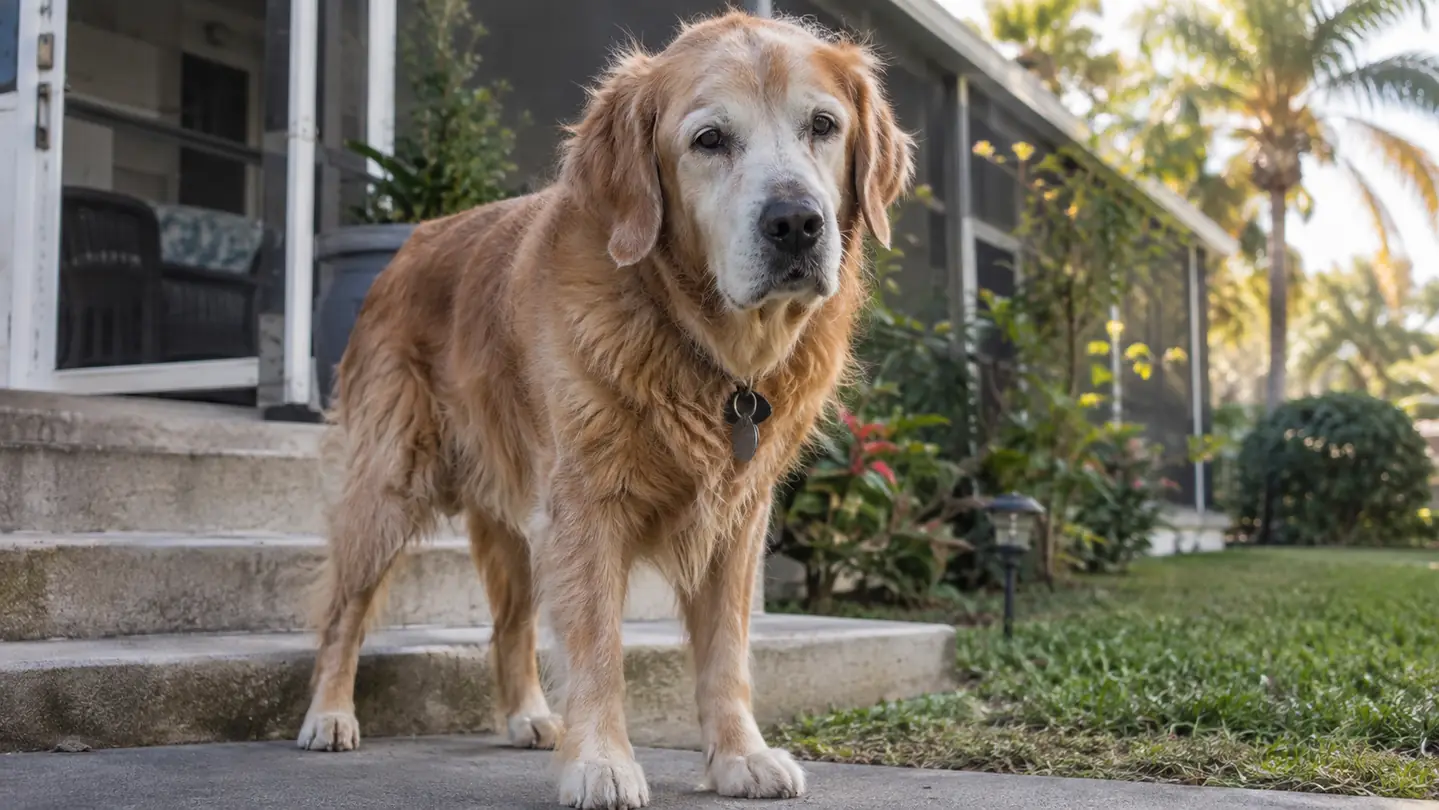
There is a particular sound a big old dog makes at the bottom of two porch steps, and once you have heard it you cannot unhear it. The front feet go up fine. Then the back feet stop, the head drops about an inch, and the whole dog stands there doing arithmetic. Tucker is eleven, a yellow Lab mix, sixty-eight pounds on the vet's scale, and he started doing that arithmetic on the two steps from my lanai down to the yard last spring.
I am sixty-six, retired after twenty-nine years as a newspaper photographer, and I have a knee of my own that talks to me on humid mornings. We live in a single-story house in Sarasota with tile running through the main rooms, which is beautiful and about as much traction as a hockey rink. So I did what I always did when a problem needed watching instead of guessing. I sat on the lanai with a cup of coffee and watched him for a week. What I learned is that helping a senior dog up steps is not one heroic lift. It is a sequence, and the LOOBANI lift sling fits into that sequence better than anything else I tried.
The Two Steps Tucker Stopped Taking on His Own
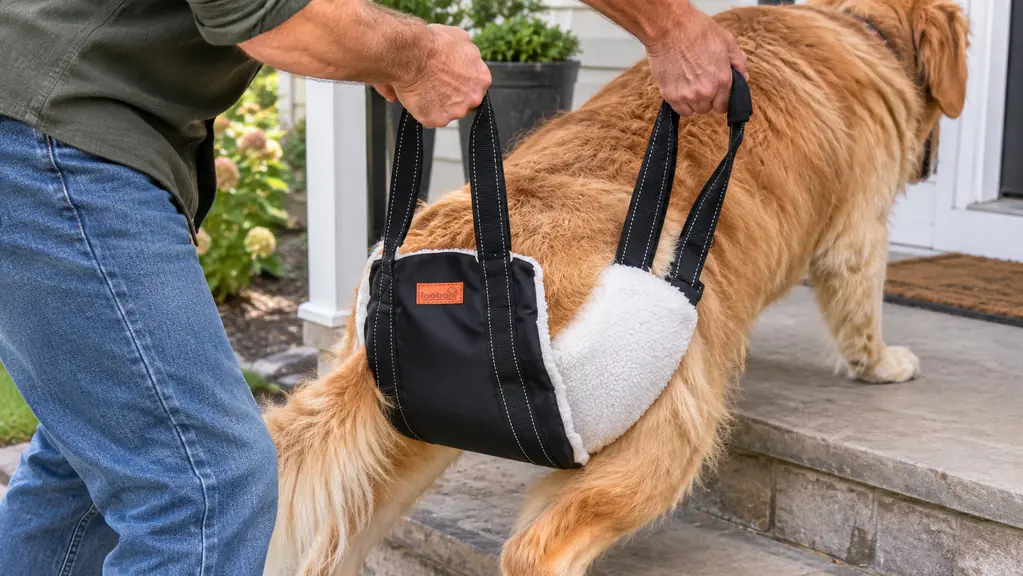
The LOOBANI dog lift harness is a nylon sling with a soft sheepskin-like lining and a drawstring closure that lets you set the fit under the hindquarters. It ships with a storage bag, it goes in the washing machine, and it weighs about fifteen ounces, light enough to live by the back door instead of in a closet.
Amazon Check Today's Price on Amazon →Five Steps, In Order
Step 1: Find Out What Is Actually Failing Before You Buy Anything
A sling helps a dog that is weak. It does not fix a dog that is painful, and those two look almost identical from the porch. Tucker's back legs were stiff after naps and on cool mornings, and he had started hesitating at the steps and at the SUV tailgate, which is the pattern most of us read as simply getting old. My vet read it as a combination: some arthritis in both hips, some muscle loss from a year of shorter walks, and nothing neurological. That distinction matters, because the plan for weakness is support and controlled exercise, and the plan for pain starts with a conversation about medication with a veterinarian who has put hands on your dog.
I am not a vet and I am not going to pretend to be one. What I will say is that the first appointment was the least expensive part of this whole year, and it saved me from buying three things I did not need. Ask specifically what is failing. Is it strength, is it pain, is it balance, is it vision? Write the answer down on the back of the receipt. It decides everything that follows.
The other thing that appointment gave me was permission to act early. Some owners wait until the dog cannot manage the steps at all, and by then you are managing a crisis instead of a slowdown. If your dog has started pausing at the bottom, that pause is the information. Act on the pause.
Step 2: Fit the Sling While Your Dog Is Standing
The first time I opened the LOOBANI sling, I did what most people do and tried to sort it out while Tucker was lying down on the lanai. That was a mistake. Fit it while your dog is standing square on a flat floor, in the kitchen, with the light on and your reading glasses on your face. The sling goes under the hindquarters, the drawstring closure lets you take up the slack, and the soft sheepskin-like lining sits against the belly and the inside of the back legs.
Here is the test I use. Slide two fingers under the lining at the front edge. If you cannot get them in, it is too tight and it will rub. If your whole hand slides in easily, it is too loose and it will shift forward the moment the dog climbs. Tucker is a big dog, so the X-Large is the size that fit him, and the nylon has enough body that it does not bunch up under him. The whole thing weighs about fifteen ounces, which is light enough that he stopped noticing it after a few days.
Then practice on the flat, on level tile or pavement, before you take it anywhere near a step. Stand beside the dog, take up the slack, and lift just enough that you feel a little of his weight come off the floor. Not his whole back end, and not nothing. Maybe a third. Do that five times, praise him, put it away. Repeat the next day. You are teaching both of you the feel of it, and you want that lesson to happen somewhere with no drop-off.
Step 3: Break the Two Back Steps Into a Count
Two steps sound like nothing, which is exactly why people rush them. Tucker's failure happened on the second step going down, when his back feet came off the edge before he had committed his weight forward. So we built a count, and the count is the same every single time, including the times he is feeling good and wants to take the steps at a trot.
Going up: square up at the base, both of us facing the steps. I say ready and then pause. That pause is not decoration. It lets him gather his back feet underneath himself, and it stops him from launching. Then up, and I take up the slack as his front feet land on the top. I am not carrying him. I am removing the part of the job his back legs cannot do that day, and his front end does the rest. Going down is the reverse and it is slower. He goes first, nose down, one step at a time, and I keep the sling taut so his back end cannot outrun his front. If he wants to stop halfway, we stop and stand there.
Do not let the leash go tight in your other hand. A tight leash pulls the dog forward and sideways, and now you have a balance problem stacked on a strength problem. I loop the leash over my wrist and keep it slack. Two people is easier than one for the first week, but with a sling and a slack leash, one is workable.
He does not need me to carry him. He needs me to take about a third of his weight for four seconds, twice a day, and then get out of his way.
Step 4: Treat the Tailgate, the Couch and the Tile as Steps Too
The porch was not the only place he was hesitating. He had started standing at the open tailgate of my small SUV with the same arithmetic face, and he had quietly stopped getting up on the couch, which he used to do without a thought. Anywhere the floor changes height is a step. The tailgate is the worst of them, because the drop is bigger and the landing is metal.
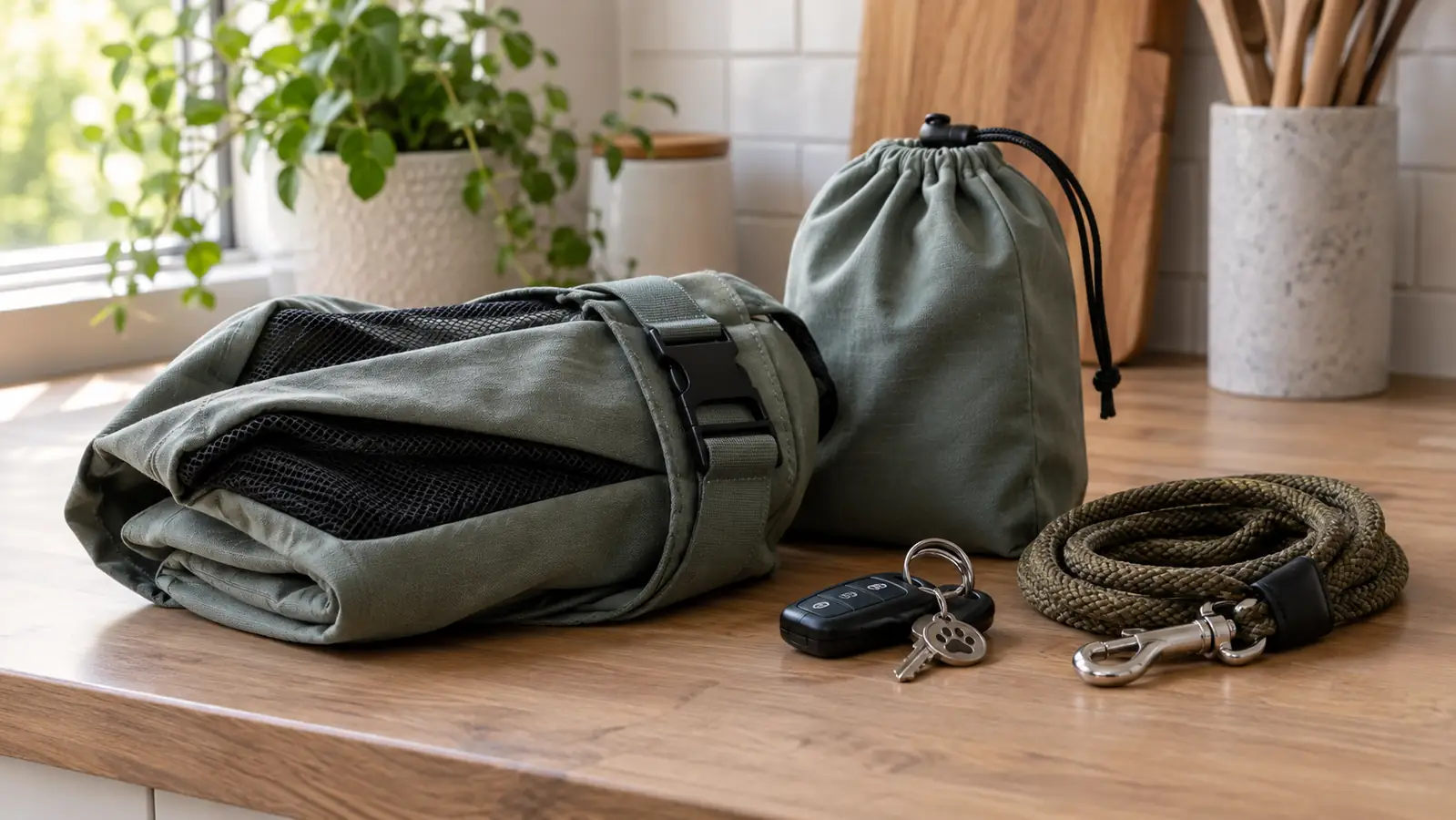
For the SUV I put his front feet on the tailgate first, then take his weight with the sling and let him walk his back feet up. Coming out, I take the weight before he commits, and we come down one back foot at a time. A ramp is a fine alternative if your dog will use one, and some will not, which is why I keep the sling in the car. It folds flat and goes into the little storage bag that comes with it, so it lives under the passenger seat and comes out at the vet's parking lot as easily as at the trailhead.
The tile is its own project. I put a runner from the lanai door to the kitchen and a second one down the hallway, and the change in his confidence was visible inside a week. An old dog on slick tile spends more energy staying upright than walking. You can fix that for the cost of a rug. Trimmed nails help too, and I now ask whoever trims his to take them a little shorter than usual.
Step 5: Build the Day Around the Sling Instead of Reaching for It in a Panic
The mistake I made in the first month was using the sling only on the bad days. That turned it into emergency equipment and made every appearance of it feel like bad news. Worse, it meant the bad days kept arriving on their own schedule. What worked better was making the sling part of an ordinary routine, so it stopped being a signal that something was wrong.
Our day looks like this now. A short walk before the Florida heat gets serious, about twenty minutes, mostly flat, at his pace and not mine. The sling goes on for the two steps down to the yard and comes off at the bottom. Water, rest, a nap on the cool tile in the hall. In the evening we go again at dusk, shorter if it has been humid. The sling comes out for the steps and the tailgate, and on a good day he does most of the work himself while I just keep the slack out of the strap.
The point of the routine is that the walking is what keeps the muscle, and the muscle is what keeps him on his feet. The sling protects him while he does the work. It does not do the work for him, and if you use it to carry him from room to room you will end up with a stronger back and a weaker dog. On the bad days, cut the distance and leave the sling on longer. Do not cut the walk out entirely unless your vet tells you to.
What Else Helps
The single biggest lever was weight. Tucker was about seven pounds heavier than he should have been, and seven pounds on a dog with sore hips is like me carrying a suitcase up those steps. We cut the treats and the table scraps, the vet gave me a target, and it took about four months. He moves better for it than he does for anything I bought. That change did more than any product in this house.
Beyond that: keep the nails short, keep the runners down, keep the water bowl where he does not have to climb for it, and ask your vet about joint supplements and about physical therapy or an underwater treadmill if there is one within driving distance of you. Ask before you start anything, including anything sold over the counter. A sling is a tool that helps a dog keep moving while the rest of the plan does its job. It is not the plan by itself, and anyone who tells you it is, is selling something.
Tuck It By the Back Door and Stop Dreading the Steps
The LOOBANI dog lift harness is a nylon hind-leg support sling with a drawstring closure, a soft sheepskin-like lining and a storage bag, and it can go in the washing machine when the yard gets muddy. About fifteen ounces, folds flat, lives by the door.
Amazon Check Today's Price on Amazon →