
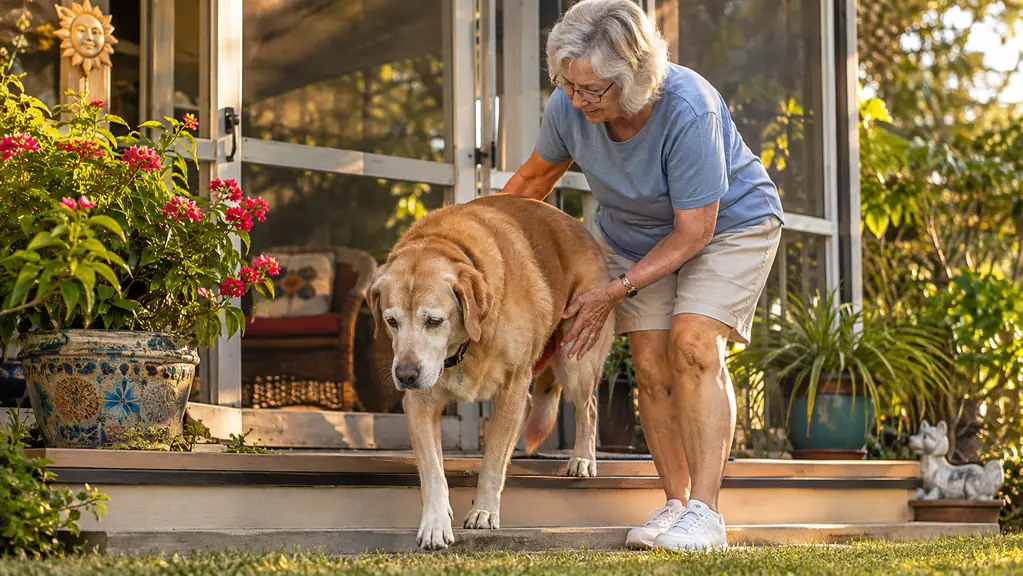
Tucker turned eleven in March. He is a yellow Labrador mix, about sixty-eight pounds, and for most of his life the two steps from the screened lanai down to the yard were not a thing either of us thought about. Last fall he started stopping at the top of them. Not refusing. Just stopping, the way a person pauses at a curb they are not sure about, and then taking both steps in one lurch with his back legs half a beat behind the rest of him. I did what most people do first, which is put a towel under his belly and hold both ends. That lasted about a week, mostly because my hands were full and there was no third hand left for the door. Then I bought a plain rear support sling. A month after that I bought a LOOBANI lift harness. I have used both on the same dog, on the same steps, in the same Florida heat, and I know which one I reach for.
The short version, if you are standing in your kitchen trying to decide. For a large dog who still walks but needs steady help with stairs, a porch, or the tailgate of an SUV, the LOOBANI harness is the one I would buy first. It stays where you put it, the lining keeps the edge of it out of a hip that is already sore, and it goes in the washing machine. A plain rear support sling is not a bad piece of equipment, and I am not going to pretend it is. It is simpler, it packs smaller, and there are mornings when a stiff dog will not stand still long enough to be fitted into anything at all. Mine lives in the back of the SUV. But it is the backup.
| LOOBANI Dog Lift Harness | Basic rear support sling | |
|---|---|---|
| What it is | Harness-style sling for large dogs with a thickened body, a sheepskin-like lining, and a storage bag | A nylon band with two handles, and nothing else in the box |
| Fitting it on a standing dog | Takes both hands and about a minute to settle the lining where it belongs | Slide it under and lift, one motion, nothing to adjust |
| Staying in place | Holds its position through a full flight of stairs | Rides forward on a deep-chested dog and needs a reset mid-walk |
| Padding at the hip | Thickened, soft lining across the contact area | Nylon against skin, so I folded a hand towel underneath mine |
| A dog who dislikes being fitted | Has to be settled around the hindquarters before it helps | Nothing wraps around the body, so some dogs accept it sooner |
| Stairs and the tailgate | Handles give a straight lift at the height of an SUV tailgate | The band rolls and the lift comes up crooked at that angle |
| Cleaning | Machine washable, and it folds back into its own bag | Rinse and hang, and mine still smells like the yard |
| Carrying it along | Folds into the storage bag that comes with it | Rolls up small enough for a jacket pocket or a glovebox |
| Best for | A large dog who still walks and needs steady help on steps, porches and the car | Quick lifts, a dog already lying down, and one kept in the vehicle |
What These Two Things Actually Are
A rear support sling is exactly what the name says. A band of fabric passes under the dog's hindquarters, or under the belly just in front of them, and you hold both handles and take some of the weight while the dog moves. Nothing is adjusted. Nothing is fastened. You fold it, you carry it, you put it under the dog, and you lift when the dog lifts. The one I have is nylon with no padding to speak of, and it does the basic job it was made for.
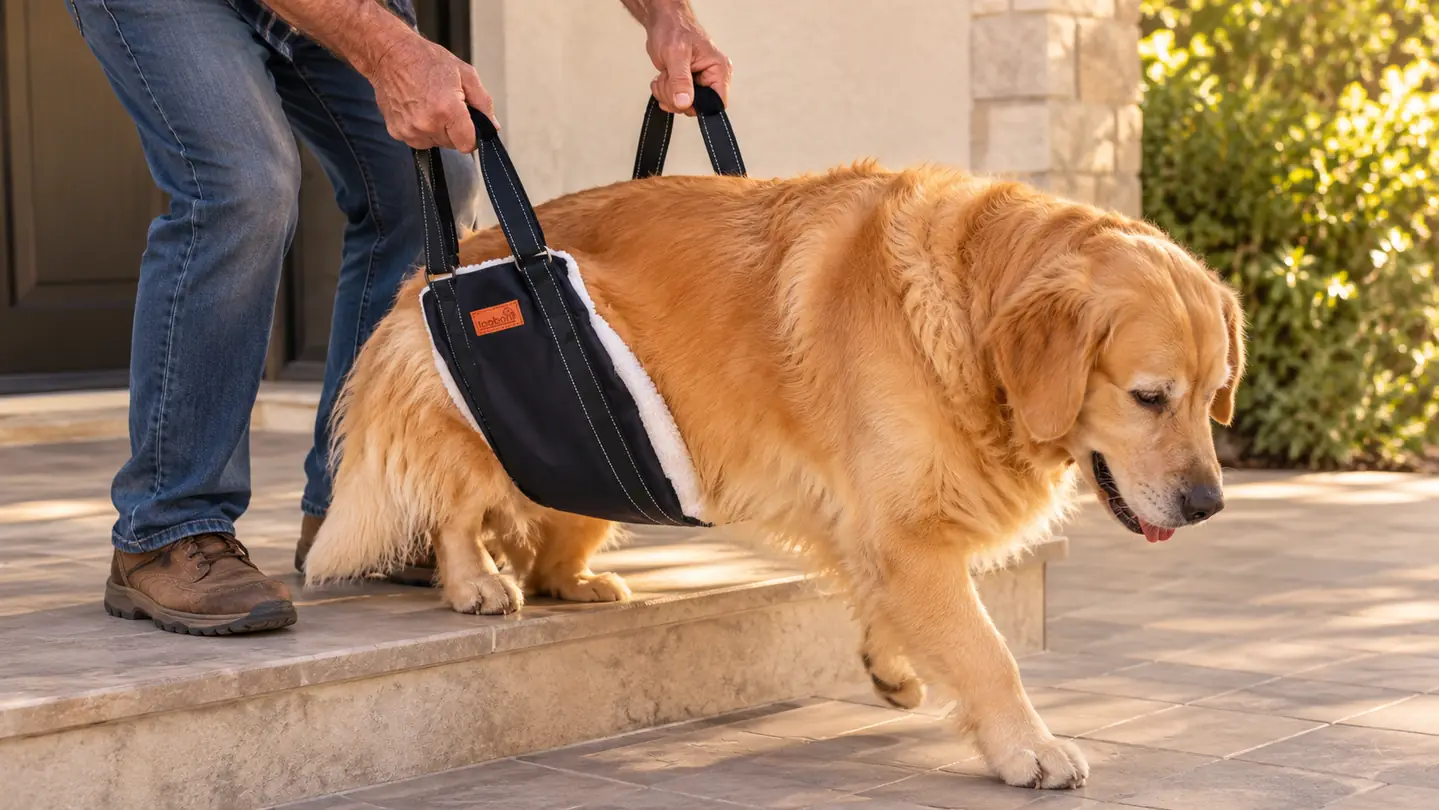
The LOOBANI is the same idea with more structure built around it. It is a harness-style lift sling for large dogs with weak rear legs, sized extra large, with a thickened body and a soft sheepskin-like lining across the part that touches the dog. It comes with a storage bag and the care instructions say machine wash. That reads like a listing. What it means at seven in the morning on a tile floor is that the sling does not travel forward halfway down the hall while you are trying to keep sixty-eight pounds of dog upright and pointed at the door.
One practical note before either of them. Measure your dog rather than guessing. A sling that hangs too long puts the handles down around your knee and you end up lifting with your back in a position your own spine will complain about for a week. The listing calls this one extra large and built for large dogs, and it is worth reading the fitting notes against your dog's actual shape, because a deep-chested Lab mix and a wide-chested dog of the same weight do not fit the same way.
The Two Steps Down to the Lanai
Here is the thing I noticed as a photographer before I noticed it as a dog owner. Watch how an old dog moves and the shape of the problem shows up in the timing. Tucker's front half commits and his back half negotiates. On flat ground that is invisible. On those two porch steps it is the whole story, because the back legs have to carry him down and they would rather not.
With the plain sling I could take weight, but I spent half of every descent chasing the band back into place. It rode forward on him. By the second step my grip was crooked and I was pulling up and slightly backward instead of straight up, which is no help to a dog who is already unsure. I tried folding a hand towel underneath. Then I spent the next week picking the towel up off the tile.
The harness solved the position problem, and position turned out to be most of it. The lined body sits where you settle it and stays there for the whole flight, so the lift goes straight up under his hips and both of my hands are doing the same thing at the same time. The first week I still held my breath at the top step. By the third week I noticed I had stopped bracing my own back before we started, which tells you something about how the two months before that had gone.
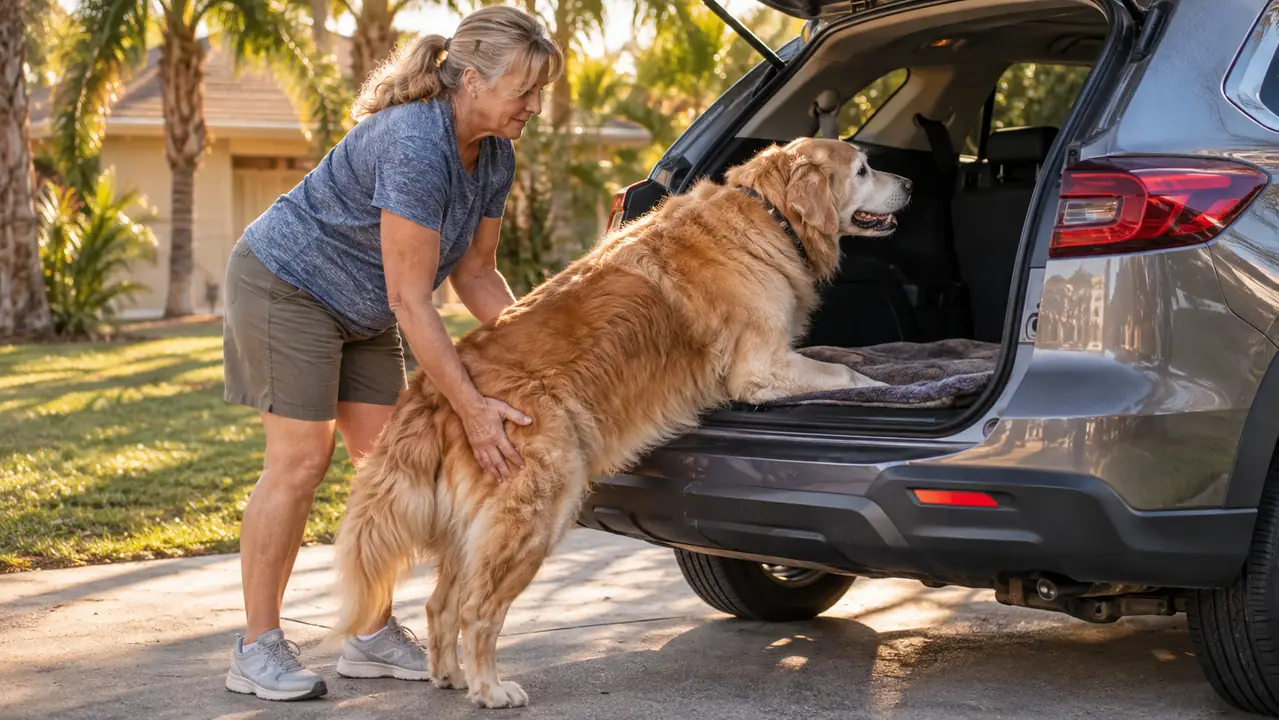
I will say the same thing about the SUV. Tucker has to be lifted into the back, not coaxed, and there is a step stool involved that he does not trust. A straight lift at tailgate height is the difference between getting to the park at seven in the morning, when it is still under eighty degrees, and not going at all. With the harness the handles sit at a workable height for a woman my age and the lift stays square. With the band it rolled, and I would end up pulling him up and sideways against the open door.
In September I was taking most of his weight on those two steps. In January I was taking some of it. That is the whole review.
Where LOOBANI Wins
Steadiness is the entire argument. On a full flight of stairs, at the tailgate, up onto the low brick edge of the lanai, the harness holds the position you set it in and the lift comes up straight under the hips. When I was using the plain sling I was correcting its position with one hand and lifting with the other. A crooked lift on a sore hip is worse than no lift at all, because the dog feels it and starts to resist the whole business, and then you are negotiating with him at the top of the steps instead of helping him down them.
The lining earns its keep too. A dog with weak rear legs does not have much padding left over the point of the hip, and a bare nylon band under load finds every bit of what is left. The thickened sheepskin-like section spreads that pressure out instead of concentrating it in one line. I also want to say something about the bag, because that kind of detail decides whether a piece of equipment actually gets used. It folds into the storage bag that comes with it and hangs on the hook by the door, so it is there when he stands up wrong after a nap, and I am not digging through a closet while he waits on the tile.
It also has a long tail of ratings behind it, about thirteen thousand of them at an average of 4.5 stars, and the three-star ones are where I learned the most. Most of the complaints are about sizing and about how much help a sling can honestly give. Read those before you order. They are more useful than the five-star ones, which are mostly people relieved that the porch steps stopped being a fight.
Where the Rear Support Sling Wins
Where the plain sling wins is speed, and I do not want to undersell it. There is nothing to settle and nothing to adjust. You put it under the dog and you lift. On a morning when Tucker is already up and moving and I have maybe four seconds to get my hands where they need to be, that band is in position before the harness would be half on. Simplicity is a real feature. Any comparison that pretends otherwise is selling something instead of explaining it.
It wins on size and on tolerance as well. It rolls into something you can drop in a jacket pocket or leave in the glovebox for the day the dog will not get out of the car at the vet's office. And for a dog who objects to anything being fitted around the hindquarters, or a dog who is already lying down and cannot stand to be handled into a harness, the sling is the only one of the two that will work at all. I used mine the night Tucker went down on the wet tile and would not get up. There was no fitting anything that night. There was a band under him and two hands and my knees on the floor beside him.
What I Liked
- Holds its position through stairs, the tailgate and the porch steps
- The sheepskin-like lining keeps the band off a sore hip
- Machine washable, and it folds into the storage bag it comes with
Where It Falls Short
- Takes both hands and about a minute to settle on a wiggly dog
- The lining picks up grass and grit from the yard
- I would not leave it on him around the house all afternoon
The tool that stays put when the back legs don't
The LOOBANI lift harness is what I reach for on the porch steps, in the hall, and at the tailgate. Lined, machine washable, and built for large dogs. Read the fitting notes against your dog's shape before you order.
Amazon See the LOOBANI Lift Harness on Amazon →Who Should Buy Which
Buy the LOOBANI if your dog still walks. That is the dividing line, and it is a strange one to write down, but it is the honest one. A dog who still wants the evening loop at dusk, who still gets himself up after a nap, who hesitates at the steps rather than refusing them, is a dog who will get months of ordinary use out of a sling that stays in position under him. Buy the plain sling if the lifts are occasional, if you need something that lives in the car, if your dog is too far along for a fitting, or if he will not tolerate being handled around the hindquarters at all. Most people I know end up with one of each, and that is not indecision. It is two different jobs.
Whichever you choose, do the unglamorous part first. Tucker's back legs did not stiffen up because he needed a better sling, and there is no piece of equipment in my hall closet that changes what is happening in his hips. His vet is the one who told me to keep the walks short and frequent, to bring him in if the hesitation turned into a refusal, and to watch his weight because every extra pound rides on those joints. The harness made the porch steps possible again. It did not make him eleven years younger, and I would not want you to buy it expecting that.
Start with the two steps. That is where you will know.
If your dog hesitates at the porch or the tailgate, that pause is the moment a sling earns its place by the door. Lined, machine washable, sized for large dogs, and it comes with a bag to hang on the hook.
Amazon Check Availability on Amazon →