
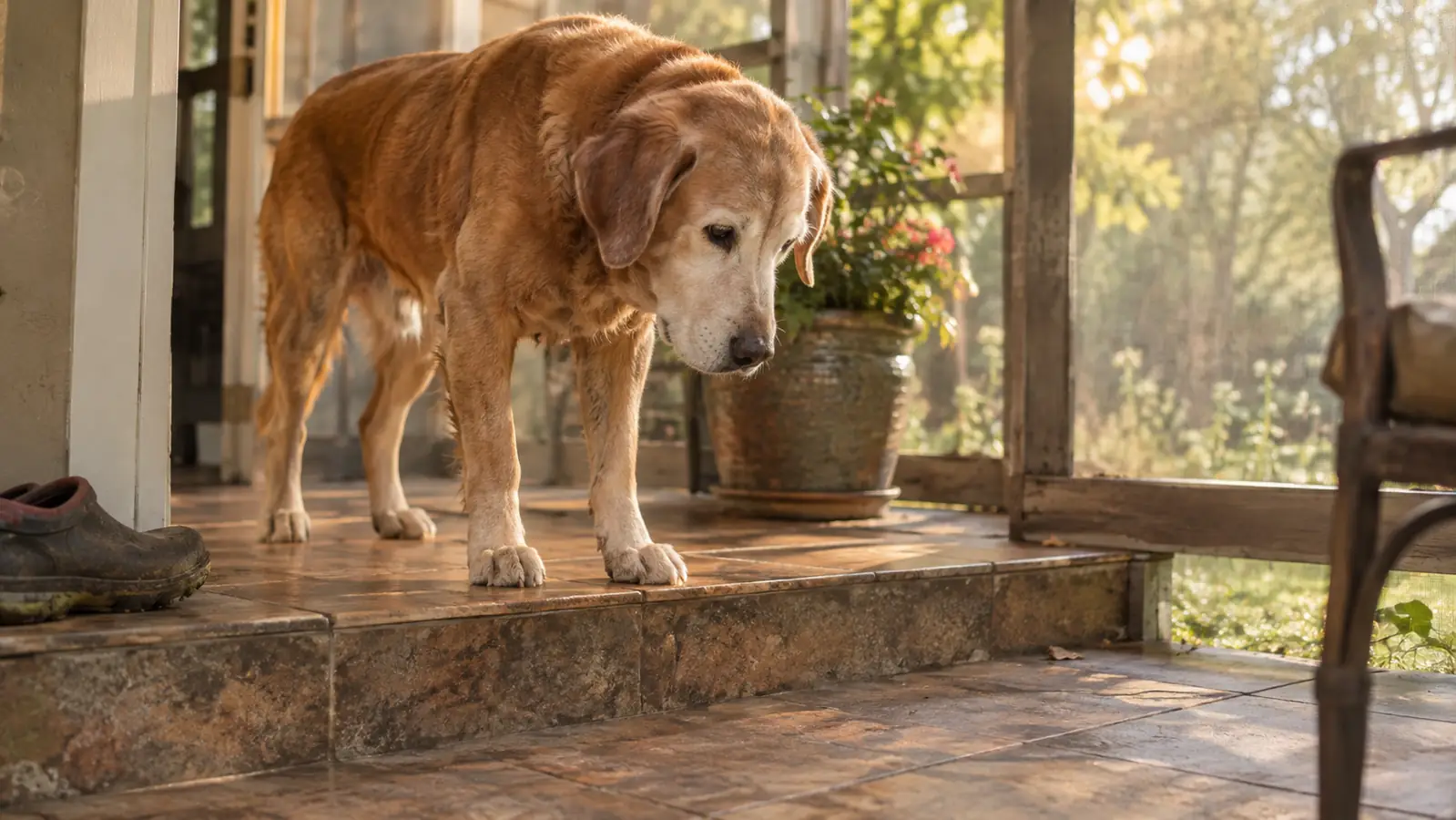
Tucker stopped at the top of the back porch steps in March and would not come down. He is an 11-year-old yellow Lab mix, about 68 pounds, and he had gone down those two steps every morning of his life without thinking about it. That morning he stood at the edge with his back legs gathered under him and his weight shifted forward, the way a dog stands when the back end is not giving him a straight answer.
I had already tried the things people suggest. I put a mat at the bottom of the steps. I shortened our morning walk to the block and back before the heat came up. I told myself he was just stiff, and then I watched him try to get into the SUV in the vet's parking lot and understood that stiff was not the whole story. The vet said his rear end was losing strength and that a support sling would buy him time and keep him moving. I ordered the LOOBANI Dog Lift Harness for Large Dogs a few days later, mostly because it had the widest spread of reviews from owners of big dogs. I have now used it for the better part of a year. Here is what it actually does, and what it does not.
The Quick Verdict
The plain thing that got my old Lab down the steps, into the SUV and back onto the porch without a fight. Nothing fancy about it, and the first fitting wants a second pair of hands.
Amazon Check Today's Price →The sling that got Tucker down the steps again
A rear lift sling takes the weight off your dog's hindquarters and puts it into your hands for the ten seconds he needs it. Simple, washable, and it folds into its own bag.
Amazon Check Today's Price on Amazon →How I've Used It
One thing to say upfront, because it is the thing I would want to know. This is not a brace and it is not a cart. It is a sling you hold. You are the motor. It takes load off the dog's hindquarters and puts some of that load into your hands and forearms, and that is the entire idea. If you are not able or willing to do the lifting, it will live in a closet. If you are, it changes the shape of your day.
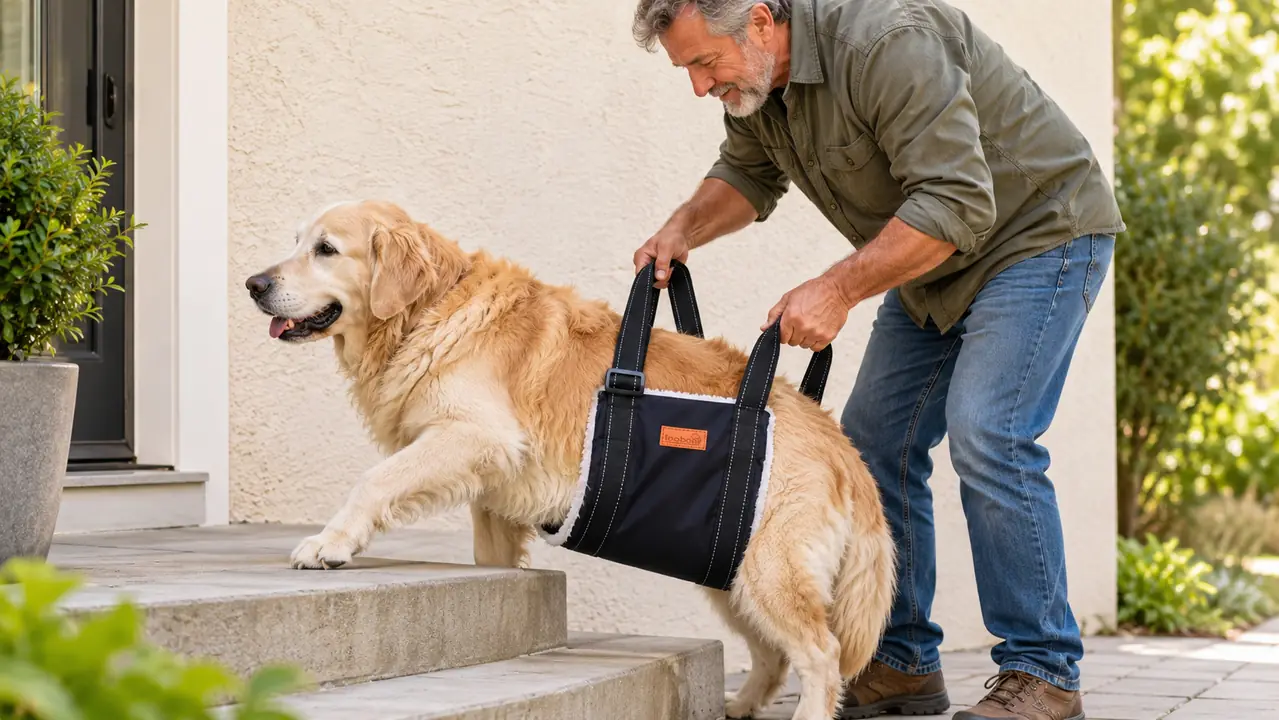
We use it four or five times a day, and each time is a few seconds of work. Mornings are the big one. Tucker sleeps on the tile in the hall because it stays cool, and tile is slick under an old dog's back feet. He gets up on his own, but he is slow and a little unsteady for the first few minutes. I slide the sling under his hindquarters, take the handles, and walk beside him to the back door and down the two steps to the lanai. Then out to the yard. Once he has been on grass and moving for a couple of minutes he does not need me, so I take it off and let him be a dog.
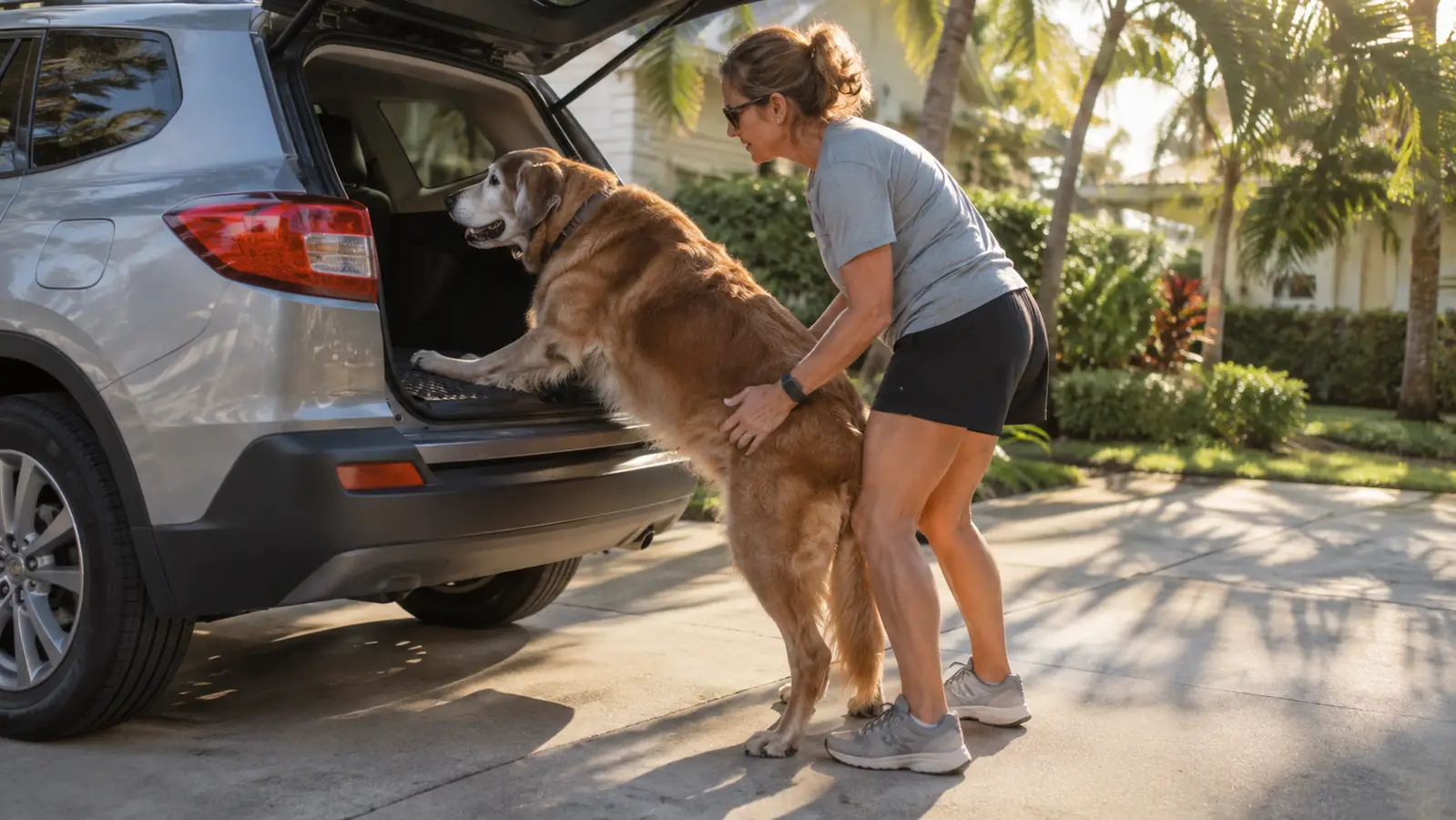
Evening is the same trip in reverse, plus the tailgate. Getting him into the SUV was the thing that finally pushed me to order it. He would put his front paws up and then stand there with his back feet on the driveway, and I could see him deciding not to try. Now I stand behind him with the sling under his back end and lift while he pushes with his front. Three seconds and he is in.
Then there are the odd ones. Nails on the tile after a bath. The slippery floor at the vet's office. The afternoon he lost his footing on the lanai and I could not get him up by his collar without hurting him. That last one is why the LOOBANI sling lives in the back of the car now instead of on a hook in the laundry room. The rest of the time it hangs folded in its bag by the door. It weighs under a pound and the bag cinches shut, so it slides into the pocket behind the passenger seat without a second thought.
What the Sling Actually Does, and What It Doesn't
The mechanics are simple. The sling goes under the dog's belly just ahead of the hind legs, you take the handles on either side, and you lift enough that his back end is not carrying his full weight. The thickened panel spreads the pressure across his middle instead of digging into one spot. The lining is a soft sheepskin-like material, which sounds like a small detail until you have used a folded towel and watched it bunch up and slide the moment the dog moves.
What it does not do is just as important. It does not strengthen anything. It does not fix a joint. It does not make an unsteady dog steady. It is a pair of hands with better geometry. My vet was clear about that and I will pass it along, because I think it is where people get disappointed. A sling buys time and keeps a dog moving, and keeping a dog moving is most of the battle with an old back end. It is not treatment, and it does not replace whatever your vet has planned.
It also does not lift the front. If your dog's trouble is in the shoulders or the front legs, this is the wrong piece of equipment and no amount of adjusting will fix that. Tucker's front end is fine, so a rear-only design is exactly what I wanted. I watched a neighbor try to make a rear sling do front-end work and it went about as well as you would guess.
And it does not walk the dog for you. You are still on the other end of it, bent slightly, matching your pace to a slow one. If I have one honest caution, it is this: your back will notice. I am 66 and I do not lift heavy things anymore. I learned quickly to bend my knees, keep my back straight, and take small steps beside him rather than reaching out in front of me. On the stairs I go down first and let him follow with me below him, which is the opposite of what felt natural at first.
The Fit Details That Matter on a 68-Pound Dog
The LOOBANI sling comes in a size X-Large for large dogs, and Tucker at 68 pounds sits comfortably inside it. There is a fair amount of material to work with, which is what you want on a big-boned dog. On a much smaller dog the panel would swallow the whole middle, so measure rather than guess.
The first fitting was clumsy. I had it too far forward and he gave me a look that I have learned to interpret as a complaint. It wants to sit under the widest part of the belly, just in front of the hind legs, with a handle coming up on each side. Once it is there, it stays there, because the dog's own weight keeps it seated while you lift.
Having a second person hold the dog's head the first time makes it far easier. I did it alone and it took me three tries and a fair amount of muttering. If someone is around, have them stand at the dog's chest with one hand steadying him while you get the sling placed and the handles sorted out. After the first week I could do it one-handed, but that first week is a real learning curve.
It goes in the washing machine, which matters more than I expected. It has been rained on, dragged through the yard, and used on a dog who had a bad stomach day. It comes out of the wash soft and no worse for it, and I have not had a seam give or a handle stretch out in eleven months of steady use.
It does not strengthen anything and it does not fix a joint. It is a pair of hands with better geometry, and on a bad morning that is the difference between a dog who goes outside and a dog who does not.
Eleven Months In: What Changed and What Didn't
There has been no dramatic turnaround and I want to be plain about that. Tucker is 11 and his back end is not going to rebuild itself. What changed is that we kept the routine. Morning walk. Evening walk. In and out of the car. Down to the yard four or five times a day. He has not lost ground the way I feared he would last spring, and I believe the reason is that he never stopped moving. A dog who stops going out gets worse faster. I have watched it happen to dogs on my street.
His weight has stayed steady, which is its own kind of progress for a Lab mix who would eat the furniture if I let him. We did the other things the vet asked for. I moved his water bowl off the slick part of the floor and onto the mat. I put a folded blanket at the bottom of the porch steps so his back feet land on something with grip. I cut the afternoon walk short in the summer heat and moved it to dusk. The sling is one piece of a routine, not the routine itself.
Two things I would do differently. First, I would have bought it two months earlier, when he first started slowing down, instead of waiting for him to refuse the steps outright. Refusing the steps was late. Second, I would have asked the vet to watch me place it once, because I did it wrong for the better part of a week and could not figure out why it kept slipping.
Where It Falls Short
The handles are the weak spot for me. They work and they have not torn, but they are not padded, and on a longer carry or a bad morning my hands feel it. I have taken to wearing a pair of thin work gloves when we are going any distance. It is a small workaround and I would rather have it than a bulkier handle I could not fit in my pocket, but you should know it is there.
The larger issue is posture. A sling puts you slightly bent and walking sideways, holding weight at hip height. Ten feet across the lanai is nothing. A hundred yards down a driveway is a different job entirely. If your dog needs help over distance, a sling is the wrong tool and you should be looking at a cart or a harness with wheels. This is a few-seconds-at-a-time device.
It also takes two hands. That means no leash in one hand and no coffee in the other. Getting a dog who needs a sling down two steps and out to the yard is a two-trip operation unless you are more coordinated than I am. And the learning curve is real. Nobody warns you that the first week will feel like you are doing it wrong, because you are. The sling has to be under the belly and not around the hips, and a dog who is already unsteady does not enjoy being rearranged while you figure that out.
What I Liked
- Two-hand support that takes real weight off the hindquarters instead of a token lift
- Thickened panel and soft sheepskin-like lining spread pressure rather than digging into one spot
- Machine washable, which matters on a dog who has bad days
- Folds into its own drawstring bag and weighs under a pound, so it can live in the car
- Enough material in the X-Large size to fit a 68-pound Lab mix with room to spare
Where It Falls Short
- Handles are unpadded and get uncomfortable on longer carries
- Puts the handler in a bent, sideways posture, which is hard on an older back
- Rear-only design, so it is no help at all for front-end weakness
- Fitting a wriggling dog alone is genuinely awkward the first few times
- Not a substitute for a cart with wheels if your dog needs support over distance
Who This Is For
If your dog can still walk but his back end is quitting on stairs, on the car, or on slick floors, this is the right kind of tool. It is for the owner who is willing to be the motor. It is for a dog whose front end still works and whose back end needs a hand for a few seconds at a time, several times a day.
It is also, honestly, for the owner who wants to keep the routine. The reason I have kept using the LOOBANI sling is not that Tucker loves it. He tolerates it and that is the best I can report. The reason is that without it we stopped going out, and stopping is the thing that starts the slide. If you are the kind of person who will keep a folded sling by the back door and actually pick it up, this will earn its place.
Who Should Skip It
If your dog has gone down and cannot bear weight at all, this is not enough, and the conversation you need to have is with your vet about a cart, not with me about a sling. If the weakness is in the front legs, a rear sling will not help you. And if you have a back injury or cannot lift 30 or 40 pounds at hip height even briefly, please do not buy this and hope. Talk to your vet about what will actually work in your house and your body.
One more. If what you want is something that lets your dog get up and down the steps on his own, this is not that. You are part of it every single time. That is the deal. It is worth knowing before you order rather than after.
If your dog has started stopping at the steps, start here
X-Large, made for large dogs, machine washable, and it folds into a bag small enough to keep in the car. Read the sizing note and measure your dog's middle before you choose.
Amazon Check Today's Price on Amazon →