
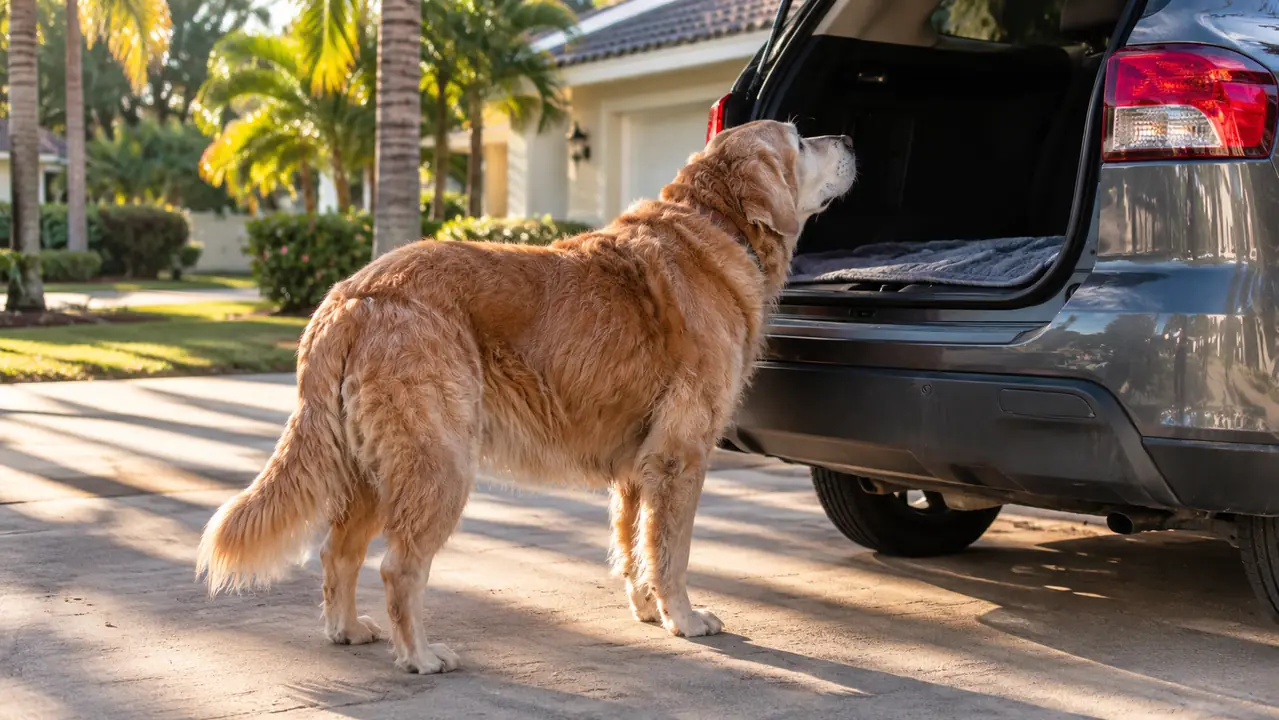
Tucker is eleven years old, sixty-eight pounds, and a yellow Labrador mix who still believes he is four. His back legs have not agreed to that story in about a year. He stands up from the tile floor in stages, and last spring he started stopping at the tailgate of my small SUV, looking at the height, then looking back at me. That look is the reason I bought the PetSafe Happy Ride Telescoping Dog Ramp and then spent three weekends figuring out how to use it without a fight.
The ramp was never the hard part. The hard part was that I had a lifetime of lifting habits and Tucker had a lifetime of being lifted. Hoisting sixty-eight pounds into a cargo area is a two-hand, brace-your-back job, and at sixty-six I could feel precisely where that road ended. What follows is the order that finally worked in my driveway in Sarasota, including the two steps I got wrong first so that you do not have to.
Six feet of ramp beats a two-hand lift, every single morning
The PetSafe Happy Ride Telescoping Dog Ramp extends from 39 to 72 inches, carries up to 400 pounds, and has side rails plus rubber feet so it stays put while your dog works out the slope. Today's price is on the listing.
Amazon Check Today's Price on Amazon →Step 1: Park on flat ground with room behind the tailgate
Do this before you go get the dog. The ramp wants hard, flat, level ground, and the rubber feet want something they can actually grip. My driveway is asphalt with a shell shoulder at the edge, and the difference between those two surfaces is the difference between a ramp that sits still and a ramp that rocks under a nervous paw. Grass is worse. Gravel is worse than grass. If the only flat spot you have is the street, use the street and keep the leash short.
Then look behind you. At full extension the ramp is 72 inches long, which is six feet of aluminum between the bumper and the driveway. If the garage wall is three feet from the back of your SUV, you will be forced into a short, steep setup, and that steep angle puts back the exact load on the back legs you were trying to take off. Back the SUV out first. Give yourself the whole six feet.
Shut the engine off. The first week I left the car running so the air conditioning would keep the cargo area cool, and the idle vibration traveled straight up the ramp into the dog's feet. Tucker stopped halfway up and would not move for anything. Engine off, radio off, doors shut. The ramp went quiet and so did he.
One Florida detail worth knowing: metal in direct afternoon sun gets hot enough to matter on bare pads. I park under the carport now, or I run the back of my hand along the surface before I let him on it. Ten seconds of checking is cheaper than a dog who decides the ramp hurts.
Step 2: Set the length before your dog ever sees it
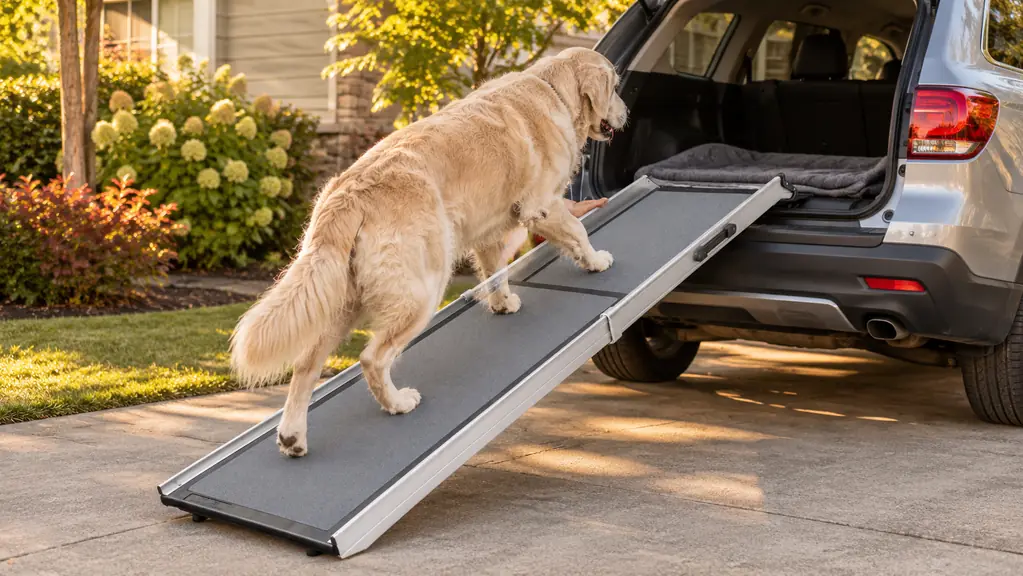
The ramp telescopes from 39 inches to 72 inches, which is how one ramp covers a sedan trunk, a minivan, and the taller tailgate of an SUV. Set the length once, before you bring the dog out, so that the first time he sees it the thing is already still and finished and not sliding around in your hands.
Longer is gentler. On my SUV, the full 72 inches gives a slope Tucker walks up on his own four feet without a pause. At 39 inches, the same tailgate height turns into a scramble, and a scramble is a hop with extra steps. The entire point of the exercise is to remove the jump from the job, so start long and only shorten it if the space truly demands it.
Check the contact points. The top lip should rest flat against the tailgate or bumper. The rubber feet should be flat on the ground. Push down hard in the middle with your hand: nothing should shift, rock, or slide. The PetSafe ramp carries a 400 pound load capacity and it is 17 inches wide, which is enough room for a dog to walk up without his feet hunting for an edge.
The whole thing is aluminum and weighs about fifteen pounds. That number matters more than it sounds like it does, because you will move it twice a day, every day, and a ramp that is a chore to set up is a ramp that stays in the garage. I can carry it one-handed with a leash in the other, which is the only test that counts.
Step 3: Teach the ramp on the ground first, no car involved
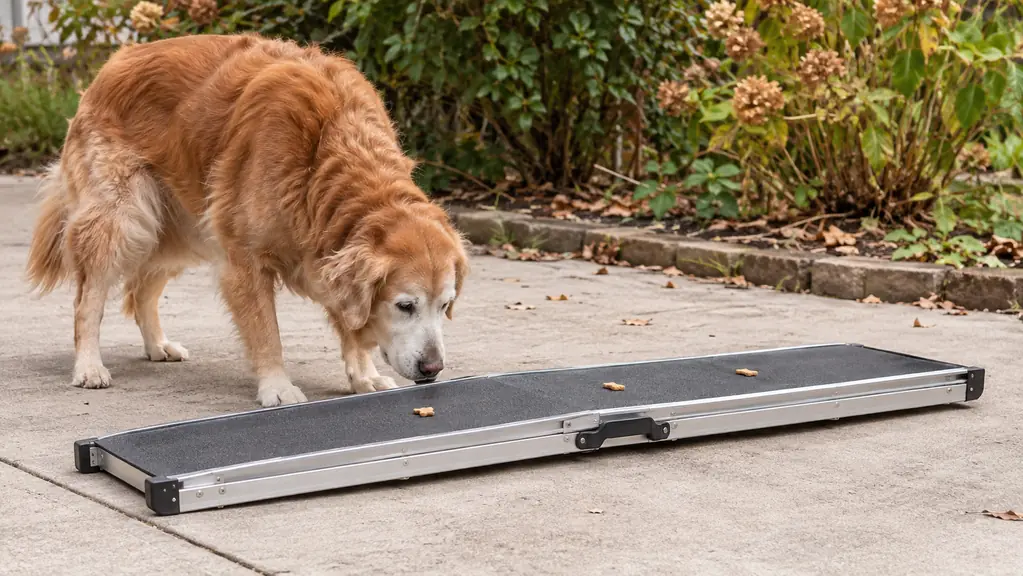
Lay the ramp flat on the driveway, collapsed, and let him sniff it. Do not coax, and do not stand at the far end calling him. A ramp lying on the ground is just an odd flat object, and odd flat objects get sniffed and then ignored, which is exactly the reaction you want.
Then put treats on it. Not at the end of it. On it. Small ones, spaced a foot apart, so his nose has a reason to travel the length of the high-traction surface. This is where the decision gets made, and the decision gets made through the feet. Aluminum makes a low hollow note under a paw, and some dogs dislike that note more than they dislike the height. Tucker did.
Keep the first session under two minutes and end it while he still wants more. I did three short sessions over a weekend before the ramp ever touched my SUV. That weekend is the whole difference between a dog who walks up a ramp and a dog who is placed on one and quietly tolerates it for the rest of his life.
If he will not put a paw on it, back up. Treats just off the edge first, then on the edge, then one front foot, then two. Three days is normal. Two weeks is also normal. There is no prize for speed here, and a dog who gets rushed at this stage is a dog you will be lifting again next month.
One thing I would not do is drape a towel or a piece of carpet over the surface at this stage. The ramp is already made to grip, and a loose towel bunches up under a paw and turns a steady surface into a sliding one.
Step 4: Walk beside him, hand low on the rail, and never push
Attach the ramp, set the length, then walk up alongside your dog instead of behind him. My hand goes on the side rail, low, level with his shoulder. Not on his back. Not on his hips. A hand on the hips of a stiff dog tells him to brace, and a braced dog stops moving forward and starts leaning back.
Keep your body slightly ahead of his shoulder so he is following you rather than being driven. Hold the treat level with his nose, just in front of it, never up above his head, because reaching up shifts his weight backward on a slope, and backward weight is how a dog decides the ramp was a mistake.
If he stops halfway, you stop. Stand still and let him think. The temptation to boost is enormous, and a boost teaches him that the ramp is a thing that happens to him. If he will not take the top lip, put the treat on the cargo floor itself instead of in your hand, so that he has to commit a front foot to reach it.
Use a harness with a handle and a short leash for the first couple of weeks. A collar pulls a dog's head sideways at the precise moment he is trying to judge a slope, and it gives you nothing to hold that is not his neck.
Two weeks in, Tucker was walking up on his own while I carried nothing but a cup of coffee. It was not a training triumph. It was repetition, and the same hand in the same place on the same rail, at the same time every morning.
Step 5: Same order every time, and add the engine last
Dogs learn sequence faster than they learn commands. My order never changes: ramp out of the back, feet flat on the pavement, length set, top lip on the tailgate, hand on the rail, dog. Same spot in the driveway, same side of the car. By about the tenth repetition he was waiting at the base of the ramp instead of at the bumper.
Do not add the departure until the loading itself is calm and boring. Then add the engine starting with no driving. Then a drive around the block with no destination. Then something that actually matters, like the vet, and only once the first four are dull. Skip ahead and you get one bad morning that undoes a month.
The mistake I made first was running this whole routine on a morning when I was already late for an appointment. Everything that was calm on a Saturday fell apart on a Tuesday. If you take one thing from this article, take that one: build the habit on a day when the schedule has slack in it, not on the day you need it to work.
Where the ramp lives matters too. Mine stands collapsed against the garage wall next to the door, which means it is the first thing I touch and the last thing I put away. I have never once talked myself out of using it, because it was never buried behind anything. That sounds small. It is the reason the habit stuck.
What Else Helps
The ramp solves one height. It does not solve the tile floor in the hallway, the two steps down to the lanai, or the way a stiff dog on a slippery surface takes shorter and shorter strides until he is shuffling. A couple of inexpensive runners through the main rooms did more for Tucker's walking last year than anything else I bought.
Talk to your vet before you change his exercise or start him on anything at all. I am a retired newspaper photographer, not a veterinarian, and I have no business telling you what to put in your dog's bowl. What I can tell you is the question my vet asked me at the last visit, which was whether Tucker was reluctant to start the walk or reluctant to finish it. The answer changes what you do next, and it is worth writing down before you go in.
Nails matter more than people expect. Long nails on a hard surface change how a dog stands, and a dog who cannot get his pads flat is a dog who will not use a ramp well either. The technician at my vet's office showed me the sound to listen for on the tile, and once you have heard it you cannot unhear it.
And if a ramp turns out not to be right for your car, or your dog simply will not accept it, stairs are the usual alternative. They suit some tailgates and not others, mostly because of how much floor space they eat up when you are parked in a full lot. I compared the two side by side, and the honest answer is that it depends on the height of your tailgate and how much room you have to swing the door open.
Six feet of aluminum between the bumper and the driveway. That is the whole difference between a walk and a scramble.
Build the habit this Saturday, not on the morning you are already late
Ramp out, feet flat, length set, hand on the rail, dog. That is the entire routine, and it takes about ninety seconds once your dog knows it. Tucker loads himself now. Yours can too.
Amazon Check Today's Price on Amazon →