
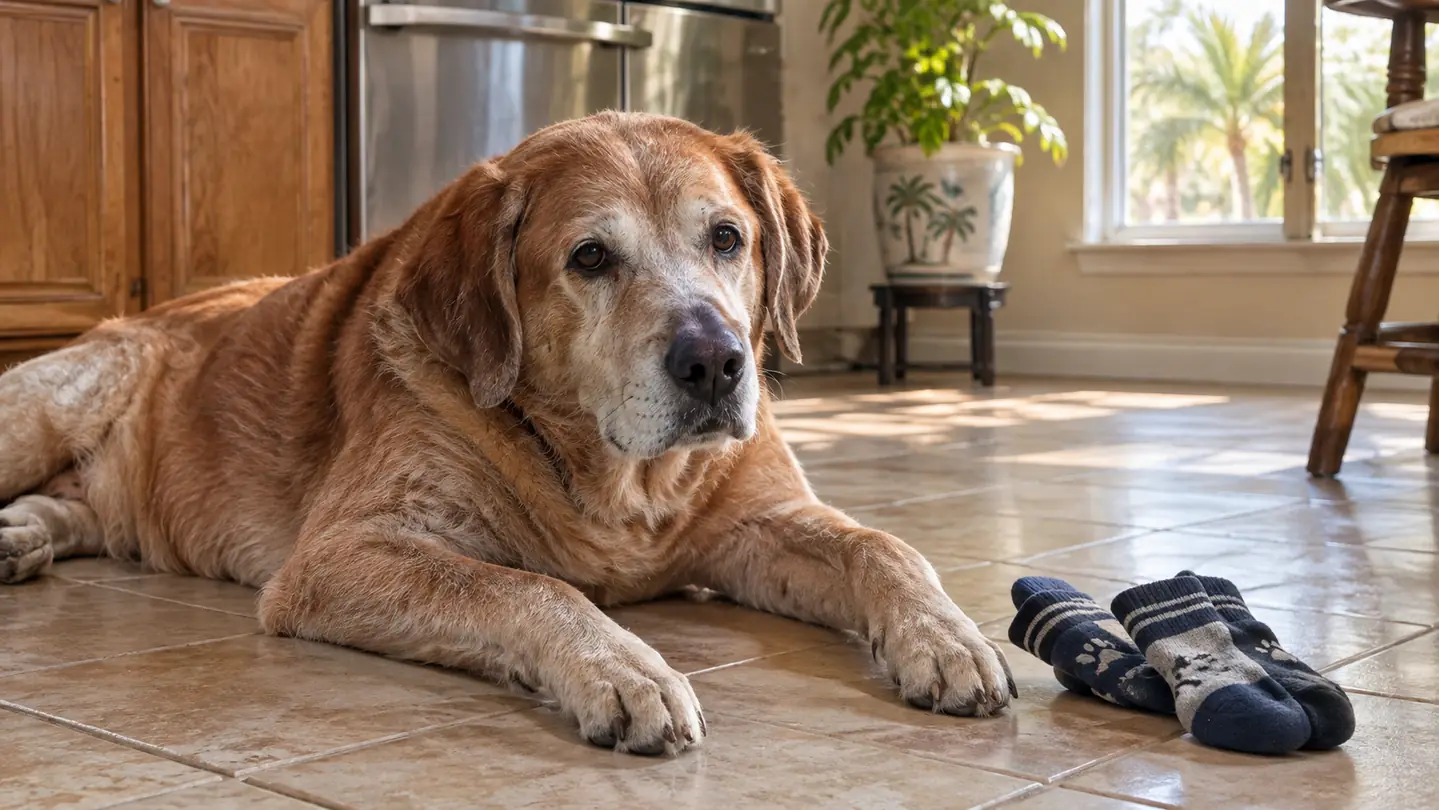
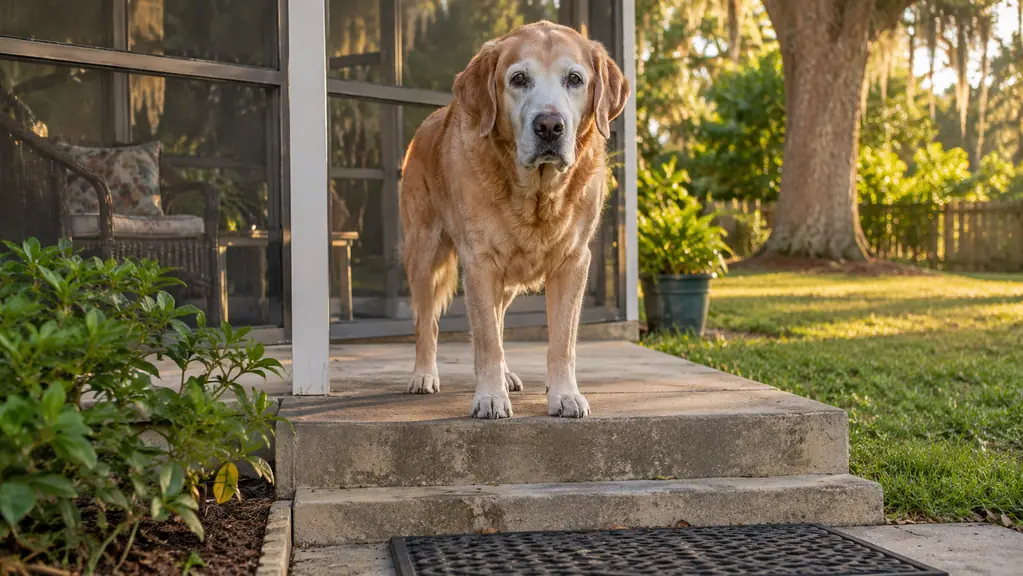
Tucker is eleven, sixty-eight pounds, and a yellow Labrador mix who used to take the two porch steps at a trot. Now he stands at the top, looks down, and thinks about it. That pause is what sent me looking for something to put on his feet. I bought a pack of DOK TigerToes dog socks the way most people do: skeptical, a little embarrassed, and hoping I would not have to explain the purchase to anyone.
I am sixty-six and retired from twenty-nine years of daily newspaper photography, which means I spent a career watching bodies move and noticing the moment they stopped moving well. It also means I have no veterinary training whatsoever. Everything below is one owner's observation on one dog in one house with tile in every main room, and you should run any change to your senior dog's routine past your vet first. With that said, here is the honest version, including the parts that annoyed me.
The Quick Verdict
Real traction on hard flooring and a strap that keeps the sock where you put it. The large size only fits a paw measuring 2.5 to 2.8 inches, and you will be washing them more often than you expect.
Amazon Check Today's Price →If your dog is bracing at the top of the stairs, this is the first thing I would try
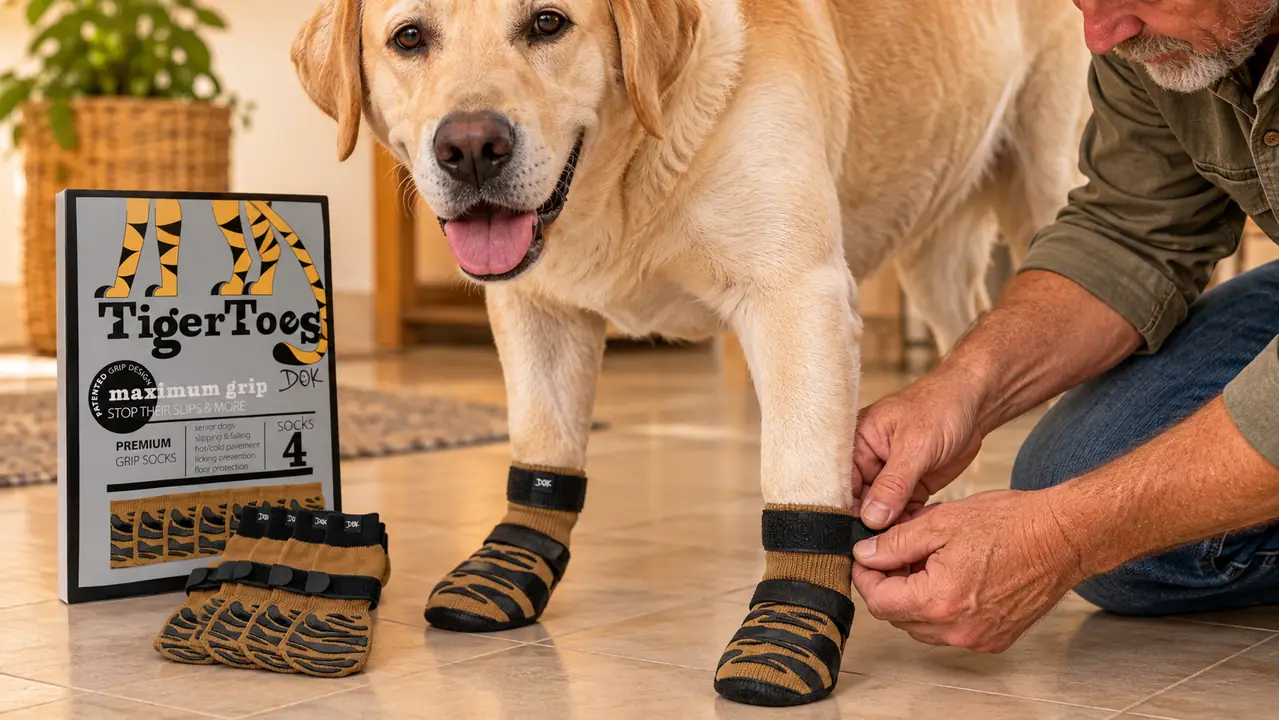
DOK TigerToes come four to a pack in a large size built for a 2.5 to 2.8 inch paw width. The hook and loop strap closes across the top of the foot, and that strap is the part that decides whether you get a tool or a floor decoration.
Amazon Check Today's Price on Amazon →What Nobody Tells You Before You Buy Dog Socks
The first thing nobody tells you is that dog socks are not a footwear purchase. They are a management purchase. You are not buying something your dog wears all day, every day, the way he wears a collar. You are buying a tool you put on for the twenty minutes he is on the slippery floor and take off before he heads outside. The people leaving one-star reviews are usually people who put them on at seven in the morning and expected them to survive a yard, a walk, and an afternoon nap. That is not what they are for and it is not what these are built to do.
The second thing is that a sock without a strap is a sock you will find under the couch. Every dog I have ever met can remove a plain tube sock in under a minute, and Tucker is not even a determined dog. The DOK TigerToes have a hook and loop strap that closes over the top of the foot, and that single detail is the difference between a product and a joke. I want to be clear that the grip is not the hard part to get right. Keeping the sock on the foot is the hard part, and this is the one place where the design clearly thought about it.
The third thing is that the sizing is not forgiving. This is the source of most of the complaints in the listing and the part I want to spend real time on later, because the large size is built around a paw that measures 2.5 to 2.8 inches across. If your dog sits outside that window you are going to have a bad week no matter how well the grip performs. There is no extra large in this line and no adjustment that fakes one.
How I've Used Them on Tucker
Our house has tile in the kitchen, the hall, and both bathrooms. That is the whole main floor. On a good day it is cool and easy to clean. For a sixty-eight pound dog with stiff back legs, it is a skating rink. Tucker's problem was never walking on carpet. It was the moment he stood up from his bed, took two steps onto tile, and his hind feet went out from under him. He would catch himself, look startled, and then walk flat footed and tense for the next ten minutes.
The first week I put the socks on him only in the kitchen, for the ten minutes while I made dinner. He did the high step walk that every dog does the first time something is on their feet, lifting each leg higher than necessary like he was marching in a parade. That lasted about two days. By the third evening he was walking normally and, more important, he was turning on the tile without that little hesitation before the turn.
Now it is part of the routine twice a day. He gets the socks in the morning between his bed and the back door, because the hall is tile and he is stiffest right after waking. That is the window where he used to slip. I put them on while he is still lying down, which he tolerates, and take them off once he is out on the lanai. Then in the evening he gets them again before his dusk walk, because the last stretch is our driveway and the porch landing. Roughly forty minutes a day total.
That is the honest usage pattern, and I think it is the right one. If you are imagining a dog padding around the house in socks all day like a small person, adjust the picture. The point is to get him across the slippery stretch safely, not to keep him in them permanently. Two on-and-off cycles a day, four socks each time, and I have gotten quick at it. It takes me about a minute for the set.
The socks did not fix his hips. What they fixed was the flinch. He stopped bracing before he turned, and that changed how much he was willing to move.
The Grip Question: What Three Times More Traction Feels Like
DOK describes the grip as three times more traction, engineered so it still works if the sock twists on the foot. That last clause matters more than the number. Any sock will rotate. A dog's foot is not shaped like a human foot and the sock will migrate as he walks. The real question is what happens after it does. On the pair I have, the grip is placed so that when the sock turns, there is still grip material touching the tile rather than a smooth panel sliding underneath him.
On the tile I could feel the difference before I trusted it. The first test I ran was the one that scared me most, which is Tucker standing up from his bed on the kitchen floor. He used to scramble for a half second, back feet paddling, before he got his weight over them. Now he pushes up and stays up. It is not dramatic to watch. It is the absence of a bad moment, and with an old dog that is exactly the improvement you are hoping for.
The porch steps are the other test, and here the honest answer is that the socks help on the landing but they are not a substitute for a ramp or a mat at the bottom. He still hesitates at the top step. What changed is that he does not slide on the concrete landing once he is down. I put a rubber mat there as well, and the two together did more than either one alone. Anyone telling you a sock solves a staircase is selling you something.
What I Liked
- The hook and loop strap keeps the sock on through a normal evening, not just long enough for a photograph
- Grip is positioned so a twisted sock still has traction on tile
- Four socks per pack means a spare set while one is in the wash
- Machine washable cotton and nylon blend that has not stiffened after nine cycles
- Built with older dogs in mind, and it shows in how the top of the sock is cut
Where It Falls Short
- The sizing window is narrow at 2.5 to 2.8 inches and there is no extra large
- They are indoor tools, and a rough yard will grind grit into them fast
- A determined dog can still work the strap loose eventually
- You have to put four on and take four off, twice a day, forever
Fit: The Two and a Half to Two Point Eight Inch Window
Measure the paw. Not the whole foot and not the leg. Put the dog's foot flat on a piece of paper, mark the widest part across the pads while he is standing and bearing weight, and read it with a ruler. Tucker measured just over 2.6 inches on his front feet and about 2.5 on his back, which put him comfortably inside the large size. That is why this review is not a sizing complaint, and I want to be upfront that my experience is the best case.
My neighbor's shepherd mix measured 3.1 inches across, and the large size was never going to work for her. If you are over the window, the honest advice is to look at a different product rather than squeeze your dog into these and blame the socks. A sock that is too tight will leave marks around the ankle. A sock that is too loose will twist constantly, and while the grip is designed to cope with twisting, the strap ends up doing work it was not meant to do.
The closure is a hook and loop strap plus a pull-on cuff, so it goes on over the foot rather than being rolled up the leg. If your dog carries thick fur around the ankle, expect the strap to want to catch hair. Trimming that fur a little, or just fastening it slowly and deliberately, solves the problem. The socks themselves are elastic cotton and nylon that stretches, so there is a small amount of give in the fabric even though the size range is fixed.
Wear After Six Weeks of Daily Use
Six weeks, roughly forty minutes a day, and they have been through the wash nine times. I run them in a mesh bag on a normal cycle and let them air dry, which the care instructions do not require but is a habit from decades of washing camera bags. The cotton and nylon blend has not stiffened. The elastic has not gone slack. The straps still close with a firm grip. The grip material has visibly smoothed on the two socks that see the most wear, but they still hold on the tile.
What I do not expect is for one pack to last a year. These are cloth goods living on a floor. The reason four socks come in the pack is that you rotate them and you have a spare while one set is drying. If you buy a single pack and expect it to survive an entire winter of daily use without visible wear, you will be disappointed, and that is less a fault in the product than a mismatch in expectations.
One thing surprised me. The socks also cut down on the licking. Tucker had been worrying at his back paws in the evenings, which is common in older dogs with sore joints, and there is something about having the paws covered that interrupts the habit. DOK lists paw licking among the recommended uses and I can see why. It is not a cure for anything. It is a barrier, and sometimes a barrier is enough to break the loop for an hour.
The limitation is the yard. I tried them outside exactly once. The screened lanai is fine and the driveway concrete is fine, but the moment he stepped onto the shell and dirt of the yard, the socks picked up grit and I could hear it grinding against the fabric. These are for hard, smooth indoor floors. If your dog needs traction in the yard or on a walk, you need boots, not socks, and no amount of careful washing brings a sock back from a week of gravel.
What the Four Point Two Rating Is Really About
The listing shows a 4.2 average across more than fourteen thousand reviews, and after owning a pair I think I know what that number is made of. The positive reviews are almost all about the same thing: an older dog who stopped sliding. The negative reviews cluster around two issues, fit and temperament. Either the paw was outside the size window, or the dog would not tolerate anything on his feet. Both of those are real. Neither one is about the grip failing to do its job.
I read a long stretch of the low reviews before I bought, which is a habit left over from the newspaper business. The pattern held. Almost none of it was about the product performing badly. It was about measuring, or about a dog who fights the process. That is the most useful thing I can pass along: know your dog's actual measurement and know whether he will stand for something on his feet, and the rating stops being mysterious.
The Two Things I'd Change
First, I would widen the size range. One large size covering 2.5 to 2.8 inches leaves out a lot of big dogs, and the reviews make that plain. Second, I would print the measuring instructions on the outside of the package. Half the fit complaints I read could be prevented by a line drawing of a paw on a piece of paper with an arrow across the widest part. The product is good enough that poor measuring is doing it real commercial damage.
What I would not change is the strap. It is the reason these work at all, and it is the reason I stopped finding socks under the furniture after the first week. It is also the part that made me stop feeling foolish about the whole idea. A tool that stays where you put it is a tool you will actually use twice a day, and twice a day is what an old dog needs.
Who This Is For
This is for the owner of an older, larger dog who lives in a house with hard flooring and who has watched that dog hesitate, slip, or scramble to stand up. It is for someone willing to spend a minute putting four socks on and taking them off twice a day, because the alternative is a dog who quietly stops moving. It is for the owner whose dog is licking at sore paws in the evening. And it is for people like me who would rather try a modest tool before rearranging the entire house. Though I did buy a mat as well, and you probably will too.
Who Should Skip It
Skip it if your dog's paw measures outside 2.5 to 2.8 inches across, because the fit is not adjustable enough to fake it and the strap will not save you. Skip it if you want something the dog wears all day while you are at work, because that is not what these are and you will come home to socks scattered across the floor. Skip it if your dog is a chewer who goes after anything on his own feet. Skip it if the real problem is the staircase, because a sock does not fix stairs and a ramp or a gate is the safer answer. And skip it if you are looking for a treatment for arthritis, because this is footwear, not medicine, and Tucker's comfort plan still runs through our vet before anything else.
Honest bottom line: a real fix for tile, and nothing more than that
If your dog measures inside the 2.5 to 2.8 inch large size and your floors are hard, these are the most useful change in our daily routine. Four socks, a strap that holds, and grip that still bites after the sock twists. Measure the paw first, and talk to your vet about the rest.
Amazon Check Today's Price on Amazon →