
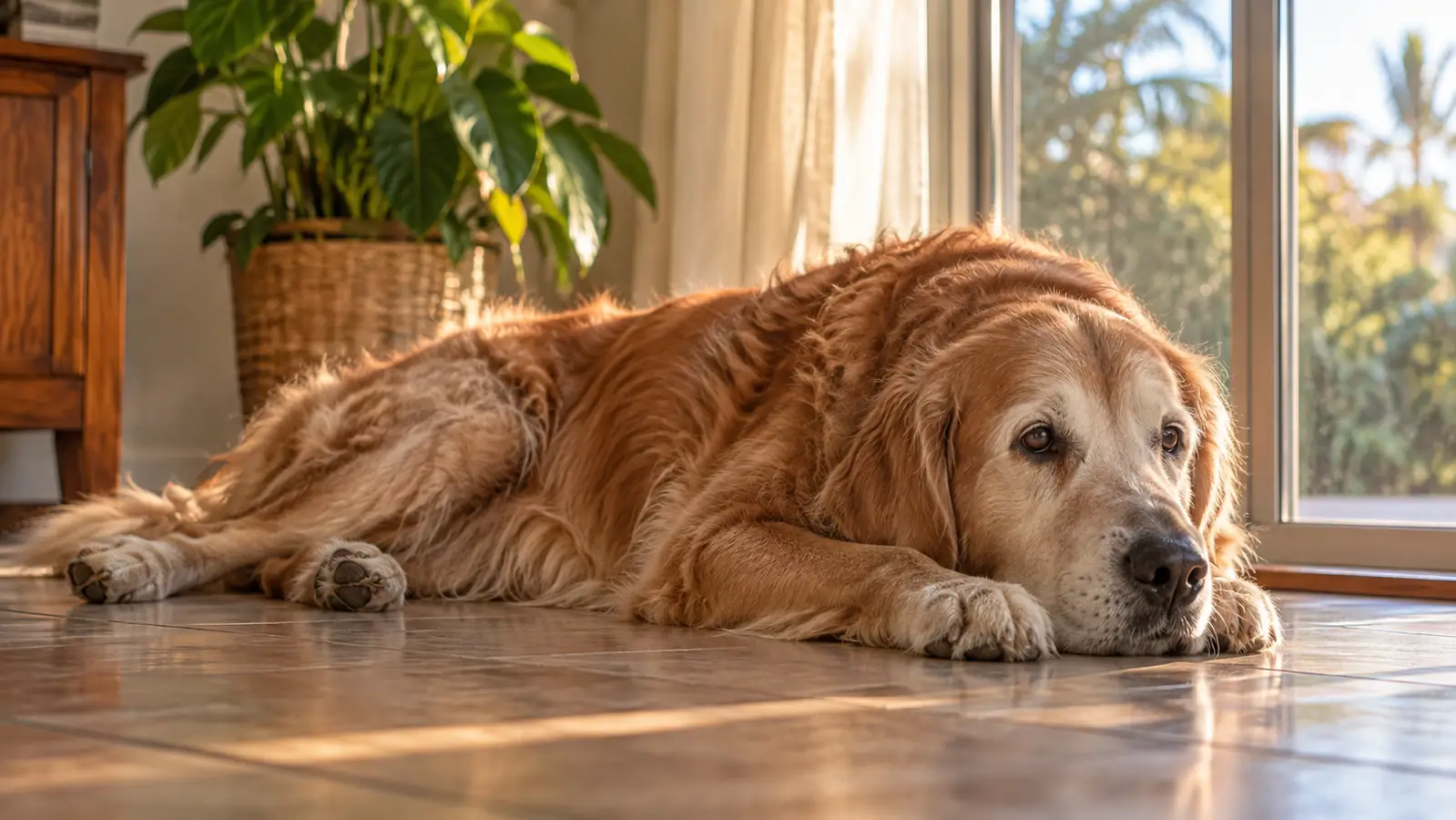
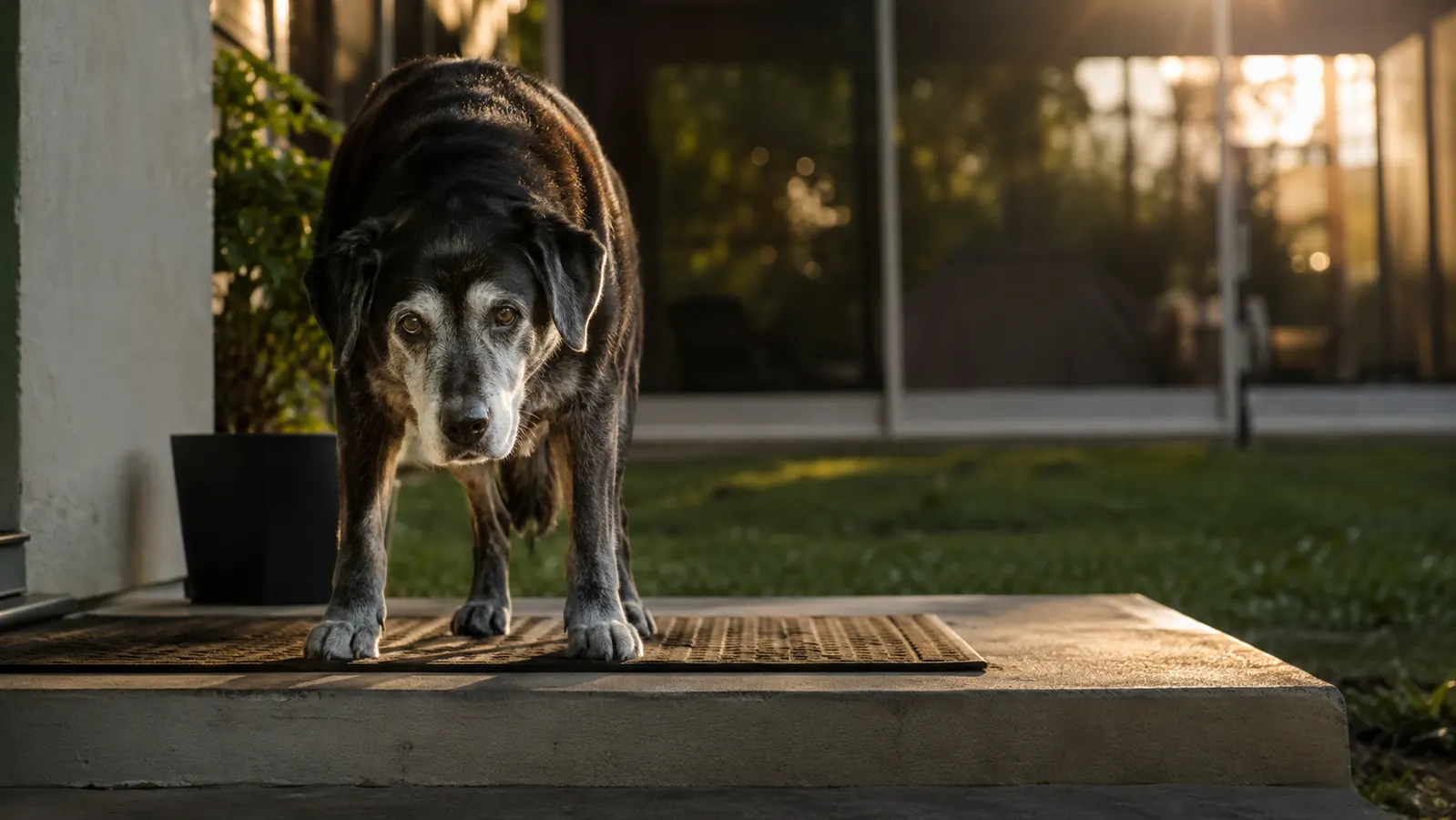
Tucker started stopping on the lanai steps last spring. Not falling, not yelping, not doing anything a stranger would notice. He would put his front paws on the first step, stand there a second, and then hop up with a small grunt that had not been part of his vocabulary before. Two shallow steps down to the yard. He had taken them at a run for a decade.
He is 11 now, a yellow Labrador mix, about 68 pounds, and stiff in the back legs after a nap and on cool mornings. That pause at the steps is what sent me looking. What I found, after a vet visit, a lot of reading, and about eight months of paying attention, is that easing a senior dog's stiffness is not one thing. It is a stack of small things, and a joint supplement is one plank in that stack, not the whole deck. The one I settled on is Nutramax Laboratories Cosequin Maximum Strength, a tablet with glucosamine hydrochloride, sodium chondroitin sulfate, and MSM in it. This is the order I would do it in if I had to start over.
Before that, I did what most people do. I bought a bottle off a shelf because the label had a picture of a happy dog on it. I cut our walks short, which made him stiffer. I told myself he was just getting old, which is true and also useless. None of that was a plan. What follows is.
The tablet my vet named first, and the one that stayed on the counter
Cosequin is the retail joint health supplement brand veterinarians recommend most often. It will not rebuild a joint. It gives you something steady to build the rest of the routine around.
Amazon Check Today's Price on Amazon →None of this is dramatic or expensive. It is mostly paying attention, which is the one thing a retired photographer has in surplus.
Step 1: Get a diagnosis before you buy anything
Stiffness in an 11-year-old Lab is not a diagnosis. It is a description. The same slow rise after a nap can come from hip arthritis, from a cruciate strain, from a sore back, or from a dog who simply slept nine hours on a hard floor. Some of those get better with a supplement and a sensible routine. One of them gets worse if you exercise it wrong.
So step one is a vet exam, not a purchase. I asked for a hands-on orthopedic check and I asked a plain question: what are we actually dealing with? The answer changed what I bought and, more usefully, what I stopped doing. A dog with a disc problem and a dog with hip arthritis need different exercise, and no tablet on earth fixes a wrong exercise plan.
The exam itself took about forty minutes. She walked him down the hallway, watched him turn, ran a hand down each back leg, and flexed each hip slowly while I watched his ears for the tell. Then she drew a small diagram on the back of a receipt and showed me which joint she thought was doing the talking. That receipt is still on my refrigerator, and it is the reason I stopped letting him launch himself off the tailgate.
Ask your vet before starting any supplement, including this one, especially if your dog takes other medication or has kidney or liver issues. I am not a veterinarian. I am a woman with one dog, a camera, and a habit of writing things down. The vet gets to make the call. I get to report what I saw.
Step 2: Start the supplement with a schedule, not a shrug
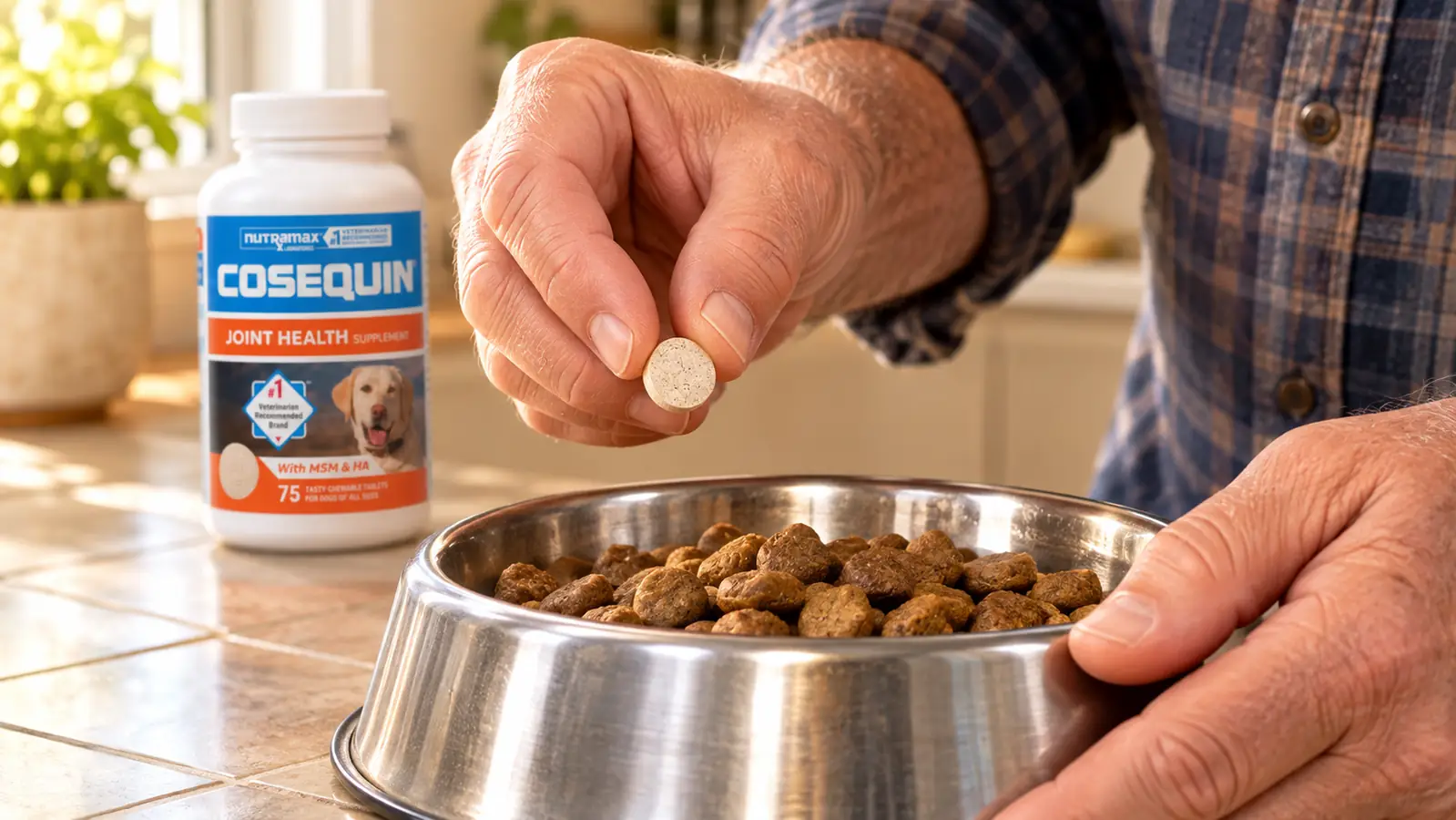
Cosequin Maximum Strength comes as a tablet. The label gives directions by weight, and the starting amount is usually higher than the amount you settle into, so read it twice before you build a habit around it. I weigh Tucker on the vet's scale every couple of months, because 68 pounds can drift to 72 without anybody noticing.
What is in the tablet, per the label: glucosamine hydrochloride at 600 mg, sodium chondroitin sulfate at 300 mg, and MSM. Nutramax Laboratories has been in pet health for over 25 years, and Cosequin is the retail joint health supplement brand veterinarians recommend most often. That is not a guarantee it will work on your dog. It is a reason to start with something that has a track record instead of a bottle with a cartoon on it.
Give it with food, at the same time every day, and keep it where you will see it. Mine lives next to the kibble scoop. A supplement in a cupboard gets skipped. Tucker takes his in a smear of peanut butter, which is a bribe, but a reliable one. Do not judge it in week one. Four to six weeks is the honest window, and some dogs take longer than that.
One more thing. Write the start date on the lid with a marker. When your vet asks how long he has been on it, you will not be guessing, and you will not be rebuilding the timeline from memory in a small exam room.
Step 3: Fix the floor before you fix the dog
Our house has tile through the main rooms, and for a dog with sore hips it is a skating rink. Old dogs do not fall because they are clumsy. They fall because a back foot loses grip and the front end cannot correct in time. I put a runner down the hallway and two washable mats at the corners where he turns.
The runner is twelve feet long and cost less than a decent lunch. I laid it from the kitchen doorway to the back hall, because that is the stretch where he carries some momentum and where a slip would be worst. The two mats are machine washable, one at the corner by the sofa and one at the lanai door, because an old dog leaks a little sometimes and a mat you cannot wash becomes a mat you throw away.
Then the lanai steps. I put a rubber mat on the top step and started letting him take them one at a time with a hand near his harness, not on it. Trimming his nails short helps more than people expect, because a long nail lifts the paw off the ground and takes the grip with it.
If your dog rides in a small SUV, a folding ramp is worth more than any bottle on the shelf. The tailgate sits at Tucker's chest height and he had been jumping down onto concrete for years. Now he walks up and back down a ramp, and the hesitation at the back of the car faded in about three weeks. That was not the supplement. That was the ramp.
Step 4: Change the exercise, not the amount
The instinct when a dog stiffens is to rest him. Total rest makes an old dog stiffer. What helped Tucker was the same amount of movement broken into smaller pieces: two short walks instead of one long one, morning before the Florida heat settles in, and again at dusk when the pavement has cooled.
Our morning loop is fourteen minutes by the clock, and the evening one runs closer to twenty because the air is softer and he stops to read everything. In June I combined them into a single thirty-five minute walk to save myself the second trip out the door. He came home, lay down on the tile, and did not get up for the rest of the afternoon. I have not done that since.
The first five minutes are the warm-up, not the workout. We start slow and flat and let him set the pace, and he gets to stop and sniff, which slows him down enough that his body catches up with his enthusiasm. I stopped throwing the ball high. A Lab will launch himself for a ball long after his joints have voted no.
If your vet clears it, add a little strength work. Three or four times a week I ask Tucker to stand, take one slow step over a broom handle laid on the floor, and step back. We quit while he still thinks it is a game. Two minutes is plenty. Six is too many.
Step 5: Keep a record, because memory lies
This is the step I would have skipped if I had not spent 29 years behind a camera. My memory of how Tucker moved in March is not footage. It is an impression, and impressions drift toward whatever I am hoping for.
So once a week I put my phone on the floor at his level and record thirty seconds: him getting up from his bed, walking to the door, and taking the two lanai steps. Same day, same route, same time of day. Thirty seconds of video settles arguments that a written log cannot.
I keep those clips in a folder labeled with his name and the month, so putting March next to May takes a second instead of a search. The first time I compared two of them I thought nothing had changed at all. Played back to back, the difference in how fast his back end came up off the bed was plain as a headline.
The log itself is three lines. How long it takes him to rise after a nap. Whether he pauses at the steps. How he carries his back end on the evening walk. Then review the whole thing at six weeks, not at six days, because this moves too slowly for daily inspection to tell you anything except how you feel that particular morning.
Six weeks in, he took the two lanai steps without that pause. That was the entire scorecard, and it was enough.
What Else Helps
The biggest lever after the vet visit is weight, and nobody sells it. Every extra pound is load carried by the same sore joints. Taking three pounds off a 68-pound dog did more for Tucker's morning rise than anything else I changed, and the only expense was measuring his kibble with a real cup instead of eyeballing it.
Cold stiffens old joints. He sleeps on a thick orthopedic bed in whatever room I am in, not on the tile where he used to flop down. On the two or three genuinely cool mornings we get in January, I rub his back end with warm hands before we go out the door. It sounds like nothing. He walks out looser.
What I would skip: anything sold to me rather than to him. A bottle with a picture of a wolf on it and no ingredient amounts. A chew that promises to rebuild cartilage. If a label will not tell you the milligrams, put it back on the shelf. Nutramax Laboratories prints the amounts on the Cosequin label, which is a low bar that a surprising number of products still fail.
And keep the vet recheck on the calendar. Six months out we went back, and the exam told us the routine was holding. If it had not been holding, that visit was where we would have caught it, not in a video on my phone.
What This Routine Will Not Do
It will not make an 11-year-old dog into a two-year-old dog. Tucker still takes a moment to rise after a long nap, and he still prefers the flat route to the one with the hill. What changed is the size of the moment. It went from a hesitation I noticed to a motion I no longer think about.
It will not replace your vet, and it will not work on a dog whose real problem is a torn ligament or a disc. That is why step one exists. A supplement given to a dog with an untreated injury is a delay dressed up as progress, and delays are the one thing an old dog does not have in surplus.
If your dog is pausing at the steps, this is where I would start
The mats and the shorter walks are free. The tablet is the part you buy, and Nutramax Laboratories Cosequin is the one my vet named first.
Amazon Check Today's Price on Amazon →