
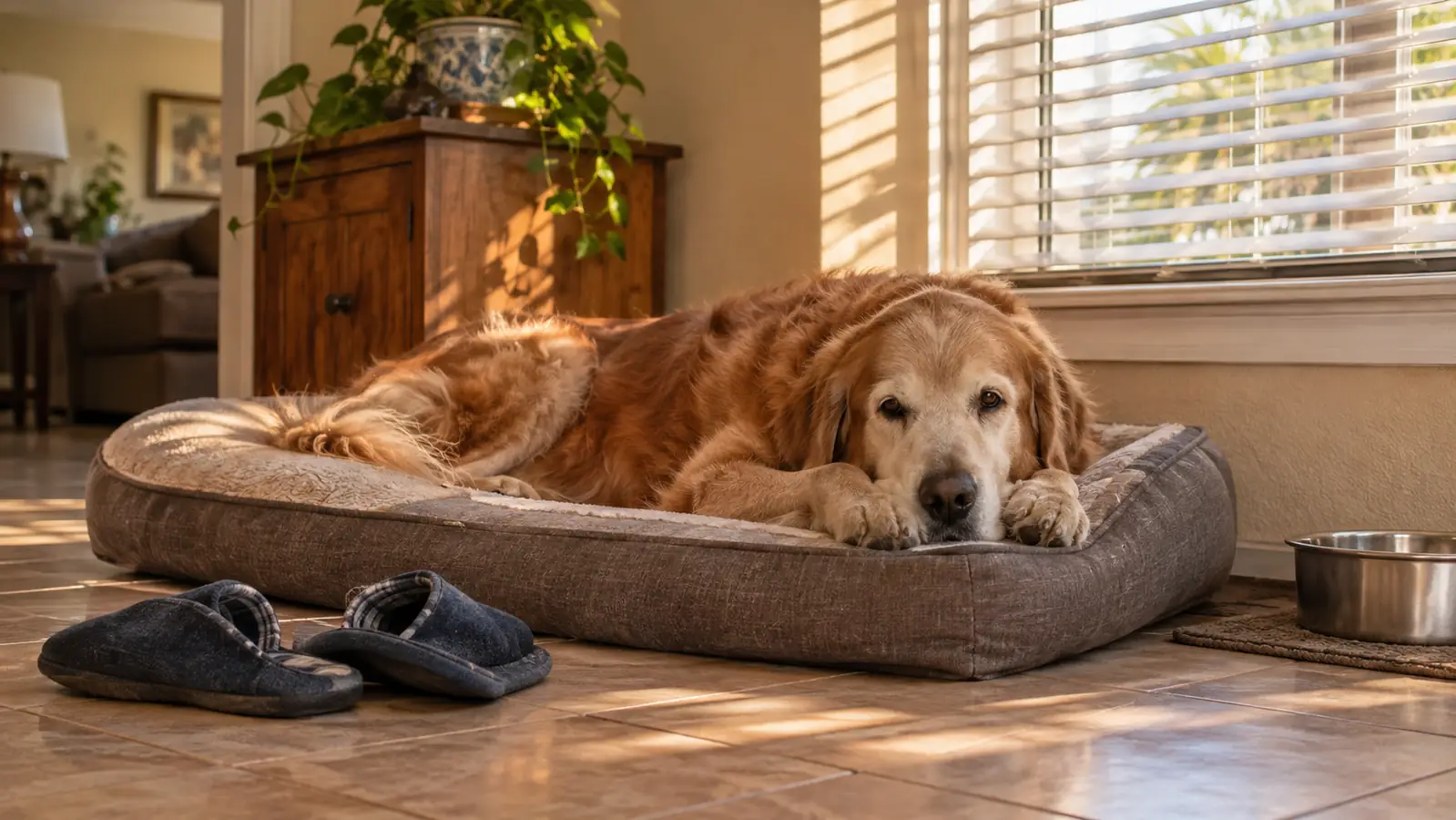
Tucker started hesitating at the two steps down from the lanai last spring. Not refusing them. Hesitating. One front paw out, a pause, then a careful commit, like a man stepping onto ice he doesn't trust. He's an 11-year-old yellow Labrador mix, about 68 pounds, and until that spring he took those steps at a trot. I'd been through three dog beds in four years, all of them flat within a season, and I was not in the mood to be sold a fourth. The Bedsure orthopedic dog bed was the fourth. It has been on my bedroom floor for months now, under him every night, and this is what I actually think of it.
I'm not a veterinarian. I spent 29 years as a newspaper photographer, which mostly taught me to watch how bodies move and to distrust a good first impression. So what follows is a household report, not medical advice. If your dog is stiff, get a diagnosis first. Then come back and read about the bed.
The Quick Verdict
A genuinely supportive bed for a stiff older dog, with a foam core that hasn't flattened after months. The soft bolster is the part you'll have an opinion about.
Amazon Check Today's Price →The bed an old dog actually chooses at nine o'clock
Orthopedic egg-crate foam, a bolster on all four sides, and a cover that comes off for the wash. Check the size chart before you order.
Amazon Check Today's Price on Amazon →How I've Used It
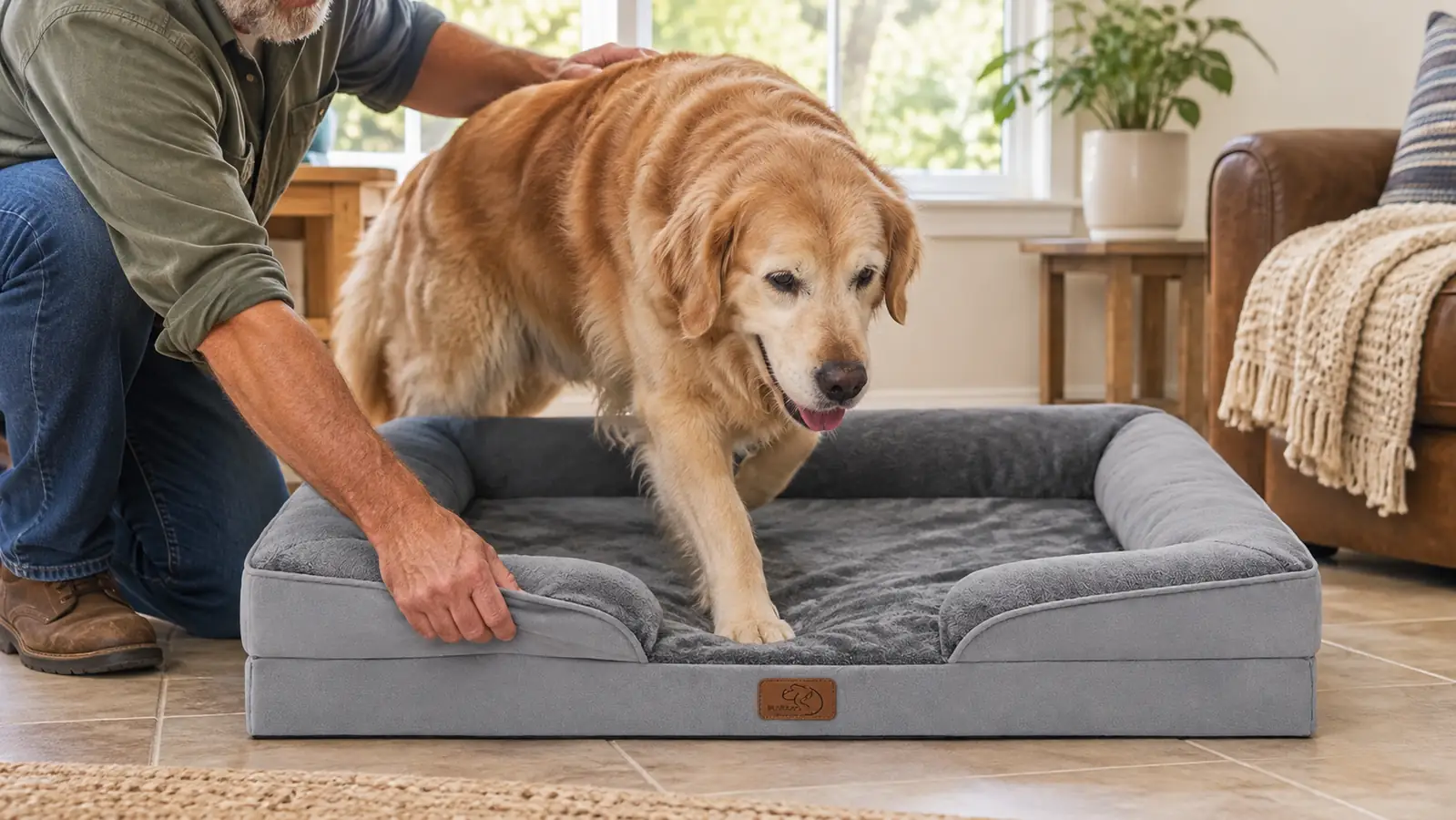
The bed sits on the tile floor beside my side of the bed, which is where he wants to be and where I want him. I ordered the large, listed at 35 by 7 by 25 inches and a little over five pounds, rectangular, with bolsters on all four sides. It's light enough that I move it myself when I vacuum, and the front is low enough that he steps into it rather than over anything. That last part mattered more than I expected. A bed with a high wall is a bed an old dog quietly stops using.
I measured him before I ordered, which took two tries. The first time I measured him standing, which told me nothing useful, because a standing dog is barely half the length of a stretched-out one. The second time I waited until he was flat on the tile in the afternoon heat and ran a tape from his nose to the base of his tail. That number, plus a few inches of margin, is how I landed on the 35 by 25. The first night he stood in the doorway and looked at the thing for a while before he committed to it. By the third night he was in it before I had the lamp off.
For the first two weeks he circled it. He'd been sleeping on a flat polyester pad that had gone down to about the thickness of a folded towel, and he had a habit of pawing at it for a full minute before lying down. With this one the pawing dropped to a few turns within about ten days. I don't know what that means clinically. I know what it looked like, which was a dog who found his spot faster and stopped editing himself.
Nothing dramatic happened. That is the report. He gets up, he goes out, he comes back in and eats. What changed is the getting up. For most of last year the first three or four steps after a nap were short and careful, back legs stiff, and he'd sort of gather himself before we started the morning walk. Now the gather takes less time. Some mornings there isn't one at all. He's eleven. He is not going to trot again. But the mornings are easier, and easier mornings are the whole point of buying one of these.
What the Egg-Crate Foam Actually Does for an Old Dog's Hips
The core is polyurethane egg-crate foam, which is a plain name for foam molded into a grid of bumps and valleys. You have probably seen the same material in a mattress topper. The reason for the shape is that it gives in small spots instead of one large one, so a hip or an elbow sinks a little rather than resting on a flat plane. For a dog carrying 68 pounds on joints that have been carrying it for eleven years, that difference isn't cosmetic. It's the difference between a surface that pushes back and a surface that receives.
The bed he had before was a flat pad. When he lay on it, his weight went straight through to the tile. He might as well have been on the floor with a blanket over it. The Bedsure bed has enough give that his hip settles into the foam instead of pressing against something hard, and enough structure underneath that he isn't touching tile at all. I put my hand under the bed where he lies most, and I can feel the foam taking the load rather than the floor.
I did the hand test more than once, because I wanted to be sure I wasn't talking myself into something. Press a palm flat on the old pad and it bottoms out against the tile almost immediately. Press on this bed and there is give before the foam pushes back, and then it pushes back evenly across the whole hand instead of in one hard spot. That evenness is the trick. A dog's hip is a small, heavy point. A surface that spreads that point over a wider area is a surface that isn't digging into him for eight hours.
Here is the part where I have to be careful. This is a bed, not a treatment. Egg-crate foam is not memory foam, it isn't medication, and it won't reverse anything. What it can do is take the edge off the surface your dog sleeps on for eight or nine hours a night, which is a great many hours to spend on something unforgiving. If your dog is limping, favoring a leg, or having trouble getting up at all, that's a conversation with your vet before it's a conversation with a shopping cart.
Living With It: Tile Floors, Laundry, and That Bolster
My house is single story with tile in the main rooms, which is cool and easy to clean and about as forgiving as a parking lot for an old dog. The bed gives him one reliable soft landing in the room where he spends the night. He gets up less splay-legged than he used to, because he isn't starting from a dead flat surface. That's an observation, not a claim. I've watched him long enough to trust the difference I'm seeing.
The cover comes off. That was the deciding factor for me after the last bed, which went into the wash as one piece and came out as a lumpy slab. On this one the cover unzips and the foam core stays out of the machine. The cover is waterproof, which I tested by accident in February when he came in wet from the yard and lay down before I could get a towel on him. The foam underneath was dry. I've washed the cover a dozen times now and it still zips and still fits the way it did the first week.
Wash day here means stripping the cover, running it on a normal cycle, and hanging it over the lanai rail, which takes most of an afternoon to dry even in a Florida winter. The first time I did it I stood the bare foam core against the hallway wall and Tucker walked past it twice without recognizing it, then lay down on the tile where the bed usually sits. That tells you how much of the appeal lives in the cover and how much in the foam. He was back in it the moment it was zipped up again.
The bolster runs around all four sides, and he uses it as a chin rest more than as a wall. His head hangs over the front edge most nights, which looks uncomfortable to me and clearly isn't to him. The bolster does make the bed warmer, which is a plus for the three weeks of a Florida January and a minus in July, when he sometimes gets up halfway through the night and stretches out on the tile instead. He comes back. He always comes back.
What Held Up Over Months of Nightly Use
The thing I expected to fail has not failed, which is the short version of this Bedsure review. There is no sunken trench where he lies. He's a creature of habit and picks the same quarter of the bed every single night, and after months the foam there is still doing its job. It has softened slightly, the way a good pillow softens, but it hasn't gone flat and the edges haven't collapsed into the middle.
The stitching on the bolster is intact. One seam at the back corner has a little pilling from where he drags himself in, which is cosmetic and not structural. The zipper still runs. The bottom hasn't slid around the tile, which surprised me, since there is nothing grippy about either surface.
I keep a small notebook for the dog, mostly vet notes and weight, and I started jotting a line about the bed each month. Month one: foam firm, bolster still stiff at the seams. Month three: the quarter he sleeps in has softened but not sunk. Month six: the same, plus a little pilling at the back corner where he drags himself in. That is the entire log. Months of nightly use, and the honest summary is that the bed stopped being interesting, which is the highest thing I can say about a piece of dog furniture.
Size is worth a note. The line runs from 20 inches up to 52, nine sizes in all, and the large at 35 by 25 is right for Tucker at 68 pounds with room to sprawl. If your dog is much smaller, the large will look like a swimming pool. If your dog is much bigger, measure him nose to tail while he's stretched out flat and go up a size from your instinct. Nobody has ever regretted a bed that was slightly too big.

Where It Falls Short
The bolster is soft. If your dog leans hard against the side of his bed to push himself up, this one will give under him rather than hold him. It's a pillow, not a rail. Tucker doesn't lean, so it's a non-issue here, but I've watched friends' dogs who do, and those dogs would want something firmer at the edge.
The bed is low to the ground, which is exactly why it works for Tucker and exactly why it won't work for every dog. If yours does better stepping up onto a raised platform, or if you need something high enough to keep him off a cold floor entirely, this isn't that bed. And washing the cover means the bed is out of service for a few hours. I keep an old pad in the closet for wash days, and I'd suggest you plan for the same.
What I'd Check Before You Buy
Measure your dog. Not standing, but stretched out flat, nose to the base of the tail, then add a few inches. That number, not his weight, is what tells you which of the nine sizes to order.
Then watch how he gets into the bed he has now. If he steps in, this one works. If he climbs, or needs to brace against a wall, or circles for five minutes looking for the right spot, think about what he's bracing against and choose accordingly. And ask your vet about the stiffness itself. A bed makes a dog more comfortable. It doesn't tell you why he's stiff.
What I Liked
- The egg-crate foam core has not flattened after months of nightly use under a 68 pound dog
- The cover unzips and washes separately, and the foam stayed dry when he came in wet
- The low front means an old dog steps in instead of climbing over a wall
- A bolster on all four sides gives him something to rest his chin on
- Light enough to slide aside for vacuuming and to reposition
Where It Falls Short
- The bolster is soft and gives under a dog who leans on it to push up
- Too low for a dog who does better on a raised platform
- The cover is out of service for a wash cycle, so you need a backup plan
- Warmer than a flat pad, which he notices in a Florida summer
What changed is the getting up. The first three or four steps after a nap used to be short and careful. Now the gather takes less time, and some mornings there isn't one at all.
Who This Is For
This is for the owner of a big dog who has slowed down but is still getting around. The dog who hesitates at the porch steps. The one who takes a few stiff steps after a nap and then loosens up. The one who sleeps eight hours on a bed that went flat two years ago and nobody replaced it because he never complained about it. If that's your house, this bed is a modest, unglamorous improvement, and you'll notice it in the mornings rather than in the moment you open the box.
It also suits anyone who is tired of beds they can't wash properly. The separate cover is the feature I'd pay attention to if I were buying again, more than the foam, more than the bolster.
Who Should Skip It
Skip it if your dog needs a firm edge to push against, if he's a chewer who goes through covers, or if he's already sleeping well on a raised platform bed that's doing its job. Skip it if the stiffness comes with limping, swelling, or a sudden change in how he moves, because that needs your vet, not a purchase.
And skip it if you want a bed that holds its shape like a piece of furniture. This one is soft by design, and soft is the point.
You are not buying a bed, you are buying easier mornings
The Bedsure orthopedic bed has a foam core that hasn't gone flat and a cover that comes off for the wash. Measure your dog stretched out, then check today's price and the size chart.
Amazon Check Today's Price on Amazon →