
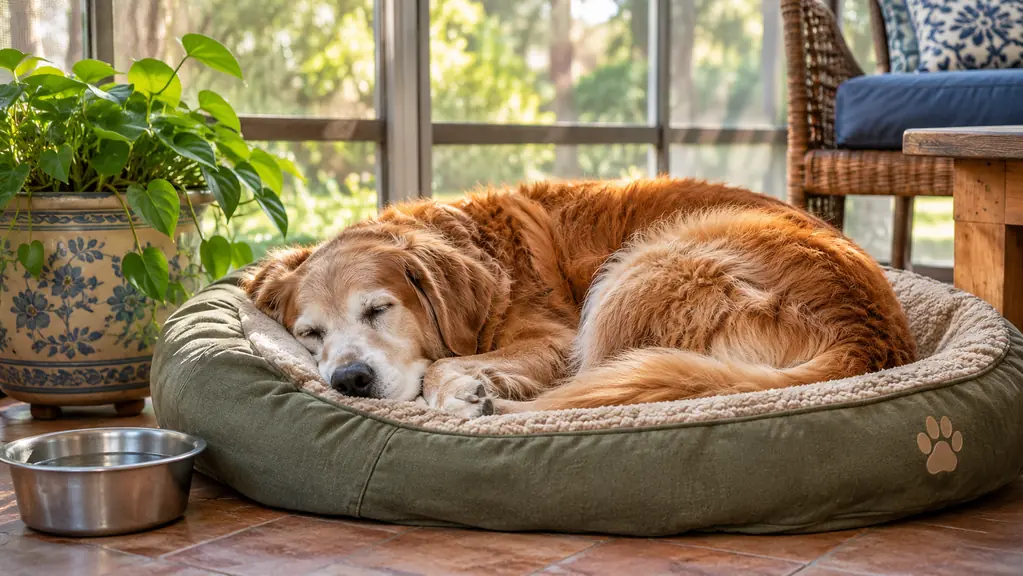
Tucker is eleven, a yellow Lab mix, about sixty-eight pounds, and for most of a decade he followed me from room to room like a shadow with a tail. Last winter he started stopping at the two steps down to the lanai. Not falling. Not yelping. Just stopping, looking at the step, and taking a second to decide. If you live with an older dog, you know that pause. It is not stubbornness. It is a dog doing arithmetic on his own joints.
The Bedsure orthopedic dog bed, the sofa-style design with the four-sided bolster, is what finally worked in this house. But I got to it the long way, by buying two beds that looked plush in a photograph and watching Tucker sleep on the tile beside them. What I learned is that a bed for an arthritic dog is equipment. It has a job: take weight off the elbows, hips and spine, make getting in and out easy, and survive the accidents that come with being old. The bed is the last decision you make. These five steps are how you get there, in the order that actually matters.
The bed he stopped hesitating over
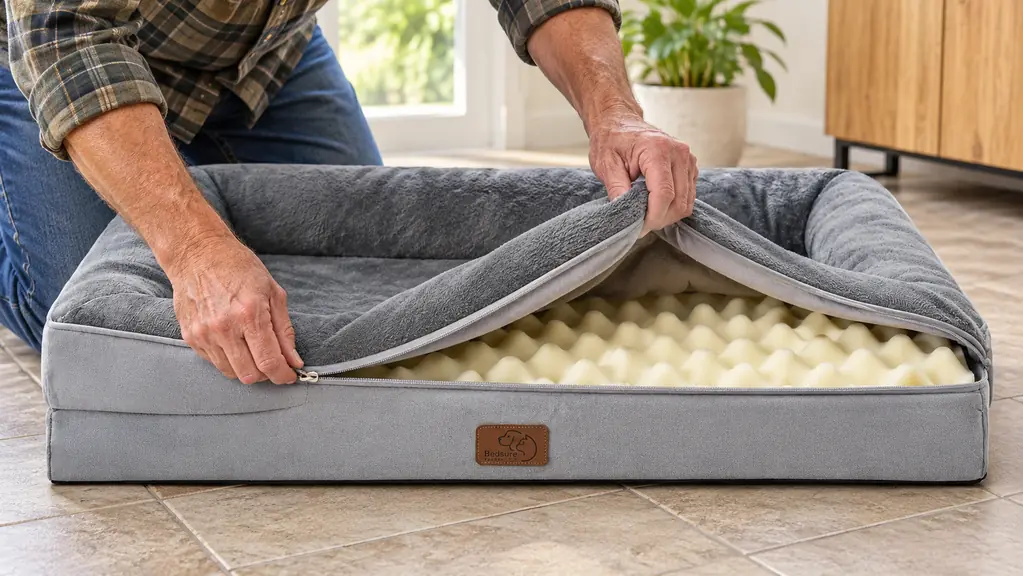
A 35 by 25 inch orthopedic bed with a four-sided bolster, a removable waterproof cover, and an egg-crate foam base. It is the one sitting on my lanai right now.
Amazon Check Today's Price on Amazon →Step 1: Measure the dog lying down, not standing up
Every listing gives you dimensions and almost no listing tells you what to measure. Do not measure your dog standing up. A standing dog is compact. A sleeping arthritic dog sprawls, and the sprawl is what the bed has to hold. I put a blanket on the kitchen floor at about three in the afternoon, when Tucker sleeps deepest, and marked where his nose landed and where his rump landed. Forty-four inches, nose to tail. Then I marked where his elbows landed, because that is the part that actually hurts.
Two numbers matter and they are not the same number. The first is length, for the sprawl. The second is flat space inside the bolster, because the raised sides take their share of the footprint. The Bedsure large is listed at thirty-five by twenty-five inches, seven inches tall including the sides, and Tucker curls on it rather than stretching the full length. Sixty-eight pounds of Lab fits with room to spare. A ninety pound dog that insists on the full sprawl would want the next size up, which is why the bed comes in nine sizes from twenty to fifty-two inches.
The listing also says every size gets the same construction, from a fifteen pound dachshund to a ninety pound lab. What changes with size is the footprint, not the quality of the foam. So you are picking a footprint that matches your dog, not upgrading to a better bed. If you are between sizes, take the bigger one. An arthritic dog with an elbow hanging over the edge is not getting the pressure relief you bought the bed for, and a bed that is too small is the most common reason a good bed gets rejected.
Step 2: Look at the floor under the bed before the fabric on it
The main rooms in my house are tile, which is lovely in a Florida August and terrible for an old dog's traction. Watch what happens when your dog pushes up out of a bed on a hard floor. The bed slides, the back feet skate, and standing up becomes a small trust exercise he did not ask for. If the bed slides, he will start avoiding it, and he will not tell you why.
Pick the bed up and look at the bottom before you buy. The Bedsure is polyester and polyurethane foam, and the listing does not advertise a non-slip base, so I put a thin rubber mat from the hardware store under it. That solved it. Do that check before the bed arrives, not after, because a bed that skates across tile is a bed your dog will use once and then sleep beside.
Cold is the other half of it. Tile pulls heat out of old hips overnight, which is why so many stiff dogs end up on the hall carpet instead of the expensive bed in the living room. Tucker's bed sits near the slider now, on the mat, where the afternoon sun lands. That was his choice. I just watched where he went and put the bed there.
One more measurement while you are down on the floor anyway: the clear space where the bed will sit. A thirty-five inch bed against a wall needs thirty-five inches of wall, plus room to step in from the front. I have watched people buy the right bed for the dog and the wrong bed for the room, and the bed ends up folded in the garage.
Step 3: Watch the get-on and the get-off, not the sleep
The four-sided bolster is the reason most people buy this bed, and the reason it is wrong for some dogs. Raised sides give a dog something to press his spine against instead of the flat floor, and they give him a place to rest his chin. For Tucker that is the difference between sleeping and dozing. He backs into the corner, drops his head over the side, and stays there for two hours.
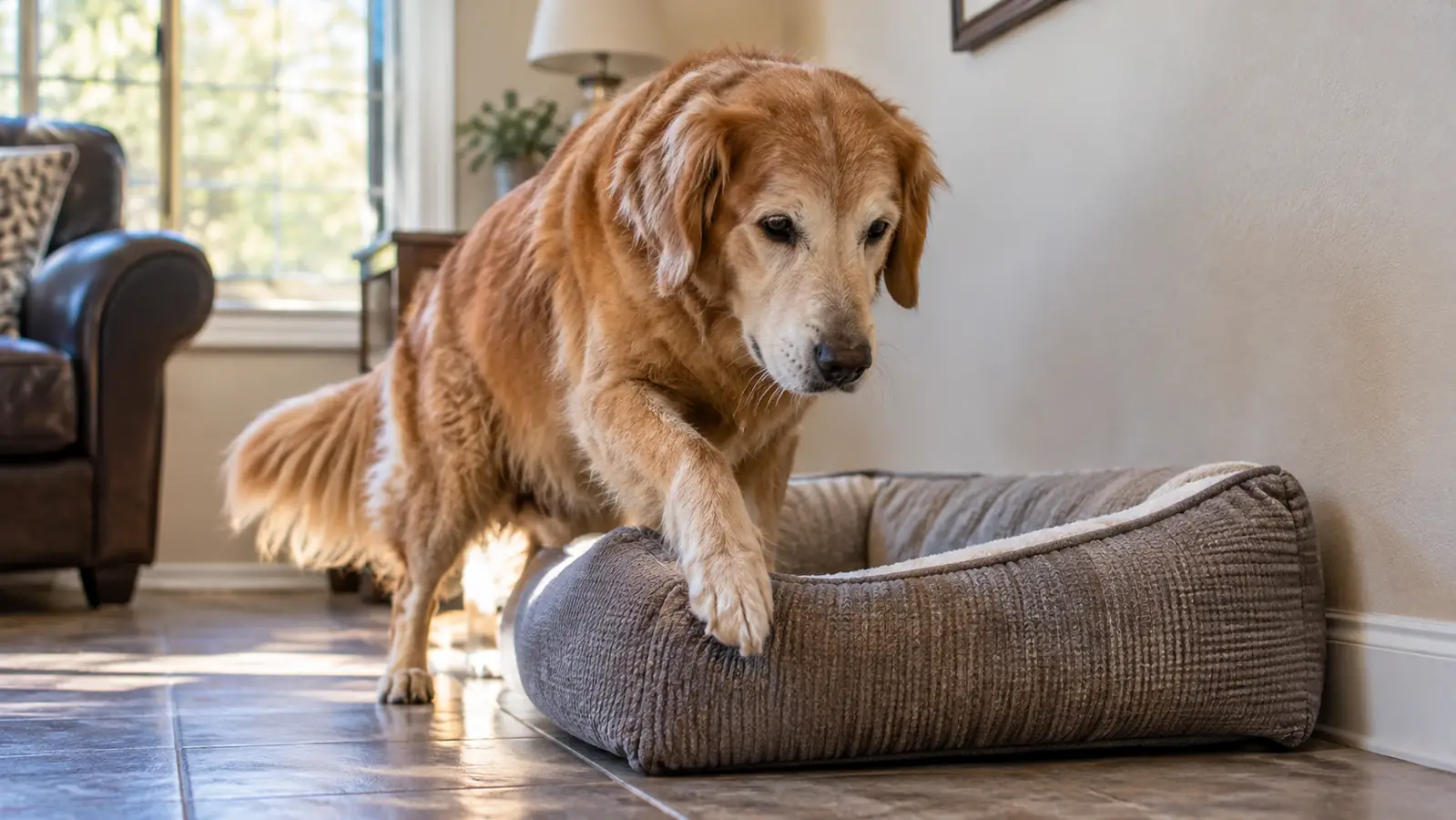
But four raised sides mean a lip to step over, and if your dog's front legs are weaker than his back legs, that lip is a wall. No amount of cushioning makes up for a bed he cannot get into. Watch him do it three times before you decide. The first time he is being careful. The second time he is being polite because you are standing there watching. The third time is the truth.
There is a nighttime version of the same test. Watch him get off the bed at two in the morning, stiff and half asleep, not at four in the afternoon when he is warm and loose. If he stumbles coming off it in the dark, that is your answer, and it is a better answer than anything on the box.
Two things help if the lip worries you. Put the bed against a wall or the side of a sofa so he can brace a shoulder on the way in, and keep the path to it clear of feeders and toys he has to climb over. What I would change if I could is one side cut lower for a dog with weak front legs. This bed does not offer that, so if your dog needs a true step-in with no lip at all, this is not the one, and I would rather say so out loud.
Step 4: Decide how much washing you are signing up for
Old dogs leak. That is not a training failure, it is a kidney thing and sometimes a medication thing, and pretending otherwise is how people end up dragging a bed to the curb in month four. Ask two questions before you buy. Does the cover come off, and is there something waterproof between the cover and the foam?
The Bedsure answers both. The cover zips off, the listing describes the cover as waterproof, and the bed is listed as washable. The part to handle with care is the egg-crate foam insert, because that is where a cheap bed dies: soak the core once and it clumps, sours, and never sits flat again. The listing's own copy makes a point of an insert that does not soak up water and clump in the wash, which tells you the company has heard from people like me.
The practical version: keep the cover zipped, wash the cover, spot the foam, and dry both flat and all the way through before they go back together. A damp foam core in a Florida house is a mildew problem by Thursday, and no dog will sleep on that.
One detail in the listing I have come to appreciate: the included components are the cover with the bolster and the orthopedic egg-crate foam, together, not sold in pieces. That sounds small until you have gone looking for a replacement cover for a bed you already own.
Step 5: Put it where the dog already sleeps, then leave it alone
This is the step almost everyone gets wrong, myself included. I bought the bed, set it in the living room where I thought a dog bed ought to go, and Tucker slept on the tile six feet away for four days. That was not the bed's fault. That was me arranging furniture for the room instead of for the dog.
Watch for three days and note where he lands. Not where you would like him, where he lands. For Tucker that was the tile by the slider, in the warm patch, which explains a great deal about old dogs and afternoon sun. I moved the bed there, put an unwashed T-shirt of mine on it, and stopped fussing with it. He was in it that night.
If he uses it for part of the night and moves to the tile at three in the morning, that is not rejection. That is him overheating or stiffening up. Check the room temperature and check for a draft off the slider before you blame the bed. Tucker shifts to the cool tile around two most summer nights and comes back to the bed at dawn. I stopped worrying about it.
Then give it a week before you judge it. New foam smells like new foam, a new bed in a new spot is a change, and old dogs do not love change. Do not stand over him coaxing him in. Put the bed down, walk away, and let him find it on his own schedule. If he still will not use it after a week, move it once more, closer to wherever he actually chooses to lie. In my experience the dog is right and the human has the address wrong.
What Else Helps
None of this replaces your vet, and I want to be plain that I am a retired newspaper photographer, not a veterinarian or a vet tech. Before I changed Tucker's exercise or added anything to his food, I asked. That conversation gave me a plan and a realistic picture, and it cost me an afternoon. Weight is the other lever. A few pounds off a sixty-eight pound dog takes real load off hips and elbows, and it is the one thing on this list that helps every single day.
Small things add up around the bed. Keep his nails short, because long nails on tile are ice skates. Put a cheap runner rug on the path between his bed and the door he uses. Put a folded towel or a ramp at the SUV tailgate, since the jump down is the one that hurts. Walk him before the heat and again at dusk, on leash, on flat ground, at whatever length your vet signs off on. The bed is doing the hours in between, and those are most of the day.
The other thing that helped was my own behavior. I stopped making the porch steps a game. No more tossing a ball down into the yard so he would charge down after it and then labor back up. He still goes down when he wants to, on his own terms, and the arithmetic he does at the top of those steps has gotten a little less grim. That is not the bed. But the bed is part of the same week, and they worked together.
A bed does not treat arthritis. It buys your dog the comfortable hours between walks while you and your vet handle the arthritis. For an old dog, comfortable hours are worth counting.
The bed he walks to on his own
Bedsure orthopedic dog bed, 35 by 25 inches, four-sided bolster, egg-crate foam base, cover that comes off for the wash. If your dog is doing arithmetic at the back steps, start with the measuring tape and then start here.
Amazon Check Today's Price on Amazon →