

I spent twenty-nine years at a regional daily newspaper looking through a viewfinder at things other people walked past. When you do that for a living you learn to watch how a body moves before you decide what you are looking at, and that habit is the reason I noticed Tucker's back legs before anyone else did. He is eleven now, a yellow Labrador mix, about sixty-eight pounds, and the two steps down from the lanai to the yard had started to require a decision. He is also the reason I started reading about joint supplements, and the reason he ended up on Cosequin Maximum Strength from Nutramax Laboratories long enough ago that I have an opinion worth handing over.
This is the review I wish I had found at the start. There are more than ninety thousand reviews of this product online and a 4.7 star average, and nearly all of them say one of two things: my dog is better, or my dog is the same. Neither tells you what the tablet is actually doing, what it cannot do, or which dogs it will never help no matter how faithfully you keep at it. I am not a veterinarian and I am not going to pretend to be one. What I am is an owner who watched closely, kept notes, and is willing to say the parts that do not flatter the product.
The Quick Verdict
It gives an older dog's joints the raw material they are short on, slowly and without drama. It will not touch pain, it will not work in a week, and it is not a substitute for your vet.
Amazon Check Today's Price →The Joint Tablet Most Clinics Name First
Cosequin Maximum Strength is the one a lot of vets reach for when an owner asks about joint support, and it is the one sitting on my counter. Worth seeing what today's price looks like before you decide either way.
Amazon Check Today's Price on Amazon →Here is the frame I want you to hold onto while you read the rest. Cosequin is a supply problem solver, not a pain problem solver. If Tucker's stiff back end were a house, this supplement is the lumber delivery, not the fire department. Lumber is genuinely useful. You cannot frame a wall without it. But if the house is on fire, a truck full of two by fours does nothing at all, and that is the single most important thing I can tell you about this bottle.
How I've Used It
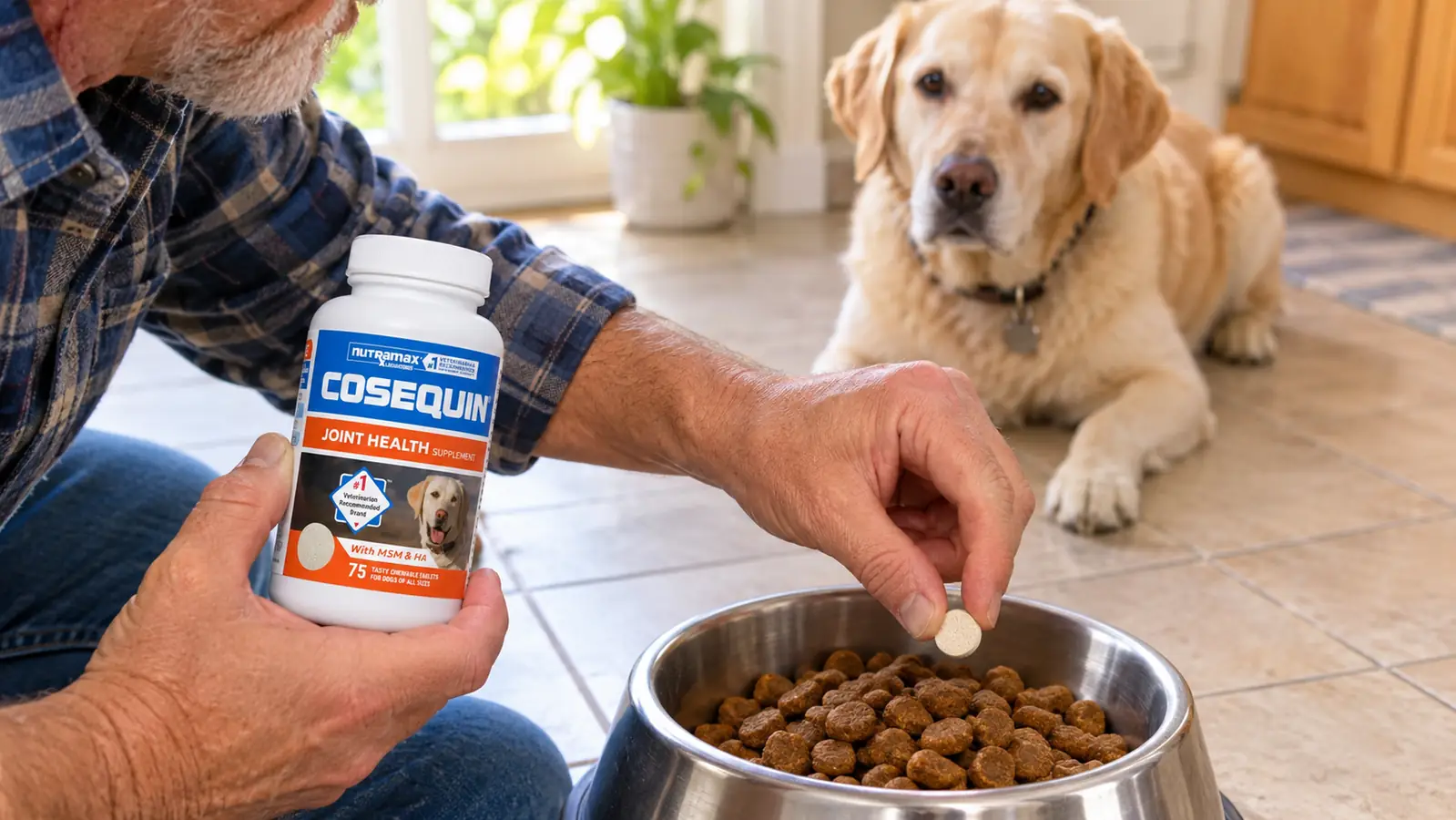
Tucker started on it in the spring, on his vet's recommendation after a routine exam and some x-rays that showed the ordinary wear you would expect in a Labrador of his age. I am going to be careful here, because I am not going to quote a dose and you should not take one from me. What I will tell you is that the routine was dull and unremarkable, which is exactly what a supplement routine should be. A tablet, wrapped in a piece of deli turkey, on top of the morning food, before the walk, every day, including the days I did not feel like it.
The bottle is small, roughly five inches tall, and it lives on the counter beside the coffee maker so I cannot forget it. That placement matters more than it should. Every day I have missed was a day it was in a cabinet instead.
What I noticed, and when: nothing in the first two weeks. Nothing in the third. Somewhere around the sixth or seventh week I realized I had stopped holding my breath when he came down the lanai steps. That is not the same as a cured dog. It is a dog making the same decision a little more easily than he had been. The change was small enough that I would have missed it if I had not been watching for it, and I would not have believed it if I had read it in someone else's review.
What It Actually Does
The panel lists glucosamine hydrochloride at 600 mg and sodium chondroitin sulfate at 300 mg, plus MSM. Nutramax Laboratories gives its glucosamine and chondroitin their own identifiers, FCHG49 and TRH122, which is the company's way of saying these are the specific forms it tested rather than whatever arrived on the pallet. Whatever you think of the branding, the underlying idea is simple and it is not new. Glucosamine and chondroitin are materials cartilage uses. An older dog's joint is not holding onto those materials the way it did at four, and the tablet is an attempt to keep the supply up.
That is a supply argument, and supply arguments are slow. Nothing about this resembles giving a dog a pain medication, where you can watch a limp soften inside an hour. It is closer to a change in diet. You adjust an input, then wait to see whether the output shifts, and the honest answer is that for some dogs it does and for some dogs it never will. The reviews bear that out. Read the one-star entries and you will find as many people reporting that nothing happened as you will find people saying it was the only thing that ever worked.
What I can tell you about my own dog is narrower and more useful. On the supplement he moves more willingly in the morning. Off it, on the two occasions I ran out and did not reorder promptly, the hesitating came back within about ten days and eased again after roughly the same stretch. I did not plan those two experiments and I would not repeat them on purpose. But they are the closest thing to evidence an owner like me will ever get, and they convinced me more than any abstract I read.
Around the sixth week I stopped holding my breath when he came down the steps. Six weeks of nothing, and then a dog making the same decision more easily.
What It Does Not Do
It does not relieve pain. This is the thing I most wish someone had said plainly at the beginning. If Tucker's trouble had been active inflammation, a torn ligament, a flare of something acute, this tablet would have been the wrong tool and I would have spent weeks learning that the hard way. Joint supplements are not anti-inflammatories and they are not painkillers. They do not touch the pathway that makes a dog reluctant to rise. If your dog is yelping, holding a leg up, or refusing to bear weight, that is a vet visit today, not a supplement order.
It does not rebuild a joint. You will see language about cartilage support and it is easy to read that as repair. It is not repair. The best case is that you are slowing a decline and keeping a joint as comfortable as its structure allows. If your dog has advanced arthritis with visible bony change on an x-ray, no supplement on the market will change what that x-ray shows, and a product that implies otherwise is selling you something you will not receive.
It does not work fast, and it does not work on a dog carrying extra weight. I will say that second part as directly as I can, because it is the part owners skip. Every extra pound on a Labrador is several pounds of load through two back legs that are already worn. I took four pounds off Tucker over one summer by measuring his food instead of eyeballing it, and that change did more for his stairs than the tablet did. The tablet helped. The four pounds helped more. Nobody sells the four pounds.
It also does not fix a slippery house. My main rooms are tile, which is handsome and unforgiving. A dog with stiff back legs on tile is a dog who is going to splay and startle and lose a little confidence every time. I put down two inexpensive runner rugs along his path from the bedroom to the back door and the difference in how he walked was immediate and permanent. That is not a supplement question at all, but it is the same question, which is what is actually making this dog's life harder.
The Part Nobody Mentions: Tablets and Consistency
It is a tablet. Not a treat, not a soft chew that a suspicious dog will accept on the first try. Tucker is not a fussy dog and he still checks. He will take it wrapped in a slice of deli turkey and he will spit a bare tablet onto the tile and look at me with real disappointment. That is a small thing on any given morning. Repeated over months, it is the reason people quit.
Consistency is the whole game, and nobody warns you that consistency is a chore. Skip a week and you have not lost a week, you have lost whatever ground the supply was holding, and you will spend another six weeks finding out whether you got it back. I keep a small notebook. Not because I am precious about it, but because by the third month I could not remember what March looked like and I had started arguing with myself about whether anything had changed. The notebook settled it. If you are the sort of person who will not keep the notebook, be honest about that before you start.

How It Compares to a Plain Glucosamine Bottle
The obvious question, and the one I asked first: why not the less expensive bottle that is only glucosamine? It is a fair question and I do not think there is a single answer. The argument for Cosequin is that it pairs glucosamine with chondroitin and MSM in fixed amounts Nutramax Laboratories has tested together, and that the ingredients carry the FCHG49 and TRH122 designations, which is at least a claim somebody is willing to put a name behind. The argument against is that you are buying a combination when one ingredient might have done the same work for your particular dog, and you will never know which unless you try one and then the other.
If I were starting over, I would begin with a single-ingredient glucosamine product for eight weeks, watch carefully, and only move up to a combination if the first one did nothing. That is the thriftier path and the more informative one. I did not do it that way. Tucker was already on Cosequin by the time I understood the landscape, and taking an eleven year old dog off something that appeared to be working in order to run a tidier experiment felt like the wrong trade.
What I Would Do Differently
I would have started sooner and expected less. Those sound like opposites and they are not. I spent an entire winter deciding, because I had read enough to be suspicious and not enough to be confident, and all that deciding cost Tucker three or four months of something he could have been getting. Then I spent the first month of actual use watching him like a hawk and seeing nothing, which is the fastest possible route to concluding that a thing is worthless when in fact it is simply slow.
I also would have taken the weight off first. Not because the tablet needs a lean dog, but because I would then have known within a month whether the simple things were enough. If I had measured his food in January and seen the same improvement I eventually saw in June, I would have saved myself a year of wondering which change was doing the work. Order matters when you are trying to learn something true about your own dog.
What I Liked
- Supplies glucosamine hydrochloride, chondroitin sulfate and MSM in amounts printed plainly on the panel
- Made by Nutramax Laboratories, the company most vets name first for joint support
- The bottle is small enough to sit on a counter, which makes the daily habit easier
- More than ninety thousand reviews, with the failure stories as visible as the success ones
Where It Falls Short
- It is a tablet, and a suspicious dog will spit it out
- Six weeks or more before you know anything, which is a long time to stay attentive
- No effect on pain or inflammation, so it is the wrong tool for an acute problem
- Easy to quit by accident the moment the bottle ends up in a cabinet
Who This Is For
An older dog with the ordinary, gradual stiffness that shows up as slower mornings and second thoughts about stairs. A dog whose x-rays show wear but not disaster. A dog who is otherwise healthy and still moving, just not the way he moved at five. An owner who will give it daily for two months before forming an opinion, and who will keep a note or two so the opinion is worth something. If that describes your house, this is a reasonable place to start, and it is the one most vets will name first for a reason.
It also suits the owner who wants one bottle on the counter instead of a shelf of them. There is real value in a product from a company that has been in pet health for more than twenty five years and is willing to tell you what is inside the tablet. I do not think that makes it remarkable and I do not think it makes it the only option. I do think it makes it a sane first choice for someone who does not want to spend a season reading labels in a grocery aisle.
Who Should Skip It
Skip it if your dog is in pain right now. Limping suddenly, yelping when lifted, refusing the stairs altogether, or showing any of that on a Sunday afternoon. That is a phone call and probably a visit, and a joint supplement will only delay you. Skip it if your dog has a diagnosed condition your vet is actively managing with prescription medication, unless your vet has told you the two can be used together. I am not qualified to guess at interactions and neither is anyone else writing a review.
Skip it if you will not be consistent. I mean that kindly. If your weeks are already full and the tablet gets given on the good days only, you are better off spending that energy on the things that need no bottle at all: taking four pounds off the dog, putting a rug down on the tile, trimming the nails so the paws sit properly, and cutting the evening walk short when it is ninety degrees. Those are free, they work immediately, and no dog has ever spat one out.
And skip it if you are looking for a way to avoid the vet. I say that as someone who spent twenty-nine years being skeptical of institutions. This is not a substitute for an exam and an x-ray. It is an addition to a plan. Talk to your vet before you start, and talk to your vet again if nothing has changed after two months of honest, daily, unmissed use.
If You Are Going to Try It, Give It Two Months
Cosequin Maximum Strength is the tablet most clinics name first, and it is the one I keep beside my coffee maker. Get a bottle, write the start date on the lid, and judge it at eight weeks rather than eight days.
Amazon Check Today's Price on Amazon →